Moving to Mongolia in 2026: Live on $900/Mo, But Foreigners Own 0% Land
August 1, 2026
ShareMongolia just made its first MNT 800,000 of monthly income entirely tax-free, its economy is growing at 5.5% on the back of Oyu Tolgoi copper output, and a comfortable single-person life in the capital runs under $1,500 a month - but foreigners still cannot own so much as a square meter of land, full stop, no exceptions. Winters hit minus 30°C, immigration rules run on strict 21-day and 183-day clocks, and English thins out fast outside a few Ulaanbaatar neighborhoods. This is everything you need to know before you move.[1][2][3][4]
The Economy: Eyes Open
Mongolia's economy has swung sharply over the past three years, and the trajectory into 2026 is genuinely one of the stronger stories in this guide series. Growth hit 6.6% in 2025, recovering from a weather-battered 4.9% in 2024 when a severe winter (locally called a dzud) disrupted the critical livestock and agriculture sectors. The IMF's 2026 forecast sits at 5.5%, driven overwhelmingly by mining - specifically copper production from the massive Oyu Tolgoi underground expansion and continued strong coal exports.[2]
The IMF expects growth to stabilize around 5% over the medium term, positioning Mongolia as one of the fastest-growing economies in the region. The clear structural risk is inflation, which remains above 7%, and the deeper vulnerability is Mongolia's near-total dependence on mining exports and, by extension, on Chinese commodity demand and global copper and coal prices - a concentration risk worth understanding before betting long-term financial plans on continued momentum.[2]
Visas and Residency: What Changed in 2026
Mongolia runs an immigration system with genuinely strict, non-negotiable clocks, and it offers no dedicated retirement, digital nomad, or golden visa - every long-term stay routes through one of five formal residence permit categories.
The Core Categories
| Category | Purpose | Typical Basis |
|---|---|---|
| Official/private purpose (G) | Family, immigration, work, investment, study | Case-by-case[5] |
| Work | Employment in Mongolia | Employer sponsorship[6] |
| Investment | Business investment | Capital contribution[5] |
| Study | Enrollment at a Mongolian institution | University acceptance[6] |
| Family | Marriage or dependent relationship to a citizen/resident | Notarized relationship proof[7] |
The Two Non-Negotiable Clocks
Every foreign national entering Mongolia faces the same strict sequence: register within 7 days of arrival, and file the residence permit application within 21 days of first entry. Missing this window is treated seriously - first-time applicants must also appear in person at the Immigration Agency of Mongolia headquarters to register biometric data (fingerprints and photo).[7][5]
The Immigrant Residency Permit (Path to Long-Term Settlement)
For those pursuing genuine long-term settlement (the "G" immigrant category), the eligibility bar is meaningfully steep:
| Requirement | Detail |
|---|---|
| Minimum income | 5 times the Mongolian minimum wage per month[8] |
| Education | Undergraduate or graduate degree, or a specialized qualification in a field essential to Mongolia[8] |
| Prior legal residence | 3 consecutive years already resided legally in Mongolia[8] |
| Criminal record | None, and never previously deported or banned from entry[8] |
| Processing time | 60 days (standard)[8] |
| State fee | 135,000₮ (~$40)[8] |
This structure genuinely favors those already established in Mongolia on a work or study permit over a fresh applicant arriving with no prior legal residence - the 3-year requirement makes the immigrant category a second-stage destination rather than a first-entry option.[8]
The 183-Day Absence Rule
A permanent-style residency permit can be cancelled outright if the holder spends more than 180 days abroad in a single year, and standard holders must notify authorities online or in person 72 hours before departing the country. This is a genuinely strict continuous-presence requirement relative to many countries in this guide series.[8]
Renewal Mechanics
Extensions must be filed at least 5 working days before the current permit expires, with a standard state duty of 72,000₮ (or 144,000₮ for expedited processing). Any address change must be reported within a defined notification window, requiring an official request, a local Khoroo (neighborhood administrative unit) address statement, and the residency card itself.[7]
The Refusal Cooldown
If a residence permit application is refused, or a renewal denied, applicants must wait a full 1 year before reapplying for the same permit type - a genuinely firm penalty for a rejected or incomplete application.[8]
Path to Citizenship
Mongolia does not broadly recognize dual citizenship, and naturalization is a discretionary, lengthy process built on sustained legal residence, typically well beyond the initial 3-year immigrant-permit threshold. Given the strictness of the underlying residency system, most Western expats settle into renewable work, investment, or family-based permits rather than pursuing full citizenship.
Cost of Living: The Real Numbers
Ulaanbaatar is genuinely one of the more affordable capital cities in Asia, though estimates vary meaningfully across sources depending on lifestyle assumptions.
Monthly Cost Comparison (Ulaanbaatar, 2026)
| Source/Lifestyle | Single Person Monthly Cost |
|---|---|
| Budget-conscious | $564-$935[9][10] |
| Standard/average, incl. Rent | $900-$1,171[9][11] |
| Digital nomad / expat professional | $1,341-$1,848[12] |
| Comfortable/luxury | $1,495-$2,387[1][9] |
Rent by District (Ulaanbaatar, 2026)
| Area | 1-BR Rent (USD/month) |
|---|---|
| City center (Sukhbaatar, Chingeltei districts) | $350-$900[13][1] |
| Outside center | $220-$585[9][1] |
| Luxury (Seoul Street, Shangri-La complex) | $1,000+[13] |
| Provincial capitals (Erdenet, Darkhan) | $100-$200[13] |
The Wage Gap
Ulaanbaatar's average monthly salary sits at roughly $500-$600, running notably below the average cost of living for a single person - a genuinely important gap given that most establishment-track residency requires income at 5x the Mongolian minimum wage, a threshold local salaries alone often can't meet without foreign-sourced income.[9][8]
Living Outside Ulaanbaatar
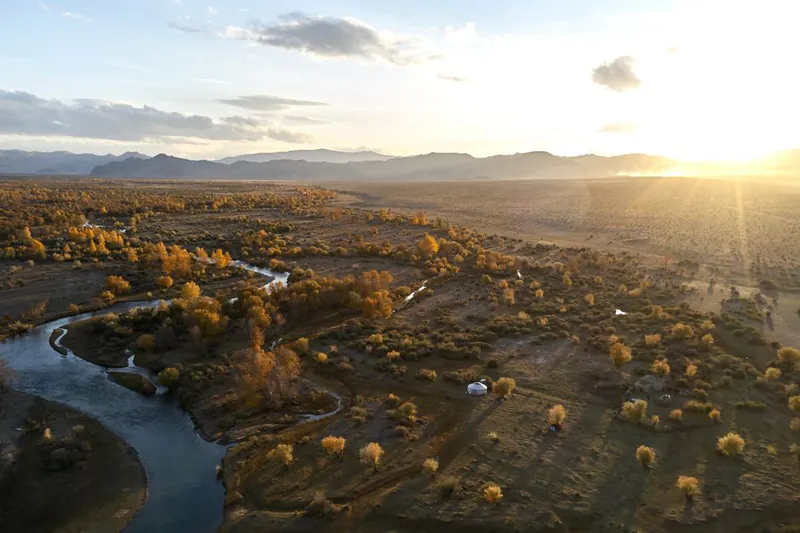
Costs drop sharply outside the capital - a furnished apartment in Erdenet or Darkhan runs $100-200/month, and for those genuinely committed to rural life, a traditional ger (yurt) can be purchased outright for $500-2,000 and pitched on the steppe, though this requires independently sorting water, heating fuel, and a serious plan for surviving Mongolia's brutal winters.[13]
Taxes: What Just Changed in 2026
Mongolia introduced a genuinely significant tax relief measure effective January 1, 2026 - a real, current legislative change worth understanding precisely.
The New Tax-Free Threshold
| Change | Detail |
|---|---|
| New monthly tax-free threshold | MNT 800,000 (~9.6 million MNT annually)[4] |
| Prior system (2025) | No general exemption; taxed from the first tugrik, aside from a minor MNT 160,000 annual credit for low incomes[4] |
| What's taxed now | Only the portion of income exceeding MNT 800,000/month[4] |
2026 Progressive Brackets (Residents, Employment Income)
| Annual Taxable Income (MNT) | Rate |
|---|---|
| 0 - 9.6 million | 0%[4] |
| 9.6 million - 120 million | 10%[4][14] |
| 120 million - 180 million | MNT 12 million + 15% on excess over 120 million[14][4] |
| Above 180 million | MNT 21 million + 20% on excess over 180 million[14][4] |
Non-Residents and Other Income Types
| Category | Rate |
|---|---|
| Non-resident flat tax (Mongolia-sourced income) | 20%[14] |
| Resident: dividends, royalties, interest, capital gains on securities | 10%[14] |
| Resident: sale of immovable property (gross) | 2%[14] |
| Non-resident: same categories | 20%[14] |
| Corporate income tax | 25%[15] |
| VAT | 10%[15] |
The Enhanced Housing Deduction
A separate 2026 change raised the maximum housing/green-investment tax deduction to MNT 15,000,000, up from MNT 600,000 in 2025 - a genuinely substantial increase that can generate tax savings of up to MNT 1.5 million for qualifying individuals.[4]
The Genuinely Confusing Point: Conflicting Top-Rate Reports
Some sources describe Mongolia's system as a flat 10% rate on employment and most professional income applied to a broad base for both residents (worldwide income) and non-residents (Mongolia-source income), rather than the tiered 10/15/20% structure above. This discrepancy likely reflects different tax categories or older/updated source material - anyone with material Mongolia-sourced income should verify current bracket treatment directly with a local tax advisor rather than relying on a single secondary source, given how recently the exemption threshold changed.[16][4]
Effective Rate in Practice
One 2026 calculation shows a €90,000 gross salary resulting in an effective tax rate of approximately 12.5% after accounting for the new exemption and progressive brackets - a genuinely competitive effective burden by international standards.[17]
Healthcare
Ulaanbaatar hosts Mongolia's main hospitals and private clinics, with healthcare costs running modestly - roughly $150/month budgeted for healthcare expenses in a comfortable single-person lifestyle. Care quality and availability drop meaningfully outside the capital, and given the country's severe winter conditions and vast, sparsely populated geography, comprehensive health insurance with medical evacuation coverage is a genuinely sensible precaution for anyone settling outside Ulaanbaatar or planning extensive countryside travel.[1]
Safety
Mongolia and Ulaanbaatar post a consistent "moderate" safety profile across independent trackers, sitting squarely in the middle of global rankings rather than at either extreme.
The Numbers
| Metric | Score | Rating |
|---|---|---|
| Numbeo Ulaanbaatar Level of Crime | 51.56-57.21 | Moderate[18][19] |
| Numbeo Mongolia (country) Safety Index | 48.09-49.72 | - [20][21][22] |
| Global Numbeo Safety Index Country Rank | 49.7 | Near global midpoint[22] |
| Independent Travel Safety Index (Ulaanbaatar) | 50/100 | Medium risk[23] |
The One Standout Concern: Corruption
As with Azerbaijan and Kazakhstan, corruption and bribery perception is the clear outlier category across every language version of Numbeo's Ulaanbaatar data, scoring 72-78 ("High") - consistently and dramatically above every other crime metric tracked.[18][24][19]
Practical Risk Breakdown
| Risk Category | Assessment |
|---|---|
| Violent crime against tourists | Uncommon[23] |
| Petty crime (pickpocketing) | Present, opportunistic[23] |
| Alcohol-related incidents | A genuine, recurring concern[23] |
| Solo female travel | Generally considered safe[23] |
| Harsh winter conditions | A material environmental risk factor[23] |
| Daytime safety walking alone | High (64-66/100)[18][19] |
| Nighttime safety walking alone | Low (38-41/100)[18][19] |
The consistent read across sources: Ulaanbaatar's crime is primarily non-violent and opportunistic rather than systemic, and the country reports lower violent crime rates than many regional peers - the more genuine risks are environmental (extreme cold, infrastructure gaps) and situational (alcohol-related incidents at night) rather than deliberate targeting of foreigners.[23]
Practical Precautions
- Stay within central districts and established neighborhoods, particularly after dark, given the sharp daylight-to-nighttime safety drop[18][23]
- Budget seriously for winter survival gear and heating if living independently - Mongolia's winters are a genuine, non-trivial hazard, not just an inconvenience[13][23]
- Treat corruption as a practical bureaucratic reality to navigate carefully, particularly around property, business registration, and land-use permitting[18]
- Exercise normal caution around alcohol-related incidents, flagged consistently as one of the more common practical risks[23]
English in Everyday Life
English proficiency in Ulaanbaatar concentrates in specific pockets - international schools, mining-sector offices, upscale hotels, and a small but growing digital nomad and coworking scene - but drops sharply elsewhere in the city and almost entirely outside it. Mongolian is essential for daily commerce, government interactions, and healthcare outside premium private clinics; Russian retains some practical utility among older generations, though considerably less than in Kazakhstan or Azerbaijan.[1]
Which District or Region?
Sukhbaatar and Chingeltei Districts (Ulaanbaatar)
The most popular residential choice for expats, offering a genuine mix of newer apartment buildings at moderate rent ($350-600/month) alongside established infrastructure and reasonable proximity to the city center.[13]
Seoul Street and the Shangri-La Complex
Ulaanbaatar's premium expat and diplomatic enclave, commanding rents of $1,000+/month, occupied predominantly by mining executives, embassy staff, and senior diplomats rather than the broader expat community.[13]
Provincial Capitals (Erdenet, Darkhan)
Dramatically cheaper - furnished apartments for $100-200/month - but with meaningfully thinner healthcare, English-language services, and international infrastructure than Ulaanbaatar.[13]
The Countryside / Steppe
A genuine option for those seeking traditional ger (yurt) living, purchasable outright for $500-2,000, though this demands independently arranging water, heating fuel, and serious winter preparation - not a casual undertaking for a first-time expat.[13]
Buying Property: The Hard Line on Land
This is the section that most sharply distinguishes Mongolia from every other country in this guide series: foreign nationals and foreign companies are constitutionally and legally barred from owning land in Mongolia, without exception.[3][25][26]
The Absolute Restriction
Mongolia's Constitution and Law on Land are unambiguous: only Mongolian citizens (and, for specific land categories, the state) may hold land ownership rights. This applies regardless of marital status - even a foreign spouse of a Mongolian citizen may not own land - and Mongolian nationals are legally forbidden from transferring their land ownership to a foreign national by sale, trade, gift, inheritance, or mortgage.[25][27][28]
What Foreigners CAN Do: Land Use Rights
| Right Type | Who Can Hold It | Duration |
|---|---|---|
| Land ownership | Mongolian citizens only | Permanent[25] |
| Land possession | Mongolian citizens and companies | 15-60 years, extendable up to 40 years once[26] |
| Land use (foreign individuals, residential) | Foreign citizens permanently residing 183+ days | Up to 5 years, extendable in 5-year increments[25][28] |
| Land use (foreign companies) | Foreign-invested entities, via Parliament approval | Up to 60 years, extendable once up to 40 years[25] |
Size Limits for Foreign Individual Land Use
Foreign citizens permanently residing in Mongolia (183+ days) may acquire land use rights only - not ownership or possession - through open auction, capped at 0.05 hectares for a residential lot or 0.1 hectares for gardening activities, decided by the local governor rather than a national body.[27][25]
Foreign Companies Face an Even Higher Bar
For foreign companies, land use rights require an actual decision by the State Great Khural (Mongolia's Parliament) - not a local or regional authority - reflecting the genuinely elevated political sensitivity around any foreign access to Mongolian land, even temporary and use-only.[25]
What You CAN Own: Permanent Physical Structures
Critically, while land itself stays off-limits, foreign investors may own permanent physical structures built on land they hold use rights to - a meaningful distinction that allows genuine building ownership even without land ownership. Statute also limits standalone real-estate ownership (buildings/structures, separate from the land question) to adult Mongolian citizens (18+) within municipalities only - and notably, Mongolian companies of any type are not permitted to own real estate either, a restriction that applies to domestic and foreign entities alike.[3]
The 2024 Rollback Worth Knowing About
Mongolia's Parliament revoked a 2024 legal mechanism that had previously offered foreign and domestic investors a clearer path to land possession and use rights, after legal experts flagged inconsistencies between that mechanism and the Constitution's foreign land restrictions. The practical result: the process for foreign investors to obtain land use rights is now governed strictly by the underlying Law on Land, with less flexibility than existed briefly in 2024 - a genuinely important caution against relying on outdated guidance from before this rollback.[3]
The Real Penalty for Violations
Should Mongolian nationals attempt to transfer land ownership or possession rights to a foreign national through sale, gift, inheritance, or pledge, the Mongolian citizen faces a fine of 1,000 units (1 unit = 1,000 MNT, so roughly 1 million MNT), and a legal entity faces 10,000 units - a real, codified deterrent against informal workarounds.[27]
Your First Steps: The Checklist
- Register within 7 days of arrival and file your residence permit application within 21 days - these clocks are strict and non-negotiable under Mongolian immigration law[5][7]
- Plan for in-person biometric registration at Immigration Agency of Mongolia headquarters as a first-time applicant - this cannot be done remotely[7]
- If pursuing the immigrant residency category, understand it generally requires 3 years of prior legal residence - most newcomers should expect to enter first via work, study, investment, or family category[8]
- Track your annual days-abroad carefully - spending more than 180 days outside Mongolia in a year can trigger cancellation of a standing residence permit[8]
- Notify authorities 72 hours before any departure if you hold a standard residence permit[8]
- Budget the real 2026 tax picture: the first MNT 800,000/month is now tax-free, with progressive rates of 10-20% above that threshold - verify current bracket treatment with a local advisor given some source discrepancy on structure[4][16]
- Choose your neighborhood realistically: Sukhbaatar/Chingeltei for standard expat living, provincial capitals for dramatically lower cost, the steppe only if genuinely prepared for winter self-sufficiency[13]
- Abandon any plan to own land outright - this restriction is constitutional, absolute, and applies even to foreign spouses of Mongolian citizens[27][3]
- If pursuing residential land use rights, expect a 0.05-hectare cap and a 5-year renewable term via local governor auction, not ownership or possession[28][25]
- Budget seriously for winter - extreme cold is a genuine, non-trivial hazard in Mongolia, not a minor inconvenience, and should factor into housing, insurance, and location decisions from day one[23][13]
Key Data at a Glance
| Indicator | Value |
|---|---|
| GDP Growth 2025 | 6.6%[2] |
| GDP Growth Forecast 2026 (IMF) | 5.5%[2] |
| Inflation | Above 7%[2] |
| Registration Deadline After Arrival | 7 days[5] |
| Residence Permit Filing Deadline | 21 days[5] |
| Immigrant Category Prior Residence Requirement | 3 consecutive years[8] |
| Absence Limit (permit cancellation risk) | 180 days/year[8] |
| New 2026 Tax-Free Monthly Threshold | MNT 800,000 (~9.6M/year)[4] |
| Top Progressive PIT Rate | 20% (above MNT 180M/year)[14] |
| Non-Resident Flat Tax Rate | 20%[14] |
| Corporate Tax | 25%[15] |
| VAT | 10%[15] |
| Foreign Land Ownership | Constitutionally banned, no exceptions[3][27] |
| Foreign Residential Land Use Cap | 0.05 hectares, 5-year renewable term[25] |
| Foreign Company Land Use Term | Up to 60 years (Parliament approval required)[25] |
| Single Person Monthly Cost (Ulaanbaatar, comfortable) | $1,495-$1,848[1][12] |
| Average Local Monthly Salary (Ulaanbaatar) | $500-$600[9][10] |
| Numbeo Ulaanbaatar Level of Crime | ~51.6-57.2, Moderate[18][19] |
| Numbeo Corruption Perception (Ulaanbaatar) | 72-78, High[18][19] |
| Independent Safety Index (Ulaanbaatar) | 50/100, Medium risk[23] |
Mongolia in 2026 rewards a genuinely narrow, adventurous profile: those drawn to a fast-growing, mining-driven economy and a newly more generous tax exemption, willing to accept strict immigration clocks and an absolute ban on land ownership, and prepared to treat brutal winters - not crime - as the country's defining practical challenge.
References
Living in Ulaanbaatar (2026): Cost of Living & Lifestyle Guide | Enough - Cost of living from $1,495/mo. Safety index 49/100. Digital nomad visa available. Complete expat gui...
IMF Forecasts 5.5% Mongolia GDP Growth in 2026 - LinkedIn - 📊 IMF: Mongolia’s Economy Expected to Grow by 5.5% in 2026 The International Monetary Fund (IMF) for...
2025 Investment Climate Statements: Mongolia - State Department
IMMIGRATION AGENCY: Residence permit - mongolia.gogo.mn - The residence permit is authorization which is issued to foreign nationals to reside in Mongolia for...
Mongolia Residence Permit Guide 2026: Apply, Extend & Update - The complete 2026 manual for Mongolian residency. Learn how to apply for a permit, extend your stay,...
Cost of Living in Ulaanbaatar, Mongolia in 2026 - This page contains up-to-date cost of living information for Ulaanbaatar, Mongolia in 2026. Compare ...
Ulaanbaatar: Cost of Living, Prices for Rent & Food [2026] - The average cost of living in Ulaanbaatar is $935, which is in the top 35% of the least expensive ci...
Cost of Living in Ulaanbaatar (2026) | Prices & Rent ... - Planning to move to or visit Ulaanbaatar? Average monthly cost is $900. Compare rent, groceries, tra...
Ulaanbaatar Cost of Living 2026: Rent, Food & Real Prices - Ulaanbaatar 1BR rent: $420.00/mo. Big Mac: $3.50. Uber 5km: $2.00. Full breakdown of housing, food, ...
Complete Guide to Moving to Mongolia in 2026 - WhereNext Blog - Ulaanbaatar $600-$1,200/mo. 30-day visa-free for most nationalities. Extreme winters (-30°C) but low...
Mongolia Individual Taxes Guide 2026 - NomadGo - Discover accurate 2026 Mongolia tax information with NomadGo. Calculate your personal income taxes, ...
Mongolia Tax Rates 2026: Income, Corporate, VAT - TaxGlass - Mongolia: 20% top income tax, 25% corporate, 10% VAT. Sources and brackets, updated 2026.
Financial Planning in Mongolia: A Guide for Expats and ... - An authoritative guide to tax residency, income and capital gains treatment, mining sector investmen...
Tax System in Mongolia 2026 - whereTOemigrate.io - Understanding Mongolia's tax system as an expat in 2026: income tax brackets, VAT, special regimes, ...
Crime in Ulaanbaatar - Information about crime in Ulaanbaatar, Mongolia. Shows how much people think the problem in their c...
Safety Index by Country 2026 Mid-Year - Safety Index by Country 2026. Vietnam 60.2 58. Mid-Year Health Care Index by Country
Is Ulaanbaatar Safe for Travel RIGHT NOW? (2026 Safety Rating) - The keys to safety in Ulaanbaatar, are all here in this comprehensive travel safety guide. Read this...
[PDF] Mongolian Immigration Agency Regulations, articles and clauses of ...
ГАЗРЫН ТУХАЙ - LegalInfo.mn - ГАЗРЫН ТУХАЙ - Эрх зүйн мэдээллийн нэгдсэн систем
Frequently Asked Questions
What are the primary visa and residence options for moving to Mongolia in 2026? Mongolia runs an immigration system with genuinely strict, non-negotiable clocks, and it offers no dedicated retirement, digital nomad, or golden visa - every long-term stay routes through one of five formal residence permit categories.
How does personal income tax work for expats in Mongolia? Some sources describe Mongolia's system as a flat 10% rate on employment and most professional income applied to a broad base for both residents (worldwide income) and non-residents (Mongolia-source income), rather than the tiered 10/15/20% structure above.
What is the average cost of rent and living in Mongolia? Ulaanbaatar is genuinely one of the more affordable capital cities in Asia, though estimates vary meaningfully across sources depending on lifestyle assumptions.
How many years of residence are required for citizenship or permanent residency in Mongolia? A permanent-style residency permit can be cancelled outright if the holder spends more than 180 days abroad in a single year, and standard holders must notify authorities online or in person 72 hours before departing the country.
Cover photo by ArtHouse Studio on Pexels.
Want to see how Mongolia stacks up?
Are you seriously considering a move? Use our interactive tools to explore Mongolia's climate, tax brackets, and nomad visas.