Moving to Papua New Guinea in 2026: 42% Tax, Work Permits, and Compound Realities
September 21, 2026
SharePapua New Guinea is not a cheap tropical escape. It is a high-cost, high-friction posting where secure housing, private transport and medical evacuation cover are basic infrastructure-not optional upgrades. Port Moresby’s estimated monthly cost for one person is K3,877 before rent, while a city-centre one-bedroom averages K9,074; the same city also has regular power and water interruptions and a serious violent-crime problem (reported by Numbeo[1], the UK Foreign Office[2], and Australian Smartraveller[3]).
The move can still make sense. PNG hires foreign specialists in mining, energy, engineering, construction, aviation, development, healthcare and senior management. But the offer needs to cover the expensive parts: guarded accommodation, a company vehicle and driver, international medical insurance, evacuation to Australia, annual flights home and school fees if children are coming.
The Economy: Resource-Rich, Operationally Hard
PNG’s economy grew an estimated 5.6% in 2025, helped by stronger resource output, but the World Bank’s June 2026 Economic Update[4] expects growth to slow to 3.8% in 2026. The same forecast puts average inflation at 4.8%, driven partly by fuel costs and the pass-through from a weaker kina.
The economy runs on two different tracks. Oil, gas, gold and copper generate export revenue, while much of the population depends on agriculture and informal activity. Foreign workers are hired mainly where employers cannot fill technical or managerial roles locally. A 2025 labour-market review found mining and resources responsible for more than 60% of analysed vacancies, with recurring demand for engineers, geoscientists, specialised technicians, heavy-equipment fitters, supervisors and trainers, according to the FACCI labour-market note[5].
For an expat, the relevant question is not whether PNG is “affordable.” It is whether the employment package transfers the country’s operating costs and risks away from the employee.
Visas and Work Permits
Visitors and Business Travellers
Almost every traveller needs an entry permit or visa. Eligible nationalities may obtain some visitor visas on arrival at Jacksons International Airport, but the safer approach is to apply before departure through the PNG Immigration and Citizenship Authority[6]. A passport should remain valid for at least six months after arrival, and immigration may request proof of onward travel (see UK entry requirements[7]).
Since 1 October 2025, travellers must submit PNG’s free online Digital Arrival Card within 72 hours before arrival (UK entry requirements[7]). Check the rule again immediately before flying; implementation and eligible visa-on-arrival categories can change.
A standard business visa generally allows a single 30-day stay. It covers genuine business activity, not ordinary paid employment (ICA business visa guidelines[8]). Do not enter as a visitor and start working while paperwork catches up.
Working Resident Visa
Foreign private-sector employees normally need two separate approvals:
- A work permit issued by ICA.
- A Working Resident or employment visa linked to that permit.
The work permit must be approved before employment begins. The permit letter, work-permit ID and valid Working Resident Visa should be in place before travelling to take up the role, as detailed in the ICA Work Permit Handbook[9].
The employer normally drives the application and supplies its company records, organisational chart and position details. The employee provides a passport copy, CV, job description, certified qualifications, signed employment contract, photographs and-where relevant-professional membership and evidence of English proficiency (ICA Work Permit Handbook[9]).
| Permit | Typical validity | Published government fee |
|---|---|---|
| Short-term general work permit | Up to 6 months | K750 |
| General work permit | 1 year | K2,500 |
| General work permit | 2 years | K5,000 |
| General work permit | 3 years | K7,500 |
| General work permit for qualifying Good Corporate Citizens | 5 years | K12,500 |
Fees and validity: ICA Work Permit Handbook[9]. Visa, portal, certification and document charges may be additional.
ICA says a complete work-permit application can be processed within about one month. Its employment-visa portal guide lists a standard processing period of 52 working days for a Working Resident or employment visa, so an employer promising a two-week relocation is not working from the published timeline (ICA Work Permit Handbook[9] and sponsor portal guide[10]).
Dependants
Spouses and children need dependent entry permits. Do not assume a spouse can work automatically: ICA explicitly prohibits employment for dependants of Resident Long-Term permit holders, except for a limited provision allowing a permanent-resident spouse to work in a family business (ICA dependants guidance[11]). A spouse who receives a separate job offer should obtain independent work authorisation.
Remote Workers
PNG does not advertise a dedicated digital-nomad visa. A visitor or business visa is not a clean substitute for a residence and work route. Remote workers should obtain written advice from ICA and a PNG tax adviser before relocating, especially if they will serve local clients, manage staff, sign contracts or remain long enough to become tax resident.
Permanent Residence
Permanent residence is not a routine consequence of holding several work visas. One published investor route requires the applicant to have been the majority owner of a resident business for at least five years, with net assets and turnover exceeding K2 million[12]. Treat this as a specialist legal process, not an automatic five-year track.
Cost of Living: The Real Numbers
Port Moresby can cost more than many developed-country cities once security is included. Imported food, reliable internet, guarded housing, generators, water storage, private transport and international-standard schooling push an expat budget far above local wages.
The September 2026 mid-market exchange rate[13] was roughly K1 = US$0.225, or US$1 = K4.44. Exchange rates move, and actual bank conversion rates can be worse.
Port Moresby Monthly Costs
| Item | Typical price or range | What it means |
|---|---|---|
| Single person, excluding rent | K3,877 | Crowd-sourced city estimate (Numbeo[1]) |
| Secure 2-bedroom apartment | K5,000-K12,000 | Expat-market estimate; specification varies (WhereNext 2026 relocation guide[14]) |
| City-centre 1-bedroom average | K9,074 | Wide reported range: K4,000-K20,421[1] |
| Basic utilities, 85 m² apartment | K442 | Reported range: K200-K850[1] |
| Mobile plan with 10 GB+ | K199 | Crowd-sourced average[1] |
| Inexpensive restaurant meal | K40 | Typical range: K20-K60[1] |
| Mid-range dinner for two | K200 | Typical range: K150-K600[1] |
| Petrol | K4.62/litre | Converted from the reported gallon price[1] |
Cost databases are thin for PNG and individual listings vary sharply. Use these figures for screening an offer, then request actual quotes for a compound near the workplace, school fees, transport and evacuation insurance.
What Your Package Should Cover
- Guarded housing: 24-hour security, controlled vehicle access, perimeter protection and a functioning alarm.
- Utilities: backup generator, fuel arrangement, water tanks, filtration and maintenance.
- Transport: company vehicle, vetted driver, airport transfers and rules for night movement.
- Medical: international private insurance with explicit air-ambulance evacuation to Australia.
- Flights: annual home leave plus emergency or compassionate travel.
- Family costs: school tuition, enrolment fees, uniforms, transport and evacuation cover for every dependant.
- Tax: written confirmation whether salary is gross, net of PNG tax or tax-equalised.
If housing and transport are not included, the headline salary is not the real salary.
Taxes: Get Advice Before Signing
Tax Residence
An individual will normally become PNG tax resident by residing in the country or by being present for more than half of the income year, subject to exceptions based on domicile, permanent home and intention (PwC residence summary[15] and PNG Internal Revenue Commission[16]). Residents can be taxed on worldwide income, while non-residents are generally taxed on PNG-source income, according to KPMG[17].
Employment performed physically in PNG is normally taxable there. Do not assume that payment into an overseas account, a foreign employer or a short rotation removes PNG tax exposure.
Key Rates
| Tax item | 2026 position |
|---|---|
| Top personal income-tax rate | 42% |
| Standard company income tax | 30% |
| Standard GST | 10% |
| GST on exported goods and services | 0% |
Sources: PwC corporate tax summary[18], PwC GST summary[19], and PwC Income Tax Act briefing[20]. Sector-specific and banking rates can differ.
The tax system changed substantially from 2026 under a new Income Tax Act, and secondary summaries are not always consistent. Before accepting a contract, have a PNG adviser confirm residency, taxable allowances, employer-provided housing, school fees, pension arrangements, foreign income, filing duties and treaty relief.
Housing: Security First
In Port Moresby, the wrong apartment is not a bargain. A suitable home needs professional guarding, controlled access, secure parking, generator capacity, water storage and a safe route to the office and school. Better compounds often add a pool, gym or small shop, but those are secondary.
Expat demand is concentrated in Town/Downtown, Ela Beach, Touaguba Hill, Harbour City/Konedobu, Waigani, Boroko and selected compounds near Seven Mile. The right district depends on the daily route; crossing the city for a prettier apartment can create unnecessary exposure in traffic.
| Area | Practical advantage | Main caution |
|---|---|---|
| Town / Downtown | Close to the CBD, clubs, waterfront and some offices | Premium rents; building and route security still matter |
| Ela Beach | Newer apartments, waterfront location, restaurants nearby | Do not interpret proximity as permission to walk freely after dark |
| Touaguba Hill | Diplomatic and senior-corporate compounds | Expensive and limited supply |
| Harbour City / Konedobu | Offices, supermarkets and modern apartment stock | Confirm access control, generator and water arrangements |
| Waigani | Government, embassies and some schools | Crime risk varies by street and time; check the exact commute |
| Boroko / East Boroko | Shops, schools and established residential stock | Property quality and perimeter security vary widely |
| Seven Mile / Airways area | Convenient for the airport; self-contained secure options | Can be costly and isolated from some workplaces |
Local property platform Hausples reports that secure two- and three-bedroom rentals in major cities commonly sit around K1,000-K3,000 per week, while top corporate properties can reach K3,000-K7,000+ per week[21]. Ask the employer’s security manager-not only the estate agent-to approve the building and every regular route.
Before signing, verify:
- Generator size, automatic switching and who buys the fuel.
- Water-tank capacity, pump backup and drinking-water filtration.
- Guard company, staffing, visitor checks and incident response.
- Window bars, lighting, fire exits and smoke alarms.
- Mobile coverage and availability of two independent internet connections.
- Secure parking and whether the driver can wait inside the compound.
- Lease currency, escalation clause, tax, deposit, maintenance and early termination.
Use a reputable agent and a lawyer to verify the landlord’s authority. Title and lease disputes are not a problem to solve after paying six months upfront.
Healthcare: Evacuation Is Part of the Plan
PNG’s medical system cannot provide a developed-country standard of complex care. Hospitals can lack medicine, supplies, equipment and reliable electricity; serious cases may require air evacuation to Australia (UK health advice[22], Australian Smartraveller[3]). Port Moresby and Lae have a small number of private clinics and hospitals, but capacity drops sharply outside the main centres.
Insurance must explicitly cover:
- Treatment in private facilities.
- Emergency air ambulance to Australia.
- Repatriation and return travel after treatment.
- Pre-existing conditions where relevant.
- Remote worksites, aviation, diving or field travel if part of the job.
- Every accompanying family member.
PNG carries risks including malaria, dengue, chikungunya, tuberculosis and Zika, while altitude illness can affect travel in the Highlands (UK health advice[22]). Visit a travel-medicine clinic six to eight weeks before departure to discuss vaccines, antimalarial medication and a personal medical kit.
Bring an adequate supply of regular prescription medication in original packaging, plus copies of prescriptions and a doctor’s letter. Do not rely on a local pharmacy carrying the same brand or dosage.
| Emergency | Number |
|---|---|
| Ambulance | 111 |
| Fire | 110 |
| Police | 112; some sources also list 000 in Port Moresby |
Emergency-number guidance is not fully consistent across government advisories, and centralised coverage is limited outside Port Moresby. Save the current numbers for your employer’s security desk, clinic, insurer, ambulance provider and embassy alongside the official services (UK emergency guidance[23], Canadian travel advice[24]).
Safety: Build Your Routine Around It
The Australian government Smartraveller service[3] advises a high degree of caution across PNG because of serious crime. The UK Foreign Office[25] identifies a high risk of violent crime in Port Moresby, Lae and Mount Hagen, including armed robbery, carjacking and sexual assault. Tribal fighting can close roads, airports, schools and public services with little notice.
This does not mean staying indoors. It means using a controlled routine:
- Do not walk after dark, even for a short trip from a restaurant to a hotel.
- Use a vetted driver or company vehicle; keep doors locked and windows up.
- Avoid public buses known as PMVs unless a trusted employer specifically approves a route.
- Do not withdraw large amounts of cash or use exposed ATMs at night.
- Avoid visible jewellery, expensive watches, laptops and phones in public.
- Check routes before every intercity or Highlands trip; fighting and roadblocks move.
- Leave demonstrations, compensation disputes and crowded confrontations immediately.
- Follow company security instructions even when local colleagues appear relaxed.
- Keep several days of drinking water, food, medication, fuel and charging capacity at home.
Current location matters. As of September 2026, the UK advises against all but essential travel to Hela and Southern Highlands provinces and most of Enga Province because of tribal fighting (UK PNG travel advice[2]). Check the latest advisory for the exact province before every trip.
Women face an elevated risk of harassment and sexual violence. Solo movement, informal taxis, isolated beaches and night-time social plans require stricter controls than many newcomers expect.
Transport: Flying Is Domestic Travel
Port Moresby has no road connection to Lae, Madang or the Highlands. Domestic flights are therefore ordinary business transport, not a luxury (Logistics Cluster road assessment[26]). Delays, cancellations and weather disruption should be built into every schedule.
Inside cities, a company vehicle and trusted driver are the default expat solution. Public transport is cheap but does not provide the security or predictability most foreign employers require. For self-driving, confirm licence rules directly with PNG authorities; road quality, poor lighting, unsafe vehicles and carjacking all add risk.
Never schedule an international connection immediately after a domestic arrival from a remote site. Use a buffer night in Port Moresby where the consequences of a missed connection are expensive.
Banking and Foreign Exchange
Opening a local account is possible once immigration and employment documents are ready. Kina Bank[27] requires valid identification; a foreign passport should be accompanied by the entry permit, and an employment ID generally needs an employer confirmation letter. Its everyday account has a published minimum opening balance of K10.
Keep an overseas account and card as backup. Card acceptance is strongest at major hotels, supermarkets and formal businesses, while cash remains useful for smaller transactions. Use ATMs inside guarded banks, shopping centres or hotels and avoid predictable cash routines.
Foreign exchange requires planning. A domestic foreign-currency account generally requires a kina account first and approval from the Bank of Papua New Guinea (BSP foreign-currency accounts[28]). PNG’s exchange-control rules can also affect offshore accounts, large remittances and access to foreign currency (Bank of Papua New Guinea guidelines[29]).
Before moving, ask payroll:
- Will salary be paid in kina, foreign currency or split between PNG and offshore accounts?
- Who absorbs exchange-rate movements?
- How long do outward transfers normally take?
- What documents will the bank require for remitting savings?
- Is the employer tax-equalising the package?
Internet and Utilities
Mobile data is the most practical first connection. Digicel and Telikom are major providers, but coverage and performance vary by neighbourhood, building and province. Test both networks before committing to a long plan.
For home working, insist on redundancy: a fixed or wireless primary line, a second mobile provider, a charged power bank and generator-backed power. Commercially available plans can be expensive, and a nominal speed is meaningless when the local tower, building cabling or electricity fails.
Water and electricity interruptions affect urban centres, including Port Moresby (UK travel advice[2] and Canadian travel advice[24]). A lease without generator and water-tank clauses is unfinished.
Schools: Budget Before Accepting
International education is concentrated in Port Moresby, with fewer options elsewhere. Confirm places before signing the employment contract; the school run also needs a security and transport plan.
At The Ela Murray International School, published 2026 annual fees range from K39,648 for early learning and preschool to K64,724 for Grades 6-8, before early-payment discounts (The Ela Murray International School 2026 fee schedule[30]). Port Moresby International School lists K82,950 for a non-citizen student in its Grade 9-10 international course (Port Moresby International School 2026 fee schedule[31]).
Do not negotiate only for “tuition.” Ask for registration, capital levies, technology fees, uniforms, books, activities, bus transport and annual increases. A family package without full school coverage can lose tens of thousands of kina in value.
Language and Daily Life
English is used in government, business, courts and formal education, so an English-speaking professional can work from day one. Tok Pisin is the country’s broad lingua franca and the language that unlocks ordinary conversations, workplace trust and daily humour. Hiri Motu remains important in parts of the south (Britannica[32]).
Learn practical Tok Pisin early: greetings, numbers, directions, market language and respectful forms of address. PNG is one of the world’s most linguistically diverse countries, and cultural expectations can change sharply between provinces and communities.
Relationships matter. Ask before photographing people, villages, ceremonies or property. In disputes, let a trusted local colleague or community liaison lead; land access, compensation and clan authority are not issues to improvise through.
Which City?
Port Moresby
The capital has the deepest corporate, government, diplomatic, school and private-medical infrastructure. It is the default base for headquarters staff, consultants, development agencies and families needing international education. It also has expensive secure housing, severe crime exposure and fragile utilities.
Best for: corporate roles, government and NGO work, families whose employer provides a full package.
Lae
PNG’s industrial and logistics centre serves the main port and the Highlands Highway. It suits manufacturing, logistics, construction, agriculture and mining-supply roles. Serious crime, poor roads and fewer international-standard services make employer support essential.
Best for: logistics, port operations, engineering and industrial management.
Mount Hagen
The commercial hub of the Highlands provides access to agriculture and resource projects. Tribal conflict and road security can change quickly; the city is not a casual lifestyle alternative to Port Moresby.
Best for: project-based roles with established security and aviation support.
Madang
Madang offers a smaller coastal setting and jobs linked to education, missions, tourism and regional operations. Healthcare, schooling and flight options are more limited than in the capital.
Best for: employer-supported specialists who accept a smaller service base.
Kokopo
Kokopo is the practical hub for East New Britain, with aviation links and a calmer physical setting than the biggest cities. Volcanic and seismic hazards, limited specialist healthcare and a small job market remain part of the calculation.
Best for: regional assignments, tourism, agriculture and development work.
| Location | Main employment base | Expat infrastructure | Main constraint |
|---|---|---|---|
| Port Moresby | Corporate, government, NGOs, services | Strongest in PNG | Crime, rent, outages |
| Lae | Port, logistics, industry, construction | Moderate | Crime and road conditions |
| Mount Hagen | Highlands commerce, agriculture, projects | Limited | Tribal conflict and transport |
| Madang | Education, missions, tourism, regional services | Limited | Healthcare and connectivity |
| Kokopo | Regional services, tourism, agriculture | Limited | Small labour market and natural hazards |
Climate: Pack for Heat and Rain
Lowland PNG is hot and humid throughout the year. Mean annual daytime highs are generally 30-32°C, with typical lows of 23-24°C; the Highlands are cooler and can be cold at altitude (PNG Department of Foreign Affairs[33]).
Port Moresby is drier than much of the country because it sits in a rain shadow. Its wet season runs roughly from November to April and the drier period from May to October. Other regions, especially the Highlands and New Britain, receive much heavier rainfall (World Bank climate profile[34]).
Air conditioning, mould prevention, mosquito screens, drainage and covered access from parking are housing requirements. Field workers also need proper wet-weather gear and plans for roads and airstrips becoming unusable.
Buying Property and Land
Foreigners cannot directly own land in PNG. Foreign businesses generally use long-term government leases, sometimes extending to 99 years, while around 97% of land is under customary ownership (PNG Investment Promotion Authority guide[35] and US investment climate statement[36]).
This is not a market for casual foreign buyers. Customary ownership, lease conditions, ministerial approvals, title delays and competing claims create risks that a normal estate-agent search will not reveal. Use a PNG lawyer with land expertise and verify the title, registered encumbrances, access rights, planning use, seller authority and every required government consent.
Buying or leasing property does not by itself create a right to live or work in PNG.
Starting a Business
A business that is 50% or more foreign-owned or controlled is treated as a foreign enterprise and must obtain certification from the Investment Promotion Authority before carrying on approved activities (IPA Investment Guide[37]). Some activities are reserved for citizens, and an IPA certificate does not replace tax registration, trading licences, sector approvals, visas or work permits (IPA reserved activities guidance[38]).
Do not assume that incorporating a company permits the owner to work for it. Company registration, foreign-enterprise certification, sector licensing, tax registration and personal immigration status are separate files.
Your First 30 Days
- Complete immigration before travel. Carry printed and digital copies of the visa, work permit, contract, employer contacts and accommodation details.
- Submit the Digital Arrival Card. Complete it within the official 72-hour window before arrival[7].
- Use a pre-arranged airport transfer. Do not negotiate transport after leaving the terminal.
- Attend the employer’s security briefing. Get no-go areas, approved routes, curfews, emergency contacts and incident procedures in writing.
- Inspect the residence. Test the generator, water system, locks, lighting, guards, alarms and fire exits before moving in.
- Activate two mobile networks. Keep one as a backup and preload key phone numbers offline.
- Register with the nearest embassy or consular service. Some nationalities receive support through another country’s mission.
- Open a bank account. Bring the passport, entry permit, employer letter, work permit and second ID (Kina Bank account requirements[27]).
- Confirm payroll and tax. Check the first payslip, allowances, tax withholding and offshore payment arrangements.
- Identify the approved clinic. Save direct numbers for the clinic, insurer and evacuation provider; do not wait for an emergency.
- Set up household reserves. Store drinking water, shelf-stable food, medication, torches, batteries and power banks.
- Map the school and office routes. Travel them with the approved driver at the actual commuting time.
- Learn basic Tok Pisin. Start with greetings, directions, numbers and workplace phrases.
- Review the package after one month. Put unresolved security, transport, housing and medical gaps in writing to the employer.
Key Data at a Glance
| Indicator | 2026 position |
|---|---|
| Real GDP growth forecast | 3.8%[4] |
| Inflation forecast | 4.8%[4] |
| Currency | Papua New Guinean kina, PGK |
| September 2026 mid-market exchange rate | About K1 = US$0.225[13] |
| Standard GST | 10%[19] |
| Standard company income tax | 30%[18] |
| Top personal income-tax rate | 42%[20] |
| Typical tax-residency trigger | More than half the income year, subject to exceptions[16] |
| General 1-year work-permit fee | K2,500[9] |
| Standard employment-visa processing guide | 52 working days[10] |
| Port Moresby single-person costs, excluding rent | K3,877/month[1] |
| Port Moresby city-centre 1-bedroom average | K9,074/month[1] |
| Medical standard | Basic; evacuation may be required[22] |
| Overall security advice | High degree of caution[3] |
| Dedicated digital-nomad visa | None advertised by the PNG Immigration and Citizenship Authority[39] |
| Direct foreign land ownership | Not permitted (IPA guide[35]) |
A PNG offer should be judged by the benefits sheet, not the base salary. If the employer will not fund secure housing, controlled transport, medical evacuation and reliable utilities, the employee is being asked to finance the posting’s largest risks personally.
References
[1] Cost of Living in Port Moresby. Sep 2026. Prices in Port Moresby
[2] Papua New Guinea travel advice - GOV.UK - FCDO travel advice for Papua New Guinea. Includes safety and security, insurance, entry requirements and legal differences.
[3] Papua New Guinea Travel Advice & Safety | Smartraveller - Australian Government travel advice for Papua New Guinea. Exercise a high degree of caution. Travel advice level YELLOW. Understand the risks, local s...
[4] World Bank’s June 2026 Economic Update
[6] PNG Immigration and Citizenship Authority
[7] Entry requirements - Papua New Guinea travel advice - GOV.UK - FCDO travel advice for Papua New Guinea. Includes safety and security, insurance, entry requirements and legal differences.
[12] Moving, living or retiring abroad - GOV.UK - What to consider when moving, living, or retiring abroad - including visas, healthcare, tax and pensions.
[13] 1 PGK to USD - Papua New Guinean Kina to US Dollars Exchange Rate - Get the latest 1 Papua New Guinean Kina to US Dollar rate for FREE with the original Universal Currency Converter. Set rate alerts for PGK to USD and...
[14] Moving to Papua New Guinea 2026: Cost, Visa & Safety Guide | WhereNext - Port Moresby $1,500-$3,000/mo. Work permits, safety tips, healthcare and cost of living. Diving, wildlife and tribal cultures. Complete relocation gui...
[15] Papua New Guinea - Individual - Residence - Detailed description of individual residence rules in Papua New Guinea
[16] PNG Internal Revenue Commission
[17] KPMG
[18] Papua New Guinea - Corporate - Taxes on corporate income - Detailed description of taxes on corporate income in Papua New Guinea
[19] Papua New Guinea - Corporate - Other taxes - Detailed description of other taxes impacting corporate entities in Papua New Guinea
[20] PwC Income Tax Act briefing
[21] Events & Announcements - No. 1 source of property news, market trends and advice for property buyers and renters in Cambodia. In-depth guides, location profiles & surveys.
[22] Health - Papua New Guinea travel advice - GOV.UK - FCDO travel advice for Papua New Guinea. Includes safety and security, insurance, entry requirements and legal differences.
[23] Getting help - Papua New Guinea travel advice - GOV.UK - FCDO travel advice for Papua New Guinea. Includes safety and security, insurance, entry requirements and legal differences.
[24] Travel advice and advisories for Papua New Guinea - Travel Advice and Advisories from the Government of Canada for Papua New Guinea
[25] Safety and security - Papua New Guinea travel advice - GOV.UK - FCDO travel advice for Papua New Guinea. Includes safety and security, insurance, entry requirements and legal differences.
[26] Logistics Cluster road assessment
[27] Kina Everyday Account - Kina Bank PNG
[28] BSP foreign-currency accounts
[29] Bank of Papua New Guinea guidelines
[30] Schools Fees - The Ela Murray International School - Schools Fees - The Ela Murray International School
[32] Britannica
[33] Climate of PNG | DFA - CLIMATE OF PAPUA NEW GUINEA Climate of PNG Constitutional Framework Cultural Events Cultural Institution Cultural Life Daily Life and Social Customs D...
[34] World Bank climate profile
[35] PNG Investment Promotion Authority guide
[36] US investment climate statement
[37] IPA Investment Guide
[38] Papua New Guinea Registry Services - The Papua New Guinea Registry Services system is a single, fully electronic solution hosting both the Personal Property Securities Registry and Busine...
[39] ICA
Frequently Asked Questions
Can foreigners work in Papua New Guinea or work remotely as digital nomads? Foreign nationals cannot work legally in Papua New Guinea on visitor or business visas. Legal employment requires two separate approvals: an approved work permit issued by the Immigration and Citizenship Authority (ICA) and a corresponding Working Resident Visa, a process typically taking 1 to 2 months. PNG does not offer a digital nomad visa, and all professional work performed in the country requires formal employer sponsorship.
How does personal income tax work for expats in Papua New Guinea in 2026? Under the 2026 tax framework, individuals present in PNG for more than half the income year are generally treated as tax residents and subject to tax on their worldwide income. PNG applies a progressive personal income tax scale with a top marginal rate of 42%. Non-residents are taxed only on PNG-sourced income. Expat remuneration packages frequently include tax-equalisation agreements due to high local marginal rates.
What are the real housing and cost-of-living expenses in Port Moresby? Port Moresby is one of the most expensive expat postings in the Pacific once security infrastructure is accounted for. While Numbeo estimates single-person monthly costs around K3,877 ($870 USD) before rent, secure compound rentals (in areas like Ela Beach, Touaguba Hill, or Waigani) with 24/7 armed guarding, backup diesel generators, and water tanks range from K1,000 to over K3,000 per week ($1,100 to $3,300+ USD monthly). Premium international school fees can add K40,000 to K83,000 annually per child.
Is medical evacuation insurance necessary when moving to Papua New Guinea? Yes, international medical insurance with dedicated air-ambulance evacuation to Australia is mandatory for expats. PNG’s public healthcare facilities face acute shortages of medical supplies, specialist equipment, and reliable electricity, making local treatment for complex trauma or serious illnesses inadequate. Travellers must also prepare for health risks including malaria, dengue, and tuberculosis prior to arrival.
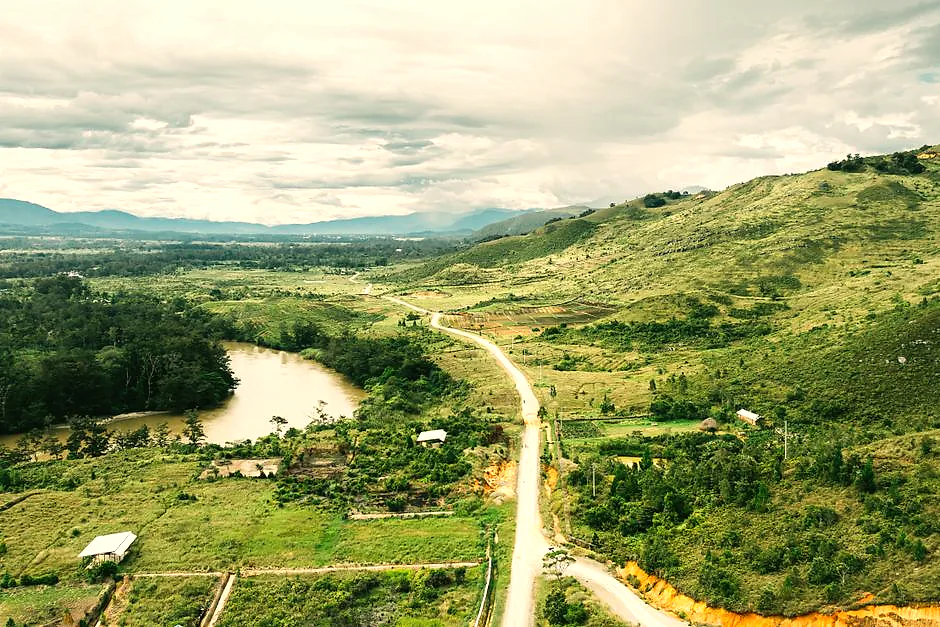
Cover photo by Adiardi Zulfansyah on Pexels.
Want to see how Papua New Guinea stacks up?
Are you seriously considering a move? Use our interactive tools to explore Papua New Guinea's climate, tax brackets, and nomad visas.