Moving to Fiji in 2026: 20% Income Tax, Pensioner Visa Rules, and Pacific Island Costs
August 26, 2026
ShareFiji's central bank slashed its own 2026 growth forecast in half in a single revision - from 3.0% down to 1.5% - while a private Australian bank publicly predicted the government's own number was too pessimistic. Meanwhile, Numbeo ranks Fiji's overall crime level as "High," yet its daytime safety score sits comfortably in the same range as Canada's. Fiji in 2026 is a genuine study in contradictions: one of the Pacific's most politically stable economies wrapped in wildly inconsistent forecasting, a visa system built almost entirely around retirees and investors rather than remote workers, and a safety profile that reads far worse in aggregate statistics than it does in the specific, narrow category - nighttime walking - that actually matters most to daily expat life.
The Economy: A Sharp Downward Revision, With One Bank Publicly Disagreeing
Fiji's growth outlook for 2026 underwent one of the more dramatic single-revision cuts documented in this guide series, and the disagreement among forecasters that followed is worth understanding before you plan around any one number.
The Reserve Bank of Fiji (RBF) cut its own 2026 growth forecast to just 1.5% in its June 2026 update, down sharply from the 3.0% it had projected as recently as November 2025, citing "higher international fuel, food and fertiliser costs, weaker household spending, softer tourism momentum and wider global uncertainty"[1][2]. Notably, ANZ's own senior Pacific economist publicly pushed back against the government's figure, forecasting 2.7% growth for both 2026 and 2027 and stating plainly that the national budget "had assumed a worst-case set of economic assumptions" - a genuinely unusual public disagreement between a major regional bank and a national budget office[3].
Other forecasters cluster in between: the IMF's May 2026 Article IV consultation flags that "growth is expected to fall in 2026 because of higher oil prices, softer tourism demand, and elevated uncertainty," without specifying an exact figure but describing 2025's 3.2% growth as the baseline being eroded[4]. The Asian Development Bank's April 2026 outlook projects 2.9% growth, moderating from 2025 levels as "visitor arrivals slow" and pre-election uncertainty weighs on investment ahead of Fiji's scheduled H2 2026 election[5], while ADB's own July update revised that down to 2.6%[6]. Fitch Solutions/BMI projects 3.0% growth, describing it as "steady," while Westpac's February update pegged growth at 3.3%, and Fiji's own Ministry of Finance fiscal strategy document from March 2026 projected 3.0%, unchanged from prior guidance[7][8][9]. Inflation forecasts show similar spread, from a low 1.4-2.8% (Westpac) up to 3.3-3.6% (ADB), with the current account deficit projected to widen to a substantial 11.3% of GDP in 2026 according to the government's own fiscal strategy[8][5][9]. Tourism remains the single dominant driver behind every one of these forecasts, and every downside scenario cited traces back to softening visitor arrivals.
Visas: Built for Retirees and Investors, Not Remote Workers - And No Formal Nomad Visa Exists
Fiji offers a genuinely generous tourist entry but has no dedicated digital nomad visa, meaning most long-term expat life here runs through one of three narrower formal pathways.
- Visitor permit: most nationalities receive a 4-month permit on arrival with no advance application, extendable to a 6-month maximum at the Fiji Immigration Department for roughly FJD 106 (~$47 USD); it does not authorize employment, and remote work for a foreign employer exists in the same legal gray area as in most countries - not explicitly banned, but not explicitly sanctioned either[10]
- Work Permit (Employment Permit): requires employer sponsorship, and the employer must genuinely demonstrate no qualified Fijian citizen is available for the role - immigration officials actively enforce this labour-market test; valid up to 3 years, tied to the specific employer, with common sectors including resort management, international schools, engineering, and marine science[10][11]
- Long-Term Work Permit fees: FJD 650.05 for the standard application, FJD 475.35 for a reduced-fee category[12]
- Retirement Visa (Pensioner Permit): the primary route for expats without local employment - requires guaranteed pension/passive income of roughly FJD 24,000-60,000/year (sources diverge, likely reflecting different program tiers or update timing) plus medical insurance coverage of at least FJD 100,000; approval rate around 85%, with the most common rejection reasons being insufficient pension proof (40% of rejections) and missing medical insurance (30%)[11][10][13]
- One source flags that 30% of Retirement Visa applicants are denied specifically because pension statements don't satisfy Fiji's strict "guaranteed for life" documentation rule - a genuinely important detail to prepare for before applying[11]
- Investor Permit: requires a minimum investment of FJD 250,000 (~$112,000 USD) in an approved business or enterprise under most guides, though one source cites investor permits starting at FJD 50,000 (~$22,000) for a 3-year visa - again reflecting likely tiered investment categories[10][14]
- Path to permanent residency: 5 years of continuous legal residence, with demonstrated community ties and sufficient financial means; Fijian citizenship is "theoretically available" after 5 years of permanent residency, though approvals for foreign nationals are described as rare[10]
- Integration in Fiji is explicitly described as social rather than bureaucratic - presenting sevusevu (a traditional ceremonial gift) to local village leaders and participating in kava sessions genuinely matters for community acceptance in ways that don't show up on any visa checklist[10]
Taxes: A Genuinely Low Top Rate by Regional Standards, With a Clear 183-Day Trigger
Fiji runs one of the more modest income tax regimes covered in this guide series, with a top marginal rate well below most Latin American or Asian comparators.
| Taxable Income (FJD) | Marginal Rate |
|---|---|
| 0 - 30,000 | 0% |
| 30,000 - 50,000 | 18% |
| Above 50,000 | 20% (top rate) |
(Source:[15])
Tax residency is triggered either by domicile in Fiji or by 183+ days of physical presence in any 12-month period, at which point residents are taxed on worldwide income; non-residents are taxed only on Fiji-source income[15]. One notable wrinkle worth flagging for higher earners: Fiji's Social Responsibility Tax (SRT), layered on top of the standard 20% rate above certain thresholds, can push the effective combined rate to 33-39% on income above roughly FJD 270,000 - a meaningfully different picture from the simple 20% headline figure most summaries cite[15].
| Other Notes | Detail |
|---|---|
| Wealth tax | None[15] |
| Retirement Visa income floor | FJD 2,000/month (~FJD 24,000/year) or FJD 60,000/year, depending on source[11][10] |
Cost of Living: Suva and Nadi Both Undercut Western Benchmarks, But Sources Disagree by a Wide Margin
Fiji produces a genuinely wide spread of cost-of-living figures across sources - reflecting different assumptions about "comfortable" lifestyle and which specific neighborhoods within Suva or Nadi are being described.
Rent (1-Bedroom, City Centre, 2026)
| City | Budget Range | Mid-to-Premium Range | Sources |
|---|---|---|---|
| Suva | $260-521/mo (national averages) | $440-1,760/mo (Domain, Tamavua, Lami) | [16][17][18] |
| Nadi | $350-880/mo (Martintar) | $1,750-3,500/mo (Denarau Island) | [19][20] |
Monthly Budget Estimates (Single Person, All-In, 2026)
| Source | Suva | Nadi |
|---|---|---|
| ExpatLife.ai | $1,500-2,500/mo | $1,200-2,200/mo[18][19] |
| WorldCostOfLiving | $1,372-1,824/mo | -[16] |
| GetWhereNext | ~$1,900/mo | ~$1,750/mo[21] |
| GlobalCostData | $500-1,300/mo | -[17] |
| RewireAbroad | ~$1,600/mo (mid-range) | -[22] |
| Abroader.io | ~$1,985/mo (mid-range nomad lifestyle) | -[23] |
Despite the spread, a realistic center of gravity sits around $1,500-2,000/month for a comfortable single-person lifestyle in either city, with Nadi running roughly 20-30% cheaper than Suva outside the premium Denarau Island resort zone, which prices at genuinely different tiers entirely[19]. Fiji's overall cost of living is consistently described as 40-50% lower than the United States[14], and Suva specifically scores just 30/100 on one Anchor Cost Index (lower being more affordable), ranking as one of the most affordable capital cities among the sources reviewed[16]. A family of three in Suva should plan roughly $2,470-2,700/month[16].
Healthcare: A Genuine Public-Private Split, With Medical Evacuation as the Honest Backup Plan
Fiji's healthcare system runs on a clear public-private divide, and the consistent message across every source is that expats plan around the private tier while treating evacuation to Australia or New Zealand as the standard answer for anything serious.
Fiji operates roughly 24-25 hospitals total - three major divisional hospitals in Suva, Lautoka, and Labasa, plus 21 sub-divisional hospitals, 84 health centers, and around 98-99 nursing stations spread across the islands[24][25]. Public healthcare is free or heavily subsidized for Fijian citizens, funded through general taxation, but expats are generally not covered by the public system - emergency treatment is available but billed at full cost, and wait times for non-emergency visits run 2-6 hours[26].
| Facility | Location | Type |
|---|---|---|
| Colonial War Memorial Hospital (CWMH) | Suva | Public, largest and oldest, main national referral/teaching centre[27] |
| Oceania Hospital (formerly Suva Private Hospital) | Suva | Private, Fiji's largest - imaging, cardiology, CT, labs, 24/7[26] |
| Pacific Specialist Healthcare (PSH) | Nadi & Suva | Private, 130-bed, opened 2017, modern equipment[28] |
| MIOT Pacific Hospitals | Suva | Private, imaging and specialist consultations[27] |
Private GP consultations run FJD 50-80 (~$22-35 USD) in Suva or Nadi, with specialist consultations at FJD 100-200 (~$44-88 USD)[26]. International health insurance - the near-universal recommendation across every source - runs $55-225/month depending on age and coverage, with top providers including Cigna Global, Bupa Global, Allianz Care, AXA Health, and April International[26][25]. Medical evacuation coverage is described as critical, not optional - flights to Sydney or Auckland (roughly 3-3.5 hours by air) for emergency treatment can cost $20,000-50,000 without insurance[26]. Retirement Visa applicants must specifically carry medical insurance covering at least FJD 100,000, confirming how central this requirement is to the entire long-stay system[11].
Safety: A "High" Crime Rating That Masks a Genuinely Decent Daytime Safety Score
Fiji's Numbeo profile is a genuine study in contrasts - the country's aggregate crime level reads poorly, yet the specific measure most relevant to daily expat life (walking around during the day) sits at a comfortable, high score.
| Metric | Value | Level |
|---|---|---|
| Numbeo Crime Index (country) | 56.4-56.6 | Moderate[29][30] |
| Numbeo Safety Index (country) | 43.4-43.6 | Moderate[31] |
| Level of crime | 61.2-61.5 | High[29] |
| Safety walking alone, daytime | 64.4-64.9 | High[29] |
| Safety walking alone, nighttime | 33.1-33.6 | Low[29] |
| Problem: corruption and bribery | 70.6 | High[30] |
| Problem: property crimes | 62.4 | High[29] |
Fiji's daytime walking safety score (64.4-64.9, "High") actually beats Canada's comparable figure of 65.2 by only a narrow margin, and both countries sit in a similar band - a genuinely counterintuitive finding given Fiji's overall "High" crime-level rating[31]. Fiji's nighttime walking safety (33.1-33.6, "Low") is meaningfully worse than Canada's 46.5 on the same comparison, confirming that after-dark caution matters more here than daytime caution[31]. A direct comparison against the United States shows Fiji's crime index (56.6) running notably higher than the US figure (49.2), with Fiji's "problem property crimes" score of 63.0 rating "High" versus the US's "Moderate" 57.8[32]. Corruption and bribery perception (70.6, "High") stands out as the single worst-scoring category in Fiji's entire crime profile - a consistent thread with several other developing economies covered in this guide series. Practically, this data suggests the standard advice applies cleanly here: daytime movement in Suva or Nadi carries genuinely low risk, while nighttime walking, particularly alone, warrants real caution.
Which City?
Suva - the capital, with the country's best healthcare access, the largest expat and diplomatic community, and the widest range of coworking and professional infrastructure, at a moderate cost premium over Nadi.
Nadi and Denarau - the tourism and airport gateway, running 20-30% cheaper than Suva outside the premium Denarau Island resort zone, with easier international connectivity but a thinner professional expat scene than the capital.
Outer islands - a genuinely different proposition entirely, with limited medical facilities, sparser infrastructure, and a lifestyle built around social integration (sevusevu, village ties, kava sessions) rather than formal expat services.
First Moves After Landing
- Arrive on the standard 4-month visitor permit, then decide early whether you're pursuing the Retirement, Investor, or Work Permit route - there is no dedicated digital nomad visa, so plan your long-term status before your permit expires[10]
- If applying for the Retirement Visa, prepare pension documentation that explicitly satisfies Fiji's "guaranteed for life" standard - this is the single most common rejection reason[11]
- Secure international health insurance with medical evacuation coverage before you need it - this is required for the Retirement Visa and functionally essential for everyone else given the $20,000-50,000 uninsured evacuation cost[26]
- Track your days against the 183-day tax residency threshold if you want to manage worldwide income tax exposure[15]
- Identify your nearest private hospital or clinic (Oceania, PSH, MIOT, or Suva Private) immediately upon arrival, and register with an English-speaking GP for routine care[24]
- Exercise real caution walking alone after dark, even though daytime movement carries comparatively low risk according to Numbeo's own breakdown[29]
- Take the social side of integration seriously - presenting sevusevu to village leaders and joining community activities like kava sessions genuinely shapes how welcomed you'll feel, in ways no visa paperwork covers[10]
Key Data at a Glance
| Indicator | Value |
|---|---|
| GDP Growth 2026 (range across forecasts) | 1.5%-3.3%[1][8] |
| Inflation 2026 (range across forecasts) | 1.4%-3.6%[8][6] |
| Current Account Deficit 2026 | 11.3% of GDP[9] |
| Digital Nomad Visa | None - Retirement, Investor, or Work Permit routes only[10] |
| Visitor Permit | 4 months on arrival, extendable to 6 months (~$47 USD extension fee)[10] |
| Retirement Visa Income Floor | FJD 2,000/month or FJD 24,000-60,000/year (source variance)[11][10] |
| Investor Permit Minimum | FJD 50,000-250,000 depending on category[10][14] |
| Path to Permanent Residency | 5 years continuous legal residence[10] |
| Top Personal Income Tax Rate | 20% standard (33-39% effective with SRT above ~FJD 270,000)[15] |
| Tax Residency Trigger | 183+ days in any 12-month period[15] |
| Suva Single-Person Budget | $1,500-2,500/month (comfortable)[18] |
| Nadi Single-Person Budget | $1,200-2,200/month (comfortable)[19] |
| International Health Insurance | $55-225/month depending on age/coverage[26] |
| Uninsured Medical Evacuation Cost | $20,000-50,000 to Australia/New Zealand[26] |
| Numbeo Crime Index (country) | 56.4-56.6, Moderate-to-High[29] |
| Daytime Walking Safety | 64.4-64.9, High (comparable to Canada)[31] |
| Nighttime Walking Safety | 33.1-33.6, Low[29] |
| Official Languages | English, Fijian, Fiji Hindi |
Fiji's honest pitch for 2026 is a politically stable Pacific economy with living costs 40-50% below the US, a genuinely modest top tax rate, and daytime safety scores that quietly rival Canada's - set against a visa system with no room for remote workers outside employer sponsorship or passive-income thresholds, a healthcare system that leans entirely on private care and costly medical evacuation for anything serious, and a growth outlook so contested that the central bank and a major regional lender publicly disagree on whether 2026 will be a slow year or a genuinely fine one.
References
[1] Press Release No 13 - Revisions to the Macroeconomic Projections for the Fijian Economy (2025-2028) - Reserve Bank of Fiji
[2] Fiji Economic Outlook 2026: GDP, Tourism & Risks - Fijieco - Read Fiji
[3] Growth to outpace budget forecast - The Fiji Times - ANZ senior Pacific economist Dr Kishti Sen projects Fiji's 2026 economic growth will outpace the Government's 1.5 per cent "worst-case" budg...
[5] "Fiji's Growth to Ease Amid Global Headwinds - ADB" - News - Pacific Business Review
[6] ADB projects softer Fiji expansion - The Fiji Times - Fiji's economic growth is expected to slow slightly over the next two years, according to the Asian Development Bank's (ADB) Economic Foreca...
[7] BMI | Fijian Growth To Hold Steady In 2026 - Fiji's real GDP growth will be 3.0% in 2026, compared to an estimated 3.1% in 2025, supported by resilient tourism and the government's expa...
[10] Moving to Fiji 2026: $1,500-$2,500/mo, Island Visa Guide | WhereNext - Suva $1,500-$2,500/mo. Retirement permit for 45+ with $1,500/mo income. Tropical climate year-round. Best islands for expats, healthcare & safety data...
[11] Visa and Residency in Fiji 2026: All Paths for Foreigners Explained - ReloMap Blog - Visa and Residency in Fiji 2026: All Paths for Foreigners Explained
[12] Long Term Work Permit – Ministry of Immigration
[13] Fiji: 18 Immigration Routes & Visa Pathways - whereTOemigrate - Every published immigration route to Fiji: 18 pathways across 10 categories, each citing an official government source. Free verdict; full report.
[14] Moving to Fiji 2026: Cost, Visa & Expat Guide - Moving to Fiji? Cost of living, visa options, Suva, Nadi rent, healthcare, and honest expat insights. Updated 2026.
[15] Fiji Income Tax 2026: Rates, Rules & Exemptions | MyNomadWorld - Fiji personal income tax in 2026: top rate 20%, brackets, the expat regime you
[16] Suva Cost of Living 2026: Rent, Food & Real Prices | WorldCostOfLiving - Suva 1BR rent: $521.00/mo. Big Mac: $3.32. Uber 5km: - . Full breakdown of housing, food, transport costs in Fiji. Updated monthly with real data.
[17] Cost of Living in Suva, Fiji 2026 - $332/mo - Cost of living in Suva, Fiji: rent from $320/mo, CoL Index 65.0 (NYC=100). Compare prices for rent, food, transport & groceries. 2026 data for expats ...
[18] Cost of Living in Suva 2026: Rent, Budget & Prices - Suva costs $1,500-$2,500/month for a single expat. Rent from $440-$1,100. Groceries $150-$300. Full breakdown of real expat expenses in 2026.
[19] Living in Nadi, Fiji 2026: Cost of Living, Neighborhoods & Expat Tips - Expat guide to Nadi from $350-$880/mo. 5 neighborhoods compared, coworking spaces, pros & cons, and getting around. Updated 2026.
[20] Cost of Living in Nadi 2026 | Nadi Living Costs - Wise - A guide to the average cost of living in Nadi. From housing and travel costs, to currency and exchange rates. Use our calculator to see what the livin...
[21] Suva, Fiji 2026: ~$1,700/mo, 47/100 | WhereNext - Live in Suva: ~$1,700/mo, 47/100 score. Top strengths: safety, climate. Neighborhoods, housing, transport & expat community.
[22] Living in Suva, Fiji (2026): Cost of Living & Expat Guide | Rewire Abroad | Rewire Abroad - Suva, Fiji: Regional hub for corporate expats and development workers. $400/mo rent, slow bureaucracy, tropical humidity, limited remote work scene.
[23] Abroader.io
[24] Jarnias Cyril
[25] Pacific Prime
[26] Fiji Healthcare 2026: $55-$225/mo Insurance & Hospitals - How healthcare works in Fiji for expats. Private insurance from $55-$225/mo. Public vs private costs, best hospitals & emergency care. Updated 2026.
[27] Fiji Healthcare System 2026 | Expat Medical Guide - What is healthcare like in Fiji? Guide to hospitals, medical facilities, costs & best health insurance options for expats living in Fiji.
[28] Healthcare in Fiji | NestFainder - How the healthcare system works, insurance, and access for residents and expats in Fiji.
[29] Crime in Fiji. Safety in Fiji - Information about crime in Fiji. Shows how much people think the problem in their community are property crimes (home broken, car theft, etc.), violen...
[31] Crime Comparison Between Canada And Fiji. Safety Comparison.
[32] Crime Comparison Between United States And Fiji. Safety Comparison.
Frequently Asked Questions
What are the primary visa and residence options for moving to Fiji in 2026? Fiji offers a genuinely generous tourist entry but has no dedicated digital nomad visa, meaning most long-term expat life here runs through one of three narrower formal pathways.
How does personal income tax work for expats in Fiji? (Source:) Tax residency is triggered either by domicile in Fiji or by 183+ days of physical presence in any 12-month period, at which point residents are taxed on worldwide income; non-residents are taxed only on Fiji-source income.
What is the average cost of rent and living in Fiji? Fiji produces a genuinely wide spread of cost-of-living figures across sources - reflecting different assumptions about "comfortable" lifestyle and which specific neighborhoods within Suva or Nadi are being described.
How many years of residence are required for citizenship or permanent residency in Fiji? Foreign residents generally become eligible to apply for permanent residency or citizenship after 3 to 8 years of continuous legal residence and passing integration benchmarks.
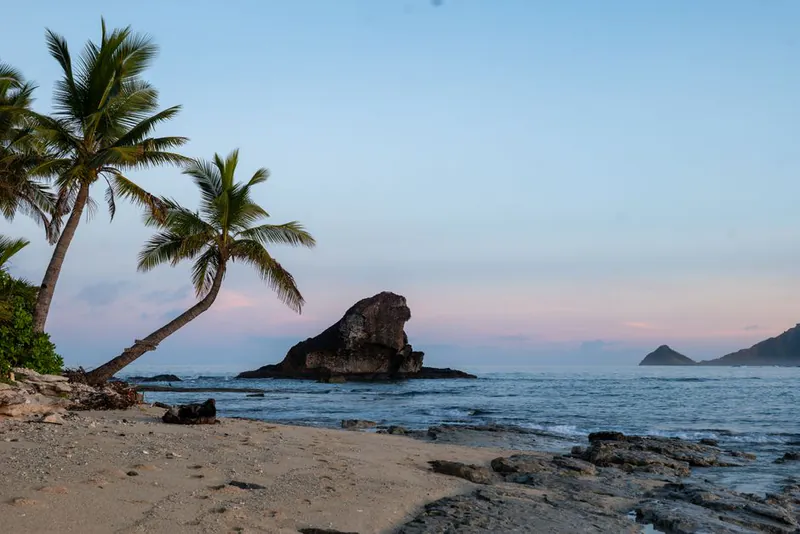
Cover photo by Mark Direen on Pexels.
Want to see how Fiji stacks up?
Are you seriously considering a move? Use our interactive tools to explore Fiji's climate, tax brackets, and nomad visas.