Moving to Estonia in 2026: 22% Flat Tax, Digital Nomad Visa & e-Residency
June 9, 2026
ShareIn December 2025, Estonia's parliament voted to cancel the planned increase of income tax from 22% to 24%. The rate stays at 22% - flat, clean, and unchanged. At the same time, the tax reform that did pass changed something more meaningful: from 1 January 2026, the personal tax-free allowance is €700/month for everyone, with no phase-out as income rises. The old "tax hump" that punished earners in the €1,200-2,100 bracket is gone. This is the most practical tax improvement for working expats in years.[1]
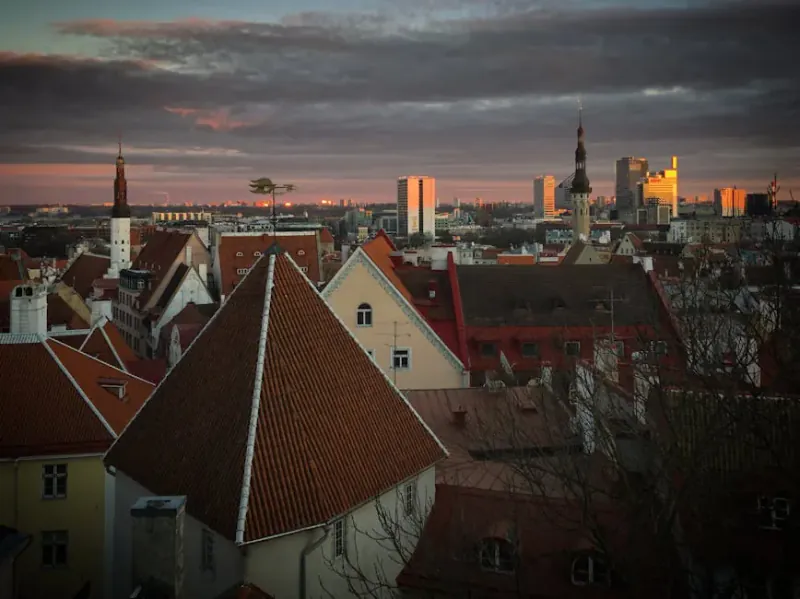
Estonia is a country of 1.3 million people with 99% of government services online, the birthplace of Skype, Bolt, Wise, Pipedrive and Veriff, a Crime Index of 23.2 (falling for three years straight), and a flat tax rate lower than most of its neighbours. Tallinn's medieval Old Town sits alongside a tech-forward startup ecosystem that consistently produces more unicorns per capita than any other EU country. The rental market is tighter than it looks and is still being squeezed. The path to citizenship requires giving up your original nationality - the single fact that stops more long-term expats than anything else in Estonian immigration law. This guide covers both the good and the hard.[2][3]
The Economy: Coming Out of Three Years of Decline
Estonia entered 2026 coming out of its longest economic downturn since independence. GDP declined from 2022 through 2024, grew 0.6% in 2025, and is now recovering on multiple fronts.[4][5]
2026 forecasts diverge interestingly:
| Institution | 2026 GDP Forecast |
|---|---|
| Eesti Pank (Bank of Estonia, Dec 2025) | 3.6%[5] |
| WIIW (Vienna Institute) | 2.3%[4] |
| European Commission (May 2026) | 1.6%[6] |
| OECD Economic Snapshot | 1.8%[7] |
The range is wide - 1.6% to 3.6% - reflecting genuine uncertainty about how domestic demand responds to the tax reform and how geopolitical developments (energy prices, conflict spillover) affect a small, open economy. The EC's lower 1.6% forecast reflects a darkened outlook following the Middle East conflict escalation in early 2026, which disrupted the stronger momentum seen in January-February.[6]
What is consistent: unemployment falling from 7.5% in 2025 to a projected 7.1% in 2026; wages growing faster than prices (real wages turned positive in 2024 for the first time in three years); inflation at 4.4% in 2026 but declining from 4.9% in 2025; and a budget deficit widening to 4.5% of GDP in 2026 as fiscal stimulus (including the tax reform) takes effect.[8][6]
For expats, the meaningful sector picture: IT, software, and cybersecurity are Estonia's international hiring sectors. Tallinn's tech ecosystem concentrates demand for developers, product managers, and data engineers. Defence technology has grown rapidly - Farsight Vision alone raised €7M in Q1 2026 - as Estonia's defence-tech sector benefits from sustained NATO-related spending and proximity to the security concerns of NATO's eastern flank.[9]
Visas and Residency: Five Real Paths
EU/EEA Citizens
Register your address in the Population Register (Rahvastikuregister) and you're done. EU citizens need no permit, no prior authorisation, and face no labour market test. Estonia is one of the most administratively frictionless EU countries for EU nationals. You can open a bank account, register a company, file taxes, and access public services entirely online through the eesti.ee portal with your EU national digital ID or an Estonian ID card issued after registration.[8]
Non-EU: Temporary Residence Permit for Employment
The standard path for non-EU professionals. Your employer sponsors you; you submit through the Police and Border Guard Board (PPA).
Requirements:[8]
- Concluded employment contract
- Employer registered in Estonia and in good standing
- Salary at or above the national average (approximately €1,900/month gross in 2026 - confirm current threshold at PPA.ee; the threshold is updated each year)
- Minimum bachelor's degree or equivalent vocational qualification for the skilled worker category
- Application fee: €96 for a standard permit
Processing time: 2 months standard; expedited processing (extra fee) in some categories. The permit is valid for up to 5 years, renewable.[8]
Digital Nomad Visa (DNV)
Estonia was the world's first country to launch a dedicated digital nomad visa - introduced August 2020. In 2026 it remains the clearest route for remote workers.[10]
| Details | |
|---|---|
| Duration | Up to 12 months (Type D long-stay visa)[11] |
| Minimum income | €3,504/month (~€42,048/year) from remote work in preceding 6 months[11] |
| Some sources cite | €4,500/month - confirm exact current threshold at PPA.ee before applying[11][12] |
| Eligible work | Must work for a company or clients outside Estonia - you cannot be employed by or serve Estonian clients[13] |
| Family | Spouse and dependent children can apply separately on accompanying visas[11] |
| Health insurance | International health insurance covering Estonia required for the visa duration[11] |
| Application fee | €80-100[11] |
| Processing time | Up to 30 days at Estonian embassy[14] |
| Tax status | If you stay under 183 days in a calendar year, you are not an Estonian tax resident - foreign income not subject to Estonian tax |
DNV does not lead to permanent residency. It is a temporary right to stay. After the visa expires, if you wish to remain, you need to transition to a different status (employment permit, registration as a business owner, etc.).
e-Residency (Business, Not Residency)
This is the most misunderstood programme in all of European expat services. e-Residency is not a visa, not a residence permit, and does not grant the right to live in Estonia. What it provides:[14]
- A government-issued digital identity (smart card with chip)
- The right to register and manage an Estonian Oàœ (limited company) entirely online
- Access to Estonian banking, payment services (Wise, LHV, Revolut Business), accounting, and digital signing
- No requirement to ever visit Estonia
In 2025, the programme generated €125 million in direct state revenue - up 87% year-on-year. A record 13,828 new e-residents joined in 2025, a 20% increase on 2024. Over 39,000 Estonian companies have been founded by e-residents to date. E-residents now account for 48% of newly founded Estonian startups.[15][16][9]
Who this is for: Freelancers, consultants, and remote entrepreneurs who want an EU company structure with access to EU VAT and banking without physically relocating. Apply at e-resident.gov.ee - processing: 3-8 weeks; state fee: €100-120; collect your card at a pickup point in your country or at a designated service point.[14]
Who this is not for: Anyone expecting residency rights. e-Residency and physical residency are completely separate systems.[14]
Residence Permit for Entrepreneurship
Non-EU nationals who want to live in Estonia and operate a business can apply for a residence permit for entrepreneurship (ettevõtluseks elamiseluba). Requirements include a viable business plan, registered Estonian company, and proof the business contributes meaningfully to Estonia's economy. This is the path for founders, self-employed professionals, and entrepreneurs who want physical presence rather than just e-Residency.[17]
Permanent Residency and Citizenship: One Immovable Line
Permanent Residency (Long-Term EU Resident Status)
After 5 years of continuous legal residence on a temporary residence permit:[18]
| Requirement | Detail |
|---|---|
| Residence | 5 years, max 6 consecutive months absent (10 months total in 5 years)[18] |
| Estonian language | B1 level - state language exam[18] |
| Income | Proof of stable legal income (~€350+/month per family member)[18] |
| Health insurance | Estonian state insurance (if working) or private[18] |
| Criminal record | Clean[18] |
| Application fee | €64[18] |
The B1 Estonian language exam is administered free of charge by the Education and Youth Board. Free preparation courses available through the Integration Foundation at integratsioon.ee. Estonian is linguistically isolated - it is not Indo-European, has no resemblance to Germanic or Slavic languages, and B1 requires genuine dedicated study. Most expats report 300-500+ hours of active learning.[18]
Citizenship: The Dual Nationality Barrier
Estonia does not permit dual nationality for naturalised citizens. To apply for Estonian citizenship by naturalisation, you must first renounce your original citizenship. This is enforced - there is no exception pathway for most nationalities.[19][20][18]
Additional citizenship requirements:[21][18]
- 8 years of total legal residence (5 on temporary permit + 3 on permanent)
- B2 Estonian language (higher than the B1 required for PR)
- Examination on the Constitution and Citizenship Act
- Permanent legal income
- Loyalty declaration to the Estonian state
- Renounce original citizenship
Estonian citizenship brings full EU rights - the right to live and work in all EU member states, vote in all Estonian elections, and hold an Estonian/EU passport with visa-free access to 183+ countries. The question is whether that exchange is worth losing your original nationality. For Americans, British nationals, and most non-EU Western nationals, it typically is not. For citizens of countries where having an EU passport represents a transformative upgrade in global mobility, it can be a compelling long-term calculation.
EU citizens holding permanent residence in Estonia can apply for Estonian citizenship at a lower B1 language threshold in some cases - check PPA.ee for the current framework as EU/non-EU rules differ on details.
Cost of Living: The Genuine Competitive Advantage
This is the honest case for Estonia. A comfortable single expat lifestyle in Tallinn: €1,400-1,800/month total including rent. In Tartu, Pà¤rnu, or other cities: €1,000-1,400/month. Compared to Berlin, Amsterdam, or Copenhagen, Tallinn is 40-50% cheaper for a similar quality of living.[22][23][2]
Tallinn's rental market has been tightening. Rent inflation reached 4.6% year-on-year in late 2025. Apartments over 11% more expensive than two years ago in central areas. Still: a furnished 1-BR in Kalamaja or Telliskivi costs €700-900/month - less than a studio in central Copenhagen or a shared apartment in Amsterdam.[24][22][8]
Rent by City (2026)
| City | Studio | 1-BR (Centre) | 1-BR (Outside) | Total Monthly (Single) |
|---|---|---|---|---|
| Tallinn | €380-600 | €700-1,100[22] | €490[23] | €1,594[23] |
| Tartu | €300-450 | €500-750[22] | €325[23] | €1,383[23] |
| Pà¤rnu | €280-400 | €400-600 | €280[23] | €1,053[23] |
| Narva | €200-300 | €400 | €275[23] | €740[23] |
Source: Investropa 2026, ExpatLife.Ai 2026, WheretoeEmigrate 2026[23][22][8]
Kalamaja and Telliskivi (creative/tech quarter west of Old Town) carry 10-15% rent premiums above the Tallinn average but are the de facto expat-favourite neighbourhoods. In these areas, expect €800-1,100/month for a furnished 1-BR.[24]
Utilities warning: Heating is never included in Estonian rent. Always ask for the previous winter's utility bills before signing. In a poorly insulated apartment, heating (district heating, kaugküte) can add €100-200/month from November through March.[22]
Daily Expenses (Tallinn, 2026)
| Item | Price (EUR) |
|---|---|
| Meal at inexpensive restaurant | €12-16[23] |
| Three-course meal for two (mid-range) | €50-70[23] |
| Coffee (cappuccino) | €3.50-5 |
| Monthly public transport pass | €30 (Tallinn free for residents!)[25] |
| Grocery shop, weekly (single person) | €50-90[2] |
| Bottle of local beer (shop) | €1.50-2.50 |
| Gym membership | €30-50/month[23] |
| Cinema ticket | €10-14[23] |
Tallinn's free public transport for registered residents has been in place since 2013 - one of the world's longest-running urban free transit programmes. Register your address in Tallinn and the bus, tram, and trolleybus network is free. Taxis and Bolt rides are inexpensive by Western European standards: a 5 km Bolt in Tallinn typically costs €5-8.[25]
Taxes: The 2026 Reform That Benefits Everyone Below €2,100/Month
Estonia's tax system for individuals is built around three layers: flat personal income tax, social tax, and unemployment insurance contributions.
Personal Income Tax (Tulumaks) - 2026
- Rate: 22% flat - the 24% increase was cancelled by parliament in December 2025[26][1]
- Universal tax-free allowance from 1 January 2026: €700/month (€8,400/year)[1][26]
- The allowance is universal - it no longer phases out as income rises (the old system reduced it progressively, creating a hump where earners between €1,200-2,100/month faced effective marginal rates above 22%)
- Above €8,400/year net income, 22% applies to every euro
Real-world example: Gross salary €2,500/month:
- Social tax and unemployment contributions deducted at employer level
- Employee gross after social deductions: approximately €2,275
- Less €700 tax-free allowance: taxable income €1,575
- Income tax: €1,575 à— 22% = €346.50
- Approximate net take-home: ~€1,928/month (~77.1% of gross)[1]
Social Tax and Contributions
- Social tax (Sotsiaalmaks): 33% - paid entirely by the employer (not deducted from employee gross salary)[26]
- Unemployment insurance contribution (employee): 1.6% of gross salary[26]
- Funded pension contribution (II pillar): 2% of gross salary (employee) + 4% employer contribution - this is the Estonian private pension system; opting out is possible but rare among long-term residents[26]
New from 2026: Defence tax (Kaitsevà¤e maks): 2% applied to businesses - this is levied on companies (Oàœ), not directly on personal income for employees. The 2% applies to distributed profits and certain income categories at the entity level.[26]
Corporate Tax - Estonia's World-Famous Deferral System
This is why Estonia has attracted tens of thousands of e-resident company founders and physical entrepreneurs.
- Corporate income tax on retained profits: 0%
- Corporate income tax on distributed profits (dividends): 22/78 of the net dividend (i.e., 22% applied to the gross-up, effectively meaning the company pays €22 per €78 distributed)[27][1]
- The planned permanent increase to 24% was cancelled; rate remains 22% in 2026[27][1]
- For EU-sourced dividends: no withholding tax if recipient holds 10%+ of shares[27]
For entrepreneurs operating through an Oàœ: If you reinvest 100% of profits back into the company, your corporate tax bill is zero for as long as profits are retained. Tax is only triggered when you take money out. This makes Estonia uniquely suitable for SaaS, consulting, e-commerce, and any cash-generative business where founders want to delay personal distributions.[27]
VAT
Standard VAT rate in Estonia: 24% (increased from 22% in July 2025). The VAT hike did proceed - unlike the income tax increase that was cancelled. Lower VAT rates (9%) apply to accommodation and specific media categories.[26]
Healthcare: Automatic Enrollment, Cost-Capped, Small Gap for New Arrivals
Estonia's National Health Insurance Fund (Haigekassa) provides universal coverage for all employed residents and their registered dependents. Coverage is automatic if you are employed and social tax is being paid on your behalf by your employer.[28]
How You Get Covered
- Employed residents: Enrolled automatically from the first month of employment - no separate registration required. Your employer's social tax contributions fund your coverage.
- Non-working residents: Not automatically covered. Options: voluntary health insurance (~€50-150/month depending on age and cover), or qualify through a working family member.
- Waiting period: Coverage activates from the start of employment. For the gap between arrival and first paycheck: arrange international health insurance for those first weeks.
What Haigekassa Covers
After enrollment, co-pays are low:[29]
- GP visit: €5 per visit after the third consultation in 12 months - first two GP visits per year are free
- Specialist consultation (with GP referral): €5 co-pay
- Hospital inpatient: €2.50/day (up to 10 days, then free)
- Emergency treatment: No co-pay for genuine emergencies
- Prescription medicine: partially subsidised at 50-90% depending on medication
What is not covered:
- Dental care for adults: private, entirely out of pocket. Routine check-up: €40-80. Filling: €50-150. Dental insurance plans (~€15-30/month) available from Salva, If, and other insurers - strongly recommended.
- Elective cosmetic treatments, non-prescription supplements, corrective lenses for adults.
Online prescriptions and digital health: Every prescription in Estonia is issued and stored digitally in the national health information system. Pick up any prescription at any pharmacy in Estonia without a paper document - just present your ID card or phone. All vaccination records, health history, and specialist referrals are accessible at digilugu.ee (the patient portal).[2]
Emergency: 112 (universal).[2]
Safety
Estonia's national Crime Index in 2026: 23.2 - Low, falling for three consecutive years. Tallinn specifically: Crime Index 18.96 - Very Low. Safety walking alone during daylight: 90.77% "Very High." At night: 72.11% "High."[30][3]
Tallinn ranked 17th globally among the world's safest cities in Crowdsourced Data's 2026 Safety Index - ahead of Singapore, Zurich, Helsinki, and Copenhagen. Violent crime is rated "Very Low." Home break-ins, car theft, muggings: all "Very Low."[31][32][30]
The safety picture is genuinely exceptional by global standards. Tallinn's Old Town, Kalamaja, Telliskivi, and Kadriorg are all considered safe at all hours. Lasnamà¤e - the large Soviet-era panel housing district in the east of the city - has a rougher reputation, but even there violent crime is uncommon. Expats living in Lasnamà¤e report it as quieter than expected.
Geopolitical context: Estonia is a NATO member and borders Russia (the Narva River marks the eastern frontier). The country manages its geopolitical position from a position of alliance strength - it is one of the most committed NATO contributors by GDP percentage in the entire alliance. The security situation for residents in Tallinn and other western cities is stable. Narva (on the Russian border) is a separate case: a city that is 97% Russian-speaking and geopolitically complex, though still safe in practical daily-life terms.
Language: Estonian Is Hard, English Is Everywhere
Estonian is one of the most challenging languages in the world for English speakers - alongside Finnish and Hungarian, it belongs to the Finno-Ugric family, sharing no vocabulary with Indo-European languages and featuring 14 grammatical cases and extensive vowel harmony patterns.[2]
The practical consequence: English proficiency in Tallinn's professional sphere is excellent. Every tech company, startup, most restaurants, shops, and service providers in central Tallinn operate in English without friction. The Estonian government's digital services are available in English and Russian as well as Estonian.
The integration and residency consequence: B1 Estonian is required for permanent residency; B2 for citizenship. These are not achievable by passive exposure. Plan for dedicated study - the Integration Foundation offers free Estonian language courses for residents at integratsioon.ee, available in multiple levels and formats including online.[18]
Russian in Estonia: Approximately 30% of Estonia's population speaks Russian as a first language - mainly in Tallinn's eastern districts and in Narva. Russian is widely understood but is politically sensitive; the government's position is that Estonian is the language of public life and integration. In business, Russian remains practically useful in some sectors, but do not plan your Estonian life around Russian - it has no administrative status and limited practical utility for professional advancement.[25]
Which City?
Tallinn
The capital, the tech hub, the Old Town, and the overwhelming first choice for most expats. 450,000 residents; EU-connected directly to Helsinki by ferry (80 minutes), Riga by road (4 hours), and Stockholm by overnight ferry. Tallinn Airport has direct connections to most European capitals and the Middle East.
Best Tallinn neighbourhoods for expats:
- Kalamaja - the definitive expat neighbourhood: wooden 19th-century houses, independent coffee shops, craft breweries, Telliskivi Creative City complex (events, markets, co-working), and the highest concentration of digital nomads and startup workers in the Baltics. Rent premium: 10-15% above city average.[24]
- Telliskivi / Põhja-Tallinn - merges with Kalamaja; more residential, slightly newer stock, the Balti jaam (Baltic Station) market; younger families, artists, and tech workers
- Kadriorg - Soviet-era embassies, Kadriorg Park, the presidential palace, excellent cycling to the Old Town; quieter, more established expat community, slightly higher rents; ideal for families
- Old Town (Vanalinn) - medieval stone streets, restaurants, tourism density; charming for the first month, impractical for daily life; steep rent, tourist noise, poor supermarket access
- Lasnamà¤e - affordable, large apartments, efficient transport; less international atmosphere but excellent value for money; families on tighter budgets often choose here
Tartu
Estonia's second city and its intellectual capital. The University of Tartu is the oldest and largest university in the country, making Tartu younger, more dynamic, and more international per capita than most comparable-sized Baltic cities. Rent 20-30% cheaper than Tallinn. Growing tech sector: Bolt, Pipedrive, and other Estonian companies have Tartu offices. 2.5 hours from Tallinn by bus or car. Best for: academics, researchers, students, remote workers, and anyone who values a university-city atmosphere with lower living costs.[22]
Pà¤rnu
Estonia's summer capital on the Baltic coast. Off-season population: 50,000. Summer: hundreds of thousands of visitors. Spa culture, beaches, wooden villas. Growing remote-work community. Rents affordable year-round (€400-600 for 1-BR). Not a serious employment market outside tourism and healthcare. Best for: remote workers, retirees, and Digital Nomad Visa holders who want nature and peace.
Narva
The Russian-border city. Cheapest rents in Estonia (~€400 for 1-BR centre). Predominantly Russian-speaking. Limited international expat community. Not recommended as a first move destination for non-Russian-speaking expats. Mentioned here for completeness - it is a city with its own distinct culture and some genuinely interesting history, but it is a specialist choice.[23]
Climate: Four Seasons, Dark Winters, Baltic Summer Surprise
Tallinn's climate is humid continental, heavily influenced by the Baltic Sea. Winters are cold and dark; summers are shorter but genuinely warm and bright with long days.
| Season | Months | Temperature (Tallinn) | Notes |
|---|---|---|---|
| Spring | March - May | 1-14°C | Slow warm-up; April often still cold; daylight returns rapidly |
| Summer | June - August | 18-25°C | Long days (18+ hours of light at solstice); warm; occasional rain[25] |
| Autumn | September - November | 3-13°C | Beautiful colours; cooling fast; rain increases |
| Winter | December - February | -10°C to +2°C | Snow likely Nov-March; 6 hours daylight at solstice[25]; ice on streets |
Winter darkness is the most consistent issue cited by expats from southern or tropical backgrounds. Tallinn at the December solstice has approximately 6 hours of daylight - less than half the summer maximum. The cold is manageable with proper clothing; the darkness is the factor that separates expats who thrive in Estonia from those who do not. Invest in a UV light therapy lamp in October; it is not optional in the Nordic psychiatric sense.
The summer flip side is extraordinary. In June and July, it never fully gets dark - light persists until after 11 pm and the sky begins to brighten again by 3 am. Tallinn's summer evenings - outdoor dining in Kalamaja, the Telliskivi flea market, kayaking on Aegna island - are genuinely exceptional. This is when Estonia's quality-of-life case makes itself felt.
Estonia is seismically inactive, has no significant flooding risk in urban areas, and no extreme weather hazards (no tornados, no extreme heat, no tropical storms). Occasional ice storms from November to March make walking and driving more hazardous - ice grips for boots (libisemistõkised) are standard practice.
Internet and Infrastructure
Estonia's digital infrastructure is a national calling card. The country introduced online voting in 2005 - the world's first country to do so - and has used it in every election since. Government services, healthcare records, company registration, tax filing, and digital signing are all available 24/7 through eesti.ee with a chip-enabled ID card or Mobile-ID.[2]
Average fixed broadband speed: approximately 100-130 Mbps nationally. Fibre-to-home plans (1 Gbps) from Telia, Elisa, and Starman: approximately €20-35/month. Among the cheapest gigabit fibre rates in Europe. 5G: available across Tallinn, Tartu, and Pà¤rnu, expanding nationally.[2]
Tallinn public transport - all buses, trams, and trolleybuses - is free for registered Tallinn residents year-round. Non-residents pay ~€1.50/trip. The Tallinn Card (tourist) includes free transport. Bus connections from Tallinn to all major Estonian cities through Lux Express and Ecolines are reliable, frequent, and cheap (Tallinn-Tartu: ~€8-12, 2.5 hours).[25]
Tallinn Airport is 3 km from the city centre - one of the closest airport-to-city distances in Europe. Direct routes to Helsinki, Stockholm, Riga, Warsaw, Vienna, Amsterdam, London, Berlin, Frankfurt, Dubai, and most major EU hubs.
Buying Property
Property purchase in Estonia is open to all nationalities for apartments and commercial property. Non-EU nationals face one restriction: direct purchase of agricultural land, forest land, and border-adjacent protected areas requires a permit. Urban residential apartments - the primary expat purchase category - are unrestricted for everyone.[33][34]
2026 Market State:
- Average price/sqm in Tallinn: approximately €3,000-3,145 - up from €2,734 average nationally[35][36]
- Transactions in Tallinn: 651 purchase-sale transactions in February 2026, average price per sqm €3,145[36]
- Quarterly price growth: approximately 2.4% per quarter consistently over the past two years[35]
- Transaction costs: 2.6-5.6% of purchase price[35]
A 50 sqm apartment in central Tallinn costs approximately €157,000-200,000 depending on condition, floor, and neighbourhood. A comparable flat in Kalamaja or Telliskivi: €180,000-250,000 for quality stock. Tartu: €130,000-180,000 for a central 50-60 sqm apartment.[35]
Mortgage access for foreigners: Estonian banks (LHV, SEB Estonia, Swedbank Estonia) do lend to residents with local employment. Standard down payment requirement: 15-20% of purchase price. Non-residents seeking investment mortgages face more scrutiny. Pre-approval before bidding strongly recommended.[37]
Costs of purchase (buyer side):
- Notary fee: approximately 0.1-0.2% of transaction value
- State duty: €10-50 registration fee (very low)
- Real estate agent fee: typically 3-5% of purchase price (can be negotiated; sometimes split between buyer and seller)[35]
- Legal review: €500-2,000 for a thorough title check
No stamp duty. Estonia abolished stamp duty on property - one of very few EU countries with no transaction-based property tax at the point of purchase.[35]
Your First 30 Days: The Checklist
- Register in the Population Register (Rahvastikuregister) at your municipality office (vallavalitsus or linnavalitsus) - bring passport and proof of accommodation (rental contract); for EU citizens this activates residency rights; for non-EU, do this after receiving your temporary residence permit[8]
- Apply for an Estonian ID card - once registered, apply at the nearest PPA (Police and Border Guard) office; the ID card is your daily life document - required for banking, signing leases, accessing eesti.ee services, and health insurance; biometric collection on-site, card issued in 1-5 business days[8]
- Activate Mobile-ID or Smart-ID - the digital authentication apps that let you authenticate and sign documents from your phone without a card reader; set up immediately after receiving your ID number; used for every government and banking platform in Estonia
- Get a SIM card - Tele2, Telia, or Elisa; bring your ID card; prepaid available at any Selver, Rimi, or R-Kiosk; all three operators have competitive data plans at €10-20/month
- Open a bank account - LHV Bank is most expat-friendly and is the bank of Estonia's startup ecosystem; SEB and Swedbank are alternatives; bring ID card and employment contract; most accounts open in-branch in 30-60 minutes; LHV also has an English-language app
- Enrol in Haigekassa (health insurance) verification - confirm with your employer that social tax payments began; check your insurance status at haigekassa.ee with your ID card or Smart-ID; if coverage has not activated, resolve with your employer's accountant within the first pay cycle
- Register for Tallinn free public transport - if living in Tallinn: register your address and link your ID card to the transport registry at tallinn.ee/transport; free transport activates within a few days
- Register your dentist appointment - Estonian public health insurance does not cover adult dental care; book a baseline check-up and assessment within the first month; arrange dental insurance immediately if your employer does not provide it
- Begin Estonian language study - register at integratsioon.ee for free courses; start from month one regardless of the B1 requirement timeline; the longer you wait, the harder the exam becomes; if you plan permanent residency (5 years), you need 300-500+ study hours - start the clock on arrival
Key Data at a Glance
| Indicator | Value |
|---|---|
| GDP Growth 2025 | 0.6%[4] |
| GDP Forecast 2026 (Eesti Pank) | 3.6%[5] |
| GDP Forecast 2026 (EC) | 1.6%[6] |
| GDP Forecast 2026 (WIIW) | 2.3%[4] |
| Inflation 2026 | 4.4%[6] |
| Unemployment 2026 | 7.1%[6] |
| Personal Income Tax Rate (2026) | 22% flat (24% hike cancelled)[1] |
| Universal Tax-Free Allowance (2026) | €700/month (no phase-out)[1] |
| Corporate Tax on Retained Profits | 0%[27] |
| Corporate Tax on Distributions | 22/78 (22% effective)[27] |
| Defence Tax (companies, 2026) | 2% on taxable base[26] |
| Standard VAT | 24% (from July 2025)[26] |
| Digital Nomad Visa Income Threshold | ~€3,504-4,500/month[11][12] |
| Digital Nomad Visa Duration | Up to 12 months[11] |
| Temporary Residence Permit Fee | €96[8] |
| Permanent Residency | 5 years + B1 Estonian[18] |
| Citizenship | 8 years total + B2 Estonian + renounce original[18][19] |
| Dual Citizenship | Not permitted[18][20] |
| National Crime Index 2026 | 23.2 - Low (falling 3 years)[3] |
| Tallinn Crime Index | 18.96 - Very Low[30] |
| Tallinn Safety at Night | 72.11% "High"[30] |
| Tallinn Safety Global Ranking | 17th safest city globally[31] |
| e-Residency Revenue 2025 | €125 million (+87% YoY)[16] |
| New e-Residents 2025 | 13,828 (+20%)[16] |
| E-resident companies (total) | 39,000+[16] |
| Tallinn 1-BR (Centre) | €700-1,100/month[22] |
| Tallinn Property Price/sqm | ~€3,145[36] |
| Property Transaction Costs | 2.6-5.6%[35] |
| Stamp Duty | None[35] |
| Tallinn Public Transport (residents) | Free[25] |
| Home Fibre 1 Gbps (monthly) | €20-35[2] |
| Emergency | 112[2] |
Estonia's citizenship law requiring renunciation of prior nationality is not a technicality - it is the decisive factor for most long-term expats. The permanent residency system is straightforwardly achievable: 5 years, B1 Estonian, stable income. The citizenship step requires a genuine personal calculation about what your original passport is worth to you versus what an Estonian/EU passport would provide. For the corporate tax system, the e-Residency programme, and the day-to-day quality of life in Tallinn, none of that calculation matters. The country functions at its best regardless.
References
Estonia tax changes in 2026: what businesses and employers must ... - Overview of Estonia's 2026 tax changes for companies and employers. Income tax, social tax, payroll ...
Moving to Estonia 2026: $1,200-$1,800/mo, DN Visa & e-Residency - Tallinn $1,200-$1,800/mo. Digital nomad visa for remote workers. e-Residency for EU company formatio...
Crime index by country | Estonia (2012−2026) - The Crime Index in Estonia in 2026 was 23.2 points. In 2025, the index value was 23.7. It has been f...
Estonia - The Vienna Institute for International Economic Studies (wiiw) - Growth is projected to accelerate to 2.3% in 2026, supported by a strongly expansionary fiscal stanc...
ECONOMIC FORECAST. The recovery in the economy will come at ...
Economic forecast for Estonia - Economy and Finance - Real GDP is projected to grow by 1.6% in 2026 and 1.7% in 2027. HICP inflation is projected to incre...
Estonia Economic Snapshot - OECD - GDP growth reaching 1.8% in 2026 and 2.7% in 2027. Growth will be driven by stronger private investm...
Estonia: The Expat Guide Updated (2026) - Investropa - Are expats moving in or leaving Estonia in 2026? As of early 2026, the expat migration trend in Esto...
Estonia's E-Residency programme brings record talent and ... - Nearly half of Estonia's newly founded startups now involve an e-resident - up from 38% in 2023 - as...
Estonia's Digital Nomad Visa is here! - e-Residency - The Estonian Nomad Visa allows remote workers and entrepreneurs to take advantage of teleworking in ...
Estonia Digital Nomad Visa 2026 | E-Residency Filing Help - Apply for Estonia's nomad visa with our help. €4,500/mo, e-residency options, full filing support.
How to Apply for the Estonia... - If you work remotely, you can apply for a digital nomad visa, and live in Estonia for up to one year...
Save On Your Relocation... - Read our complete guide to the Estonia digital nomad visa, covering fees, documents, eligibility req...
Digital Nomad Visa vs e-Residency | Eligibility & how to apply - The Digital Nomad Visa lets remote workers to legally work in Estonia. E-Residency allows you to run...
Estonia's E-Residency Scheme Generates €125M in 2025 - Estonia's digital nomad initiative boosts tax revenue, solidifying its position as a leader in globa...
Estonian e-residency program brought in €125 million in 2025 - news | ERR - 2025 was a record year for Estonia's flagship e-Residency program, bringing in €125 million to state...
Estonia Citizenship by Investment - The 2026 Guide - Foreign nationals can apply for the Estonia golden visa under certain conditions, subject to a minim...
Permanent Residence in Estonia - LegalAI.ee - Free legal information, calculators, and guides for Estonia. Tax calculator, company registration, e...
Citizenship Act - Riigi Teataja - Riigi Teataja
Conditions - Estonian citizenship for an adult - You can apply for Estonian citizenship, if:. you have a long-term residence permit or the right of p...
Estonia Housing Guide (2026) - ExpatLife.Ai - Estonia's rental market is competitive, especially in Tallinn, where prices have risen 11%+ annually...
Cost of Living in Estonia 2026: 4 Cities Compared - Detailed cost of living comparison across 4 cities in Estonia. Rent, monthly budgets for singles and...
Updated Rents in Estonia (2026) - Investropa - The latest update about rents in Estonia. Rents, rental income, rental yields, vacancy, occupancy ra...
Moving to Tallinn? Here's Everything You Need to Know - InterNations - Find out how to move to Tallinn on the InterNations website. Get answers to your moving questions in...
Tax changes in Estonia 2025/2026 - new rates and regulations - Discover key tax changes in Estonia for 2025 and 2026. Check new CIT, VAT rates, and vehicle taxes. ...
Estonian Company Tax Advantages (2026 Guide) - Deal.ee - A 2026 guide to Estonia's distributed-profit corporate income tax, VAT (KMKR), payroll taxes, divide...
Norway - Commonwealth Fund - Norway has universal health coverage funded primarily by general taxes and payroll contributions sha...
Norway Healthcare System & Insurance Options for Expats - Public healthcare is available across Norway. It is free for those who are 16 years or younger in ag...
Crime in Tallinn, Estonia - Cost of Living - Crime rates in Tallinn, Estonia ; Problem property crimes such as vandalism and theft. 29.10, Low ; ...
Top 50 Most Safest Cities in 2026 1. Qingdao, China 2. Abu ... - Top 50 Most Safest Cities in 2026 1. Qingdao, China 2. Abu Dhabi, United Arab Emirates 3. Doha, Qata...
International Buyer & Relocation Guides: How to Buy Property in ... - EU citizens can buy property in Estonia - including land - with essentially no restrictions. Non-EU ...
Buying Land as a Foreigner in Estonia (2026) - Investropa - As of early 2026, Estonia does not set any minimum purchase price or investment threshold for foreig...
Estonia Real Estate Investment for Foreigners 2026 - Immigrant Invest - €2,700 Average price per 1 m2 €300,000+ average prices in the capital city, Tallinn, can range from ...
Housing market - Kinnisvara24 - In February, 651 apartment purchase-sale transactions were completed in Tallinn, and the average pri...
A Guide to Real Estate in Estonia for Foreigners (2026) - Foreigners generally face few restrictions when acquiring property. Tallinn offers the widest a down...
Cover photo by Sergei Gussev on Pexels.
Frequently Asked Questions
How much did Estonia's parliament vote to do in December 2025 regarding income tax? Estonia's parliament voted to cancel the planned increase of income tax from 22% to 24%.
What is the new personal tax-free allowance starting from January 1, 2026? The personal tax-free allowance is €700/month for everyone.
What sectors are Estonia's international hiring sectors according to the article? IT, software, and cybersecurity are Estonia's international hiring sectors.
Want to see how Estonia stacks up?
Are you seriously considering a move? Use our interactive tools to explore Estonia's climate, tax brackets, and nomad visas.
Head-to-Head Relocation Comparisons
Compare taxes, safety, and living costs of Estonia against top alternatives.


Related Articles
July 10, 2026
Estonia Digital Nomad Visa 2026: The €4,500 Threshold, Tax Truths, and the 548-Day Hard Limit

September 21, 2026
Moving to Papua New Guinea in 2026: 42% Tax, Work Permits, and Compound Realities

September 19, 2026