Moving to Cambodia in 2026: The Undocumented ER Visa Rule, Fully Dollarized Costs, and Nighttime Safety
August 31, 2026
ShareCambodia's ER retirement visa has no legally codified minimum income - none. The widely quoted "$800-1,000/month" figure that shows up across nearly every guide is, according to at least one source that dug into the actual regulations, an informal expectation from immigration officers and visa agents, not a written statute. Cambodia in 2026 is a country running one of Southeast Asia's simplest visa systems on top of a fully dollarized economy, decelerating growth that every forecaster keeps revising downward through the year, and a safety profile with one of the sharpest daylight-to-nighttime cliffs documented anywhere in this guide series.
The Economy: A Growth Forecast That Keeps Getting Cut, Quarter After Quarter
Cambodia entered 2026 with genuinely optimistic growth targets, and nearly every subsequent revision through the year has moved in the same direction: down.
Cambodia's own Ministry of Economy and Finance's mid-year review, released in August 2026, cut the official 2026 GDP growth forecast to 4.1%, down from 4.2% in May and an initial 5% estimate at the start of the year, citing "lower-than-expected growth in agriculture and tourism, and a slight slowdown in the garment sector," even as non-garment manufacturing was flagged as "a bright spot"[1]. This mirrors the trajectory of nearly every external forecaster: the World Bank initially projected 4.5% in its early-2026 outlook, then held at 4.3% for 2026 in its January update, "broadly in line with East Asia and Pacific peers" and well above the projected global growth of 2.6%[2][3].
AMRO's forecast tells the clearest downward story of all: an initial 4.9% projection in April 2026 was revised down to 4.2% by July, explicitly "pre-Iran conflict" caveats built into the earlier number giving way to acknowledged "significant downside risks emerging" as the year progressed, alongside a sharp inflation revision from 2.9% up to 5.1% for 2026[4][5][6]. The ADB's April 2026 outlook landed at 4.5% under an "early stabilization scenario," specifically flagging that services sector growth was expected to slow from 3.4% in 2025 to just 2.3% in 2026 "as the economy adjusts to the effects of the Thailand border closure" - a real, specific headwind unique to Cambodia's geopolitical position[7]. The National Bank of Cambodia's own July 2026 projection came in lowest among official domestic sources at 3.9%, with Governor Chea Serey directly noting the IMF had cut its own forecast to just 3.0%, even as she expressed confidence growth would "improve from an estimated 3.5 percent in the first half of 2026 to 4.3 percent in the second half"[8]. Cambodia's Deputy PM and Finance Minister struck a more optimistic note in April, projecting 5% growth with GDP reaching $53.8 billion and per-capita GDP climbing to $3,020, though this figure predates most of the subsequent downward revisions[9]. Amid this genuinely confusing spread, AMRO's baseline scenario also flags the current account deficit widening to 8.5% of GDP if oil prices average $90-100/barrel through 2026, a real fiscal vulnerability tied directly to Middle East conflict dynamics[10].
Visas: The Simplest Long-Stay System in Southeast Asia, Built on an Undocumented Income Threshold
Cambodia runs arguably the most accessible long-stay visa regime in this entire guide series, and the ER (retirement) sub-class is the clearest example - genuinely easy to obtain, but resting on an income expectation that, remarkably, has never actually been written into law.
- No standalone retirement visa exists - the ER (Extension of Stay, "Retired") is a sub-class of Cambodia's ordinary E-class visa, not a separate program you can apply for directly[11][12]
- Age requirement: 55 or older, retired, and not employed in Cambodia - this is the one genuinely hard legal requirement[13]
- No codified minimum income exists in Cambodian law - the commonly cited $800-1,000/month (or, per another guide, $1,500/month) figure "reflects informal expectations from immigration officers and processing agents, not a written standard"[13][14]
- Application sequence is fixed: enter on an Ordinary E-class visa ($35, obtainable on arrival, via e-visa, or at an embassy), then convert to ER status at the General Department of Immigration in Phnom Penh - the ER classification cannot be applied for from outside the country[13][11]
- Government stamp fee: $290-300/year, though the realistic all-in first-year cost (agent fees, photos, notarization, medical certificate) runs $400-600, with similar costs on annual renewal[13]
- Documentation: valid passport (6+ months, blank pages), proof of retirement (pension letter, Social Security statement, or employer separation letter), 3 months of bank statements showing consistent USD inflows, and in some cases a medical certificate - requirements that vary meaningfully by processing agent[13][11]
- Duration and renewal: valid 12 months from conversion, multiple exits/entries permitted, no minimum stay requirement, renewable annually with no cap on the number of renewals[13][15]
- Two hard restrictions: the ER visa prohibits any paid work in Cambodia, and foreigners cannot own land - a constitutional restriction, not a negotiable policy[13]
- The simpler alternative many expats actually use: the standard EB (business) visa, which one source describes as "the simplest long-stay visa in Asia" - renewable indefinitely with no business or income proof required at all, though it doesn't carry the ER's specific retiree framing[16]
- One source frames the ER pathway toward permanent residency at 5 years, and citizenship at 7 years, though this diverges from the near-universal description elsewhere of Cambodia as having no formal PR track for most visa categories - treat this figure with caution and verify directly[17]
Taxes: A Genuinely Favorable System for Anyone Who Stays Under 182 Days
Cambodia's tax code produces one of the more nomad-friendly structures in this guide series, built entirely around a single bright-line residency test.
| Monthly Taxable Income (KHR) | Approx. USD | Marginal Rate |
|---|---|---|
| 0 - 1,500,000 | ~$375 | 0% |
| 1,500,001 - 2,000,000 | ~$500 | 5% |
| 2,000,001 - 8,500,000 | ~$2,125 | 10% |
| 8,500,001 - 12,500,000 | ~$3,125 | 15% |
| Above 12,500,000 | ~$3,125+ | 20% (top rate) |
(Source:[18])
Tax residency triggers at 182+ days of presence in any 12-month period, or by maintaining a residence or principal place of abode in Cambodia[19]. Residents are taxed on worldwide income at the progressive 0-20% rates above, with a foreign tax credit available for tax already paid abroad. Non-residents pay a flat 20% - but only on Cambodia-sourced income; foreign-sourced income earned while a non-resident isn't taxed by Cambodia at all[18]. This produces a genuinely clean planning variable: a digital nomad who stays under 182 days and earns solely from foreign clients pays $0 in Cambodian tax, while crossing that threshold brings worldwide income into scope[18]. Cambodia's economy runs almost entirely on the US dollar as the de facto currency, removing exchange-rate risk for most day-to-day expat transactions[16].
Cost of Living: Phnom Penh Runs 25-50% Above Siem Reap, With Genuinely Wide Estimates Either Way
Cambodia consistently ranks among the cheapest countries in Southeast Asia, and the sourcing here agrees clearly on direction - Phnom Penh costs meaningfully more than Siem Reap or Kampot - even where exact figures diverge.
Monthly Budget Estimates (Single Person, Comfortable, 2026)
| Source | Phnom Penh | Siem Reap/Kampot |
|---|---|---|
| Early Retire Abroad | $1,400-1,800/mo | $1,000-1,200/mo[20] |
| ExpatLife.ai | $800-1,400/mo | $500-800/mo[21] |
| GetWhereNext | $800-1,200/mo | $600-900/mo[16] |
| Megaport.hu | $950-1,300/mo | -[22] |
| PhnomPenhNow.com | $900-1,200/mo | $500-700/mo[23] |
| Nomads.com (Siem Reap, expat) | - | $1,067/mo[24] |
Rent (1-Bedroom, 2026)
| Location | Range (USD/month) | Sources |
|---|---|---|
| Phnom Penh, BKK1/Tonle Bassac (main expat area) | $400-700/mo | [25] |
| Phnom Penh, Toul Tom Poung/Russian Market | $250-450/mo | [25] |
| Siem Reap, central | $150-370/mo | [21][24] |
A realistic center of gravity sits around $900-1,400/month for a comfortable single-person lifestyle in Phnom Penh, and $500-1,000/month in Siem Reap or Kampot - with Phnom Penh running 25-35% more expensive across nearly every category, according to a direct comparison[20]. Cambodia's overall cost index was measured at just 37.3 as of April 2025, making it "one of the world's most affordable places to live"[23]. Street food runs $1-3 per meal, and a budget lifestyle "living like a local" is achievable at $400-600/month in rural areas[16][22].
Healthcare: One JCI-Accredited Hospital, and a Universal Recommendation to Plan for Evacuation
Cambodia's healthcare system generates a remarkably consistent message across every single source: private care in Phnom Penh is genuinely adequate for routine and general needs, but virtually everyone recommends treating Bangkok or Singapore as the real destination for anything serious.
Cambodia runs a two-tier public-private system, with public hospitals underfunded and crowded, meaning "most expats use private hospitals exclusively"[26]. Royal Phnom Penh Hospital is Cambodia's only JCI-accredited facility, managed by Bangkok Dusit Medical Services, and is consistently described across every source as "the gold standard" for expat care[26][27][28].
| Facility | Location | Type |
|---|---|---|
| Royal Phnom Penh Hospital | Phnom Penh | Private, JCI-accredited, 24/7 ER, "the gold standard"[26] |
| Sunrise Japan Hospital | Phnom Penh | Private, Japanese-invested, advanced diagnostics[27] |
| Sen Sok International Hospital | Phnom Penh | Private, Singaporean-managed, growing specialist range[29] |
| International SOS Clinic / Naga Clinic | Phnom Penh | Private clinics, GP and family medicine, French/expat-run[27] |
| Royal Angkor International Hospital | Siem Reap | Private, Bangkok Hospital affiliate, basic international-standard care[29] |
| Preah Kossamak / Calmette Hospital | Phnom Penh | Public, worth considering only with a Khmer speaker[30][26] |
Private GP consultations run $40-80 (or $20-50 in another source's range), specialist visits $60-150, an MRI $300-500, and a private hospital stay/emergency appendectomy runs $1,200-3,500[29][27][30]. International health insurance with evacuation coverage runs $80-200/month for adults under 50, through Cigna Global, Allianz Care, BUPA International, AXA, Pacific Cross, or the Cambodia-focused Luma Health[27]. Critically, nearly all private hospitals require full payment upfront and do not direct-bill insurance companies, even in emergencies - insurance mainly protects against being unable to cover a large bill on the spot, or pay for evacuation, rather than smoothing the immediate payment process[26]. Air ambulance evacuation to Bangkok typically costs $15,000-25,000-30,000, and to Singapore $30,000 or more - figures that vary somewhat by source but consistently land in the tens of thousands[26][29]. One source recommends insurance coverage of $100,000 as ideal, with $25,000 as an absolute floor[26]. Outside Phnom Penh, healthcare options become very basic, and counterfeit medications have been reported in the local pharmacy market - stick to reputable chains[27][26]. For genuine emergencies, going directly to a hospital is faster than calling an ambulance, which can be unreliable outside major cities - dial 119 for ambulance, 117 for police, 118 for fire[26].
Safety: One of the Sharpest Daylight-to-Nighttime Cliffs in This Entire Guide Series
Cambodia's Numbeo data produces a genuinely striking split - not just between cities, but within Phnom Penh itself between day and night - that anyone choosing a location should understand clearly before settling.
| Metric | Phnom Penh | Siem Reap | Sihanoukville |
|---|---|---|---|
| Crime Index | 49.5-52.0[31] | 32.6[32] | 62.0[33] |
| Level of crime | Moderate 56.1-57.3[31] | Low 33.2[32] | High 60.5[33] |
| Safety walking alone, daylight | High 67.5-68.6[31] | Very High 83.9[32] | Moderate 58.9[33] |
| Safety walking alone, nighttime | Low 36.9-38.9[31] | High 68.7[32] | Low 24.2[33] |
| Problem: corruption and bribery | High 79.96-80.0[34] | - | - |
Siem Reap's daytime and nighttime safety scores (83.9 "Very High" and 68.7 "High") both comfortably outperform Phnom Penh's (67.5-68.6 and 36.9-38.9 respectively), making it the clearest safety winner among Cambodia's three major expat hubs across every measured category[32]. Siem Reap even edges out Bangkok's own nighttime safety score (68.7 vs. 57.4-61.0), a genuinely notable result for a smaller Cambodian city against a major regional capital[35]. Sihanoukville stands out as the clear outlier and weakest link among Cambodia's coastal/tourist cities, with a "High" crime level (60.5) and the lowest nighttime safety score in this comparison (24.2, "Low") - a genuinely important distinction for anyone drawn to its beaches[33]. Phnom Penh's own daylight/nighttime gap is stark on its own terms - a swing of roughly 30 points on the same 100-point scale - and its corruption/bribery perception score (79.96-80.0, "High") ranks among the worst in this entire guide series, nearly identical to Ho Chi Minh City's own figure[34]. Cambodia's national Numbeo Safety Index of 50.3 places it in a similar band to Myanmar and Mongolia - comfortably mid-pack globally, but trailing most of its direct Southeast Asian neighbors[36].
Which City?
Phnom Penh - the capital, with the country's best healthcare (Royal Phnom Penh Hospital, its only JCI-accredited facility), the deepest expat and NGO community, and the highest cost of living, offset by genuinely the weakest nighttime safety score among the three major hubs covered here.
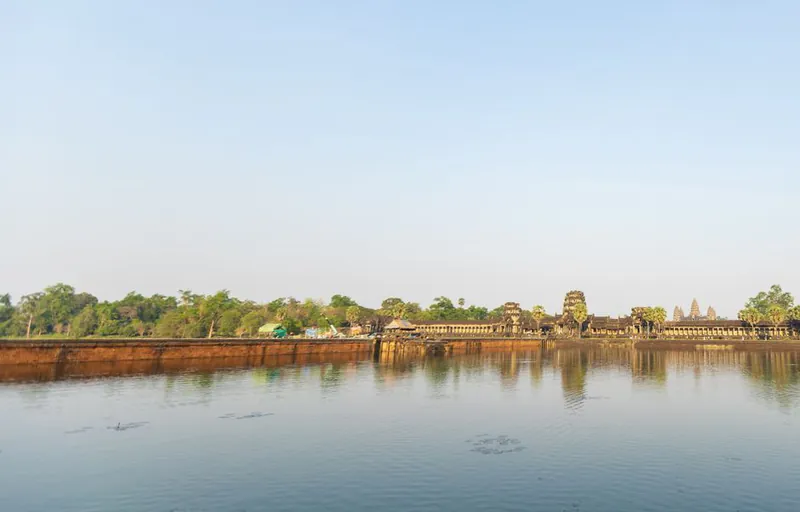
Siem Reap - the Angkor Wat gateway, 25-35% cheaper than the capital, with by far the best safety profile in the country on both daytime and nighttime measures, though healthcare drops to a single acceptable hospital before complex cases transfer to Phnom Penh or Bangkok.
Sihanoukville - the beach destination, but flagged consistently as the weakest safety profile among Cambodia's expat hubs, with limited hospital services that often require evacuation for anything beyond basic care.
First Moves After Landing
- Enter on an Ordinary E-class visa ($35) rather than a Tourist visa if you intend to convert to ER retirement status - the conversion cannot be done from outside the country[13]
- Prepare three months of clean, consistent USD bank statements before your conversion appointment - this documentation format is what immigration officers and agents actually rely on, given the absence of a codified minimum[13]
- Secure international health insurance with medical evacuation coverage of at least $25,000, ideally $100,000, before you need it - nearly every source treats this as non-negotiable given upfront-payment requirements at private hospitals[26]
- Identify Royal Phnom Penh Hospital or your nearest equivalent private facility immediately upon arrival, and treat public hospitals as a genuine last resort[30]
- Track your days against the 182-day tax residency threshold carefully if you're earning solely from foreign clients - staying under it can mean $0 Cambodian tax entirely[18]
- Exercise real caution walking alone after dark in Phnom Penh specifically - the daylight/nighttime safety gap here is among the sharpest documented in this guide series[31]
- If drawn to Sihanoukville for the beaches, weigh its comparatively weaker safety and healthcare profile against Siem Reap's considerably stronger showing on both fronts[33]
Key Data at a Glance
| Indicator | Value |
|---|---|
| GDP Growth 2026 (consensus range, wide) | 3.0%-4.9% (official government forecast: 4.1%)[1][8] |
| Inflation 2026 (AMRO) | 5.1% (revised up from 2.9%)[4] |
| GDP per Capita 2026 | ~$3,020[9] |
| ER Retirement Visa Age | 55+ (only codified legal requirement)[13] |
| ER Visa Income Requirement | None codified in law; informal expectation ~$800-1,500/month[13] |
| ER Visa Government Fee | $290-300/year ($400-600 all-in with agent fees)[13] |
| Top Personal Income Tax Rate | 20% (residents, worldwide income); 20% flat (non-residents, Cambodia-source only)[18] |
| Tax Residency Trigger | 182+ days in 12 months[19] |
| Phnom Penh Single-Person Budget | $900-1,400/month (comfortable)[22][23] |
| Siem Reap Single-Person Budget | $500-1,067/month (comfortable)[24][16] |
| International Health Insurance | $80-200/month (with evacuation)[27] |
| Air Evacuation Cost (Bangkok/Singapore) | $15,000-30,000+[26] |
| Only JCI-Accredited Hospital | Royal Phnom Penh Hospital[26] |
| Phnom Penh Nighttime Walking Safety | 36.9-38.9, Low[31] |
| Siem Reap Nighttime Walking Safety | 68.7, High (beats Bangkok)[35] |
| Sihanoukville Nighttime Walking Safety | 24.2, Low (weakest of the three hubs)[33] |
| Currency | US Dollar (de facto), Cambodian Riel (official) |
| Official Language | Khmer |
Cambodia's honest pitch for 2026 is the simplest long-stay visa system in Southeast Asia, built around an ER retirement classification with no legally required minimum income at all, a fully dollarized economy that removes currency risk entirely, and a cost of living cheap enough to rank among the most affordable in the world - set against a growth forecast that every major institution keeps quietly trimming month after month, and a Phnom Penh nightlife safety picture sharp enough that the smartest single decision many retirees make is choosing Siem Reap instead.
References
[1] Cambodia trims 2026 GDP growth forecast amid global, regional headwinds-Xinhua - Cambodia trims 2026 GDP growth forecast amid global, regional headwinds-
[3] Cambodia Investment Review/World Bank
[4] Cambodia GDP Forecast at 4.9% in 2026 and Inflation at 2.9%, 5.2% Growth by 2027 - AMRO April Outlook Pre-Iran Conflict, With Significant Downside Risks Emerging - Cambodia Investment Review - Cambodia Investment Review
[6] Cambodia's 2026 growth projection slows to 4.2 pct: report-Xinhua - Cambodia
[7] Cambodia’s Economy to Grow by 4.5% in 2026 Under an Early Middle East Stabilization Scenario | Asian Development Bank - Cambodia’s economy is projected to expand by 4.5% in 2026 if global commodity market disruptions are not prolonged by the conflict in the Middle East,...
[8] Fresh News on X: "The National Bank of Cambodia (NBC) projects the country's economy to grow 3.9 per cent in 2026, before accelerating to 5 per cent in 2027, despite global uncertainties and domestic economic challenges. Speaking at the central bank's meeting on Monday (Jul. 27), NBC Governor" / X - The National Bank of Cambodia (NBC) projects the country's economy to grow 3.9 per cent in 2026, before accelerating to 5 per cent in 2027, despi...
[10] AMRO 2026 Report
[11] Cambodia Retirement Visa: Requirements and Process | Emerhub - Thinking of retiring in Cambodia? Learn about the eligibility criteria and application process for a Cambodia retirement visa.
[12] ER Retirement Visa (E-class retirement sub-class) - Kingdom of Cambodia (2026 guide) · Visa Atlas - Indicative only. Fees apply for the E-class visa and each extension; refer to the official page for current amounts. · Indicative only. The E-class vi...
[13] Cambodia Retirement Visa: Reality Check 2026 - Retire in Cambodia on a $290/year ER visa. What most guides miss: political risk, healthcare gaps, and why foreigners can't own land. No agent fe...
[14] How to Get a Retirement Visa in Cambodia (2026 Guide) - Beach & Houses - Learn how to get a Cambodia retirement visa, eligibility requirements, costs, and step-by-step process to enjoy long-term living in Cambodia.
[15] Cambodia Visa and Residence: Everything US Citizens Need to Know - Cambodia offers flexible visa extensions for expats, including the ER Visa for retirees. Learn how to live long-term in Cambodia with ease.
[16] Moving to Cambodia 2026: $600-$1,200/mo, Easy Visa, USD Economy | WhereNext - Phnom Penh $600-$1,200/mo. Easiest long-stay visa in SE Asia. US dollar economy - no currency risk. Siem Reap vs Phnom Penh vs Sihanoukville compared.
[17] Cambodia: 25 Immigration Routes & Visa Pathways - whereTOemigrate - Every published immigration route to Cambodia: 25 pathways across 12 categories, 24 citing an official government source. Free verdict; full report.
[18] Cambodia Tax Calculator 2026: Resident vs Non-Resident Tax Rates Explained - Cambodia: Residents (182+ days) taxed on worldwide income at 0-20% progressive rates with foreign tax credit relief. Non-residents pay flat 20% on Cam...
[19] Cambodia Tax Guide 2026 | Residency Rules & 0-20% Progressive Tax - Cambodia taxes residents (182+ days present in a 12-month period) on worldwide income at progressive 0-20% monthly rates, with a foreign tax credit fo...
[20] Phnom Penh vs Siem Reap Cost of Living 2026: Where Should You Retire? – EarlyRetireAbroad.com
[21] Phnom Penh vs Siem Reap for Expats (2026) - Capital vs Temple Town - Phnom Penh ($800-$1,400/mo) vs Siem Reap ($500-$800/mo) - compare rent, cost of living, internet & lifestyle. See which city is better for expats.
[22] Cost of Living in Cambodia (2026): Full Expat & Travel Guide – Megaport Blog
[23] Expat Living in Cambodia 2026: Complete Guide to Cost, Visas, Healthcare & Lifestyle - Phnom Penh Now - Are you considering moving to Cambodia as an expat in 2026? Whether you're seeking retirement abroad, pursuing employment opportunities, or embra...
[24] Cost of Living in Siem Reap in Aug 2026 - The Cost of Living in Siem Reap is low. A single person costs: $1,057 per month. A family costs: $1,572 per month. A single traveler costs: $1,356 per...
[25] Cost of Living in Phnom Penh 2026: Rent, Budget & Prices - Phnom Penh costs $800-$1,400/month for a single expat. Rent from $400-$700. Groceries $100-$200. Full breakdown of real expat expenses in 2026.
[26] Best Hospitals in Cambodia for Expats (2026 Guide) - Compare the best hospitals and clinics for expats in Cambodia, from JCI-accredited facilities in Phnom Penh to Siem Reap, plus insurance and evacuatio...
[27] Cambodia Healthcare 2026: $80-$200/mo Insurance & Hospitals - How healthcare works in Cambodia for expats. Private insurance from $80-$200/mo. Public vs private costs, best hospitals & emergency care. Updated 202...
[28] Royal Phnom Penh Hospital - phnom-penh Expat Services | Cambodia Authority Hub - Cambodia's premier private hospital with international-standard care, expat doctors, and 24/7 emergency department.
[29] Healthcare in Cambodia 2026 - Expat Medical Guide | Cambodia Authority Hub - Healthcare in Cambodia for expats and travelers. Hospitals, clinics, insurance, medical costs, pharmacies, and emergency services listed by city.
[30] Phnom Penh Healthcare for Expats: Insurance, Public vs Private, Real Costs 2026 - ReloMap Blog - Phnom Penh Healthcare for Expats: Insurance, Public vs Private, Real Costs 2026
[31] Numbeo Phnom Penh
[33] Numbeo Sihanoukville vs Siem Reap
[34] Numbeo PP vs HCMC
[35] Numbeo Bangkok vs Siem Reap
Frequently Asked Questions
What are the primary visa and residence options for moving to Cambodia in 2026? Cambodia offers several residence routes for foreigners, including skilled worker permits, business or investor programs, and digital nomad permits.
How does personal income tax work for expats in Cambodia? Residents are taxed on worldwide income at the progressive 0-20% rates above, with a foreign tax credit available for tax already paid abroad.
What is the average cost of rent and living in Cambodia? Street food runs $1-3 per meal, and a budget lifestyle "living like a local" is achievable at $400-600/month in rural areas.
How many years of residence are required for citizenship or permanent residency in Cambodia? Foreign residents generally become eligible to apply for permanent residency or citizenship after 3 to 8 years of continuous legal residence and passing integration benchmarks.
Cover photo by Serg Alesenko on Pexels.
Want to see how Cambodia stacks up?
Are you seriously considering a move? Use our interactive tools to explore Cambodia's climate, tax brackets, and nomad visas.