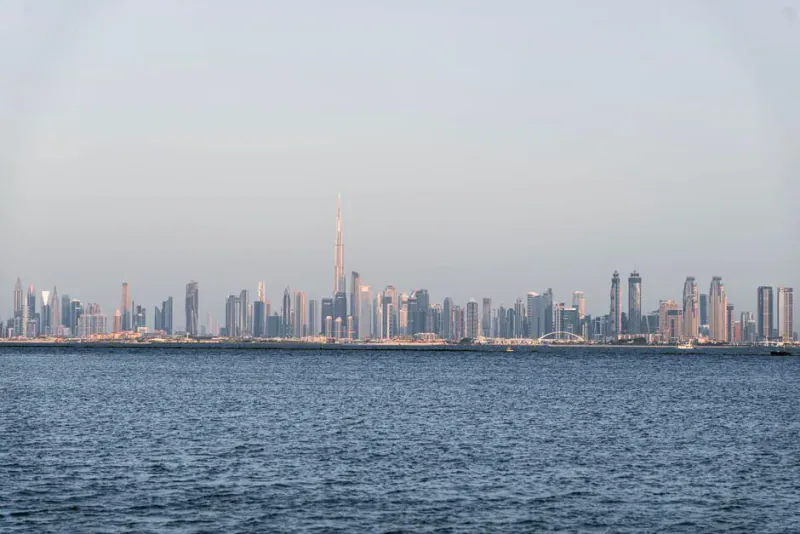
UAE in 2026: Zero Personal Tax, the World's Safest Cities, and a Citizenship That Virtually Nobody Gets
June 13, 2026
ShareAbu Dhabi has been ranked the world's safest city for the 10th consecutive year, with a Crime Index of 11.1 and a Safety Index of 88.9 out of 400 global cities surveyed by Crowdsourced Data in 2026. Dubai ranked 6th globally with a Safety Index of 83.9. Ras Al Khaimah, Ajman, and Sharjah ranked 2nd, 3rd, and 4th. Five UAE cities in the global top 10 - no other country comes close.[1][2][3]
Against that backdrop: zero personal income tax, IMF-forecast GDP growth of 5% in 2026, a new 5-year self-sponsored Green Visa, and a 10-year Golden Visa with routes accessible to senior professionals, property investors, and top graduates. The UAE is the fastest-growing major expat destination in the Middle East - over 88% of its population is expatriate, making it arguably the most international country on Earth.[4][5]
What the promotional brochures omit: citizenship is effectively reserved for a small set of exceptional individuals by Presidential nomination - it is not an open programme. The summer heat from June to September is genuinely extreme - outdoors temperatures above 45°C are routine in July and August. And the legal and cultural framework is fundamentally different from Europe or North America - a set of rules that require understanding before, not after, you arrive.[6][7][8]
The Economy: 5% Growth, Oil Plus a Diversification Story That Is Actually Working
The UAE's economy is doing what many petrostates attempted and most failed: real, sustained diversification beyond hydrocarbons.
| Institution | 2025 GDP Forecast | 2026 GDP Forecast |
|---|---|---|
| IMF (October 2025) | 4.8%[9] | 5.0%[5] |
| World Bank | 4.6%[10] | 4.9%[11] |
| Central Bank of UAE | 5%+ | 5%+[11] |
Non-oil GDP is growing at the same pace or faster than the headline number - driven by tourism (Dubai International Airport: world's busiest by international passengers), financial services (DIFC, ADGM), technology and AI (G42, Microsoft's largest non-US data centre is in Abu Dhabi), logistics (DP World: largest port operator globally by volume), real estate, and healthcare.[11][12]
UAE population in 2026: approximately 10.5 million total, with roughly 88-89% expatriate - the highest ratio of any country in the world. The labour force is almost entirely immigrant. The economy is structurally dependent on attracting and retaining international talent, which is why the visa reform agenda of the past five years (Green Visa, expanded Golden Visa, remote work visa) is not cosmetic - it is economic policy.[4]
Sectors actively hiring internationally in 2026:
- Technology and AI: Microsoft, Google, Amazon AWS, Oracle, and G42 all have major UAE presences; demand for cloud architects, AI engineers, data scientists, and product managers is intense
- Finance: DIFC (Dubai International Financial Centre) and ADGM (Abu Dhabi Global Market) host over 6,500 registered entities; banking, private equity, asset management, fintech[13]
- Energy and renewables: ADNOC (Abu Dhabi National Oil Company), plus Masdar (the world's largest clean energy developer); petroleum engineers, renewable energy specialists, sustainability professionals
- Healthcare: SEHA, Cleveland Clinic Abu Dhabi, Johns Hopkins Aramco Healthcare; nurses, doctors, specialists are in sustained demand
- Tourism and hospitality: Expo City Dubai's legacy infrastructure, new mega-hotel developments, NEOM-related tourism projects
- Construction and engineering: Multiple Gigaprojects across UAE, Saudi Arabia (many managed from Dubai), and regional infrastructure
Visas and Residency: Three Tiers, Each With Its Own Logic
The UAE has moved decisively away from pure employer sponsorship toward self-sponsored and long-term residence options. Three main tracks matter for professional expats in 2026.
Standard Employment Visa (Work Permit)
The traditional route for employees of UAE-based companies or free zone entities. Your employer sponsors you; they handle the bulk of the administrative process.
- Employer obtains work permit through Ministry of Human Resources and Emiratisation (MOHRE) - or the relevant free zone authority if applicable
- Entry permit issued (single-entry visa to enter UAE and begin residency process)
- Medical fitness test in UAE (blood test for HIV, TB, Hepatitis B/C) - standard requirement for all residence visas
- Emirates ID application - biometrics at GDRFA (General Directorate of Residency and Foreigners Affairs) or approved typing centre
- Residence visa stamped in passport
- Process: approximately 2-4 weeks after arrival if employer is organised
- Cost: typically borne by the employer; total government fees: approximately AED 3,000-5,000
Residence visa is issued for 2 or 3 years (depending on contract), renewable while employed. If you leave your employer, you have a grace period of 30-60 days to either find new employment, switch to another visa type, or depart.
Document attestation: Degree certificates and marriage certificates must be attested in your home country (notarised → attested by foreign affairs ministry → attested by UAE embassy) before they are accepted for visa applications and family sponsorship. This takes weeks - start the process before you arrive.
Green Visa (5-Year, Self-Sponsored)
Launched 2022, expanded and tightened in 2025-2026. The defining feature: no employer sponsor required. If you qualify, you hold residency independently of any specific employer - and you can sponsor your own family.
Three qualifying categories:[15][16]
1. Skilled Employee (Green Visa)
- Valid employment contract with UAE-based mainland or free zone company
- Classified in MOHRE skill Level 1, 2, or 3 (managers, professionals, technicians)
- Minimum bachelor's degree
- Minimum salary: AED 15,000/month (~€3,700/month)[16]
- Duration: 5 years, self-renewing
2. Freelancer / Self-Employed (Green Visa)
- MOHRE freelance work permit required (obtained separately before applying)
- Minimum education: bachelor's degree or specialised diploma
- Annual income from self-employment: AED 360,000 (AED 30,000/month) for the previous 2 years, OR proof of financial solvency throughout residency period[17]
- Eligible activity categories: professional services - IT, media, design, consulting, education, healthcare - not trading or physical goods businesses[18]
- 2026 tightening: Dubai GDRFA has introduced significantly more rigorous documentation requirements for freelance Green Visa renewals - detailed client contracts, invoices, work portfolios, and evidence of genuine activity in your declared professional field. Legitimate professionals are unaffected in eligibility; documentation burden has increased substantially[18]
- Duration: 5 years self-renewing
3. Investor / Business Partner (Green Visa)
- Established or participates in commercial activity in UAE
- Minimum investment: AED 750,000 in a UAE-licensed business or commercial project[16]
- Duration: 5 years
Fees for Green Visa (approximate):[18]
- MOHRE freelance permit: AED 7,500-22,000 depending on emirate and category
- Abu Dhabi (TAMM) pathway: AED 1,200-1,500 (significantly cheaper than Dubai)
- ICP processing fees: approximately AED 200-500
Golden Visa (10-Year, Self-Sponsored)
The premium long-term residence option - no renewal every 2-5 years, no sponsor requirement, full family inclusion (spouse, children of any age, parents, unlimited domestic staff).
Full 2026 qualifying routes:[19][20][13]
| Route | Requirement | Duration |
|---|---|---|
| Real estate investor | AED 2,000,000+ in property (can be mortgaged - equity portion ≥AED 2M; multiple properties combined count) | 10 years |
| Financial deposit | AED 2,000,000+ in UAE accredited bank (deposit must stay) | 10 years |
| Business equity | AED 2,000,000+ in UAE-licensed company | 10 years |
| Entrepreneur | AED 500,000+ project, Ministry of Economy / free zone approval; prior exit counts | 10 years |
| Specialised talent - Executive Director | AED 50,000+/month salary, attested degree, 5 years' relevant experience | 10 years |
| Specialised talent - Scientist / Doctor / Engineer | Relevant professional body recommendation, 10+ years' practice, accredited contributions | 10 years |
| Specialised talent - AI / technology / creative | G42, TDRA, Ministry of Culture nomination | 10 years |
| Top global university graduate | Graduated from a top-100 ranked university within last 2 years, GPA ≥ 3.8 | 10 years |
| Top UAE high school student | UAE Ministry of Education ranking, ≥95% average | 5 years |
| Humanitarian pioneer | Documented humanitarian work, AED 2M+ contributions, or 500+ volunteer hours | 10 years |
The real estate route is the most commonly used by independent expats: purchase AED 2M+ in completed or off-plan property in a designated freehold zone. Mortgage is permitted - provided your paid equity (not financed amount) reaches AED 2M. Applying from abroad: you receive a 6-month entry permit to arrive, purchase property, and convert to full residency.[21]
The Executive Director route effectively extends the Golden Visa to senior corporate expats at AED 50,000+/month - a threshold reached by senior VP and C-suite roles in multinationals, banks, and energy companies operating in the UAE.[20][13]
Fees for Golden Visa (approximate): AED 2,000-4,000 in government fees plus typing, medical, and Emirates ID fees. Total out-of-pocket: typically AED 5,000-8,000 for primary applicant.[19]
Citizenship: Understand It Correctly Before You Build Any Plan Around It
UAE citizenship (Emirati nationality) is not available through a standard naturalisation programme. It is granted by Presidential or Ruler-level decree to a nominated category of individuals.[22][7]
The categories eligible for nomination:[23][22]
- Investors (must own UAE property)
- Doctors and specialists in scientific fields of high demand - minimum 10 years of practice, acknowledged scientific contributions, active membership in a reputable professional organisation
- Scientists and researchers - with recommendation from UAE Council for Scientists
- Inventors - Ministry of Economy recommendation
- Intellectual, artistic, and cultural figures - Ministry of Culture approval
- Exceptional athletes
Standard naturalisation for long-term residents: Technically available for non-Arab individuals after 30 years of lawful residence (7 years for Arab nationals from specific countries). Arabic language proficiency, clean record, stable income, and renunciation of original nationality are required. In practice, this route is rarely exercised - the government issues very few passports through this mechanism per year.[24][23]
The operational reality: UAE citizenship is not an accessible goal for most expats regardless of how long they stay. Build your residency strategy around the Green Visa (5 years) and Golden Visa (10 years) - both offer genuine long-term stability without citizenship. The Golden Visa is the de facto permanent residency substitute, and for most professional expats, it delivers everything practically needed from a long-term residency perspective.[7]
Dual nationality: UAE law technically requires renunciation of prior nationality upon acquiring Emirati citizenship. In practice, this applies only to the very small number of people to whom citizenship is actually granted.
Cost of Living: Tax Savings vs. Housing, School Fees, and the August Effect
The core calculation: save your home country's income tax (20-45% of salary depending on origin), spend some of it on higher housing costs, international school fees, and lifestyle costs in one of the world's most commerce-oriented cities. For most professional expats earning above AED 20,000/month, the financial equation is strongly positive.
Single professional monthly budget (comfortable lifestyle, Dubai):[25][26]
- AED 12,000-18,000/month total (includes rent)
- Housing consuming 30-40% of the total
Family of four monthly budget (Dubai):[25]
- AED 35,000-45,000/month including rent and school fees
- School fees are the most variable factor - they can add AED 5,000-10,000/month per child
Rent by City and Area (2026, Annual)
Dubai - Annual Rents by Area:[27][26]
| Area | Studio (AED/yr) | 1-BR (AED/yr) | 2-BR (AED/yr) | 3-BR (AED/yr) |
|---|---|---|---|---|
| Downtown Dubai | 75,000-95,000 | 105,000-115,000 | 138,000-188,000 | 200,000-280,000 |
| Dubai Marina | 65,000-85,000 | 90,000-120,000 | 140,000-180,000 | 180,000-250,000 |
| Business Bay | 45,000-70,000 | 70,000-110,000 | 110,000-160,000 | 160,000-220,000 |
| JVC (Jumeirah Village Circle) | 35,000-45,000 | 55,000-67,000 | 85,000-110,000 | 120,000-160,000 |
| Mirdif | 40,000-60,000 | 60,000-95,000 | 95,000-130,000 | 130,000-180,000 |
| International City | 25,000-35,000 | 38,000-55,000 | 55,000-80,000 | 75,000-100,000 |
Abu Dhabi - Annual Rents (approximately 30% cheaper than Dubai):[28]
| Type | Average Annual Rent (AED) |
|---|---|
| Studio (mainland) | 30,000-40,000 |
| 1-BR (mainland) | 55,000-70,000 |
| 1-BR (Al Reem Island / Saadiyat) | 86,000-105,000 |
| 2-BR (mainland) | 85,000-100,000 |
| 3-BR (mainland) | 120,000-140,000 |
1 AED ≈ €0.25 (as of June 2026). AED 91,000/year ≈ €22,750/year ≈ €1,895/month. AED is pegged 1:3.67 to USD - the peg is hard and permanent since 1997.[29]
Rental payment norms in Dubai: Most landlords require payment in 1-4 cheques for the full year upfront. Offering a single annual cheque typically gets a discount. Rent must be registered in Ejari (Dubai's rental contract registration portal) and in the equivalent ADDC/TAMM system in Abu Dhabi - required for visa renewal and school enrolment.[30]
Rent increases: RERA (Real Estate Regulatory Authority) regulates rent increases for existing tenancies through the RERA Rental Index. A landlord can only increase rent if the current rent is below the market benchmark by more than 10% - and even then, increases are capped at 5-20% depending on how far below the index you are paying. Check your current rent against the RERA calculator at dubailand.gov.ae before any renewal negotiation.
Daily Expenses (Dubai, 2026)
| Item | Price (AED) |
|---|---|
| Meal at inexpensive restaurant | AED 35-55 |
| Three-course meal for two (mid-range) | AED 250-400 |
| Coffee (cappuccino) | AED 18-28 |
| Domestic beer (bar, licensed venue) | AED 40-70 |
| Bottle of wine (licensed restaurant) | AED 200-350 |
| Fuel (per litre, petrol) | AED 2.80-3.10[25] |
| Monthly public transport (NOL card, RTA metro/bus/tram) | AED 350 cap |
| Taxi (app-based, 10 km) | AED 20-35 |
| Gym membership (mid-range) | AED 250-400/month |
| Weekly groceries (single person, supermarket) | AED 250-400 |
Taxes: The Real Picture in 2026
The headline is correct and unchanged: no personal income tax in the UAE. Salaries, dividends, capital gains on personal investments, rental income from personal property, and returns on savings - all zero. This is federal law, not a temporary arrangement.[31][29]
What the zero-tax claim covers
- Salaries and wages: 0% - regardless of amount[32][29]
- Dividends and personal investment income: 0%[29][31]
- Capital gains on shares, crypto, property sold from your personal portfolio: 0%[31]
- Rental income from your personal UAE property: 0%[31]
What is taxed
Corporate Tax (CT) - effective 1 June 2023:[33]
| Taxable Profit (AED/year) | Rate |
|---|---|
| Up to AED 375,000 | 0% |
| Above AED 375,000 | 9% |
If you operate a business - not employment - through a UAE entity (LLC or free zone company) with annual revenue above AED 1 million, corporate tax at 9% on profits above AED 375,000 applies.[29][31]
Small Business Relief (SBR) - until 31 December 2026:[34] Companies with total revenue below AED 3 million can elect Small Business Relief, which effectively removes corporate tax liability entirely for those years. This is a significant benefit for freelancers and small business owners who have structured through a UAE company.[34]
Free zone entities: Free zone companies continue to benefit from 0% corporate tax on qualifying income (income derived from transactions with other free zone entities or designated international activities). Income from UAE mainland transactions is subject to 9% CT. Qualifying Income status requires meeting Substance Requirements - physical presence, qualified employees, and genuine business activities in the free zone.[34]
VAT: 5% - one of the world's lowest VAT rates, applied since 2018.[33][31]
- Registration mandatory if taxable supplies exceed AED 375,000/year
- Basic food items, healthcare, education: zero-rated or exempt
- Retail and services: 5%
Excise tax: 100% on tobacco products and energy drinks; 50% on carbonated soft drinks.[33]
Withholding tax: 0% on dividends, interest, and royalties - meaning UAE entities can remit income to owners in any country with no UAE withholding.[32][33]
Your home country tax obligations: Zero UAE tax does not automatically mean zero tax everywhere. Check your home country's tax residency rules before relocating. Most countries (UK, Germany, Australia, Canada) require you to formally establish non-residency in your home country, which involves meeting specific days-out-of-country thresholds and severing specific ties. Some countries (USA, Eritrea) tax citizens on worldwide income regardless of residency - Americans living in the UAE still file US returns (though the Foreign Earned Income Exclusion covers approximately USD 126,500/year for 2026). Get professional advice from a tax adviser experienced in your home country + UAE combination before you move.
Healthcare: Mandatory Insurance, Two Systems, One Premium Standard
UAE healthcare operates through a mandatory private insurance model with government regulation. Two separate regulatory authorities operate in parallel:[35][36]
| Authority | Coverage |
|---|---|
| DHA (Dubai Health Authority) | Dubai, plus Sharjah and Northern Emirates[35] |
| DOH (Department of Health Abu Dhabi, formerly HAAD) | Abu Dhabi, Al Ain[35] |
Health insurance is not optional - it is a legal requirement for residency visa issuance and renewal in both Dubai and Abu Dhabi. No insurance = no residency. Employers must provide coverage for employees; you must separately insure dependents (spouse, children).[37][36]
Premium hike confirmed for 2026: Across all emirates, health insurance premiums increased 11.5% in 2026 compared to 2025. Budget accordingly - costs below are pre-hike starting levels.[38]
Health Insurance Costs (Dubai, 2026)
| Plan Type | Annual Cost (AED) | Who |
|---|---|---|
| Basic MEC (Essential Benefits Package) | AED 600-800[35] | Low-wage workers |
| Essential individual | AED 1,500-3,500[35] | Entry-level employees |
| Mid-range individual | AED 4,000-8,000[35] | Mid-career professionals |
| Comprehensive individual | AED 10,000-20,000[35] | Executives |
| Basic family (4 people) | AED 8,000-15,000[35] | Families |
| Premium family (4 people) | AED 25,000-50,000[35] | Full coverage families |
| International comprehensive | AED 40,000+[35] | Executive/global mobility |
Abu Dhabi's minimum mandatory coverage is substantially higher than Dubai's - the Daman network (Abu Dhabi's dominant insurer) requires more comprehensive benefits packages from the baseline. Abu Dhabi standard plans: AED 3,000-7,000/year for individuals.[38]
Quality of Care
UAE private hospitals - Cleveland Clinic Abu Dhabi, American Hospital Dubai, King's College Hospital Dubai, Aster DM Healthcare - operate at Western European and North American clinical standards. Accreditation: most major hospitals hold JCI (Joint Commission International) accreditation. Physician training: largely international - American-trained, UK-trained, and European-trained doctors practice widely. Medical technology: among the most advanced in the region. Wait times for private insured patients: same-day to next-day for most consultations and diagnostics. This is one of the most cited quality-of-life advantages by professional expats from countries with public healthcare queues.[36]
Emergency: 998 (Ambulance) / 999 (Police) / 997 (Fire).[39]
Safety: Numbers That Speak for Themselves
Crowdsourced Data 2026 Crime Index - UAE Cities:[40][1]
| City | Crime Index | Safety Index | Global Rank |
|---|---|---|---|
| Abu Dhabi | 11.1 | 88.9 | #1 worldwide[1] |
| Ajman | 14.5 | 85.5 | #3 worldwide[3] |
| Sharjah | 15.6 | 84.4 | #4-5 worldwide[3] |
| Ras Al Khaimah | 16.2 | 83.8 | #2 worldwide[3] |
| Dubai | 16.1 | 83.9 | #6 worldwide[2] |
Safety walking alone in Dubai during daylight: 91.29% "Very High." At night: 83.29% "Very High." Abu Dhabi is even better - 91.85% daytime, 86.79% night.[41]
The safety performance is structural - the result of pervasive CCTV surveillance, a large and active police presence, extreme deterrent punishments for violent and property crime, and a social infrastructure in which most residents (being employed migrants with residence tied to employment) have strong incentives for law-abiding conduct. Zero tolerance for drug offences: possession of any quantity of any illegal drug carries a minimum 4-year sentence and near-certain deportation. This includes substances legal in the country you arrived from.
Legal and Cultural Framework: What You Must Know Before You Arrive
The UAE is not a liberal democracy, and its legal system is not the European or North American framework. Professional expats who thrive here understand the rules clearly and operate within them effectively. The majority of the rules are consistent with how most professionals live anyway - but the exceptions carry serious consequences.
Laws Expats Are Most Frequently Unaware Of
- Public display of affection (kissing, embracing) beyond brief contact: illegal and enforced; fine or deportation
- Swearing in public or online (including social media posts, WhatsApp groups): criminal offence under Cybercrime Law - fine of AED 250,000 and/or 6 months imprisonment
- Any critical social media post about the UAE, its rulers, government policies, or UAE businesses: criminal offence under the cybercrime law
- Photography of government buildings, military sites, ports, and people without consent: prohibited
Alcohol:
- Legal for non-Muslims in licensed venues (restaurants, hotels, bars, licensed retail liquor stores)
- Dubai: purchase from licensed retailers (MMI, African+Eastern outlets); Abu Dhabi: similar
- Public intoxication: illegal and regularly enforced
- Drink driving: zero tolerance - 0.0% blood alcohol limit - criminal offence
- Importing alcohol into Abu Dhabi by road from Dubai: technically requires a licence; in practice, enforcement is inconsistent but the risk exists
Drugs (zero tolerance):
- All illegal drugs: zero tolerance. Even trace amounts (residue in clothing, bag, or bloodstream from consumption abroad) have resulted in prosecution and detention. This is not theoretical - it is enforced.
- CBD products legal in many countries: illegal in UAE unless specifically licensed and below 0.0% THC threshold. Do not bring any CBD product.
- Certain prescription medications common in Europe and North America (some antidepressants, codeine-based pain relievers, Tramadol) are controlled substances in UAE - carry original prescription, check the MOH controlled substances list before packing your medicine cabinet
Finances:
- Bounced cheques: historically criminal offence; legal reforms in 2022 partly decriminalised small cheques, but commercial bounced cheques remain a criminal matter in some circumstances. Never write a cheque you cannot honour.
Ramadan (2026 dates: approximately mid-February to mid-March)[43][42]
During Ramadan (the Islamic month of fasting, dates shift by ~11 days each year):
- Eating, drinking, or smoking in public between sunrise and sunset: illegal. Fine: AED 2,000 or up to 1 month imprisonment. Applies to everyone including non-Muslims, inside your car, in shopping malls, on the street.[42]
- Exceptions: private residences, hotel rooms, private office cabins
- Most restaurants remain open during daylight hours with screens/barriers or serve takeaway
- Working hours legally reduced to 6 hours/day maximum for all employees regardless of religion[6]
- Dress code: more conservative than normal - cover knees and shoulders in all public spaces throughout Ramadan[43]
- Alcohol: licensed venues remain open for non-Muslims but restrictions may apply to outdoor service
- Traffic before Iftar (sunset) is extremely heavy - leave extra time or avoid driving in the 90 minutes before sunset
Labour Law Key Points
- Employment contracts in UAE must be registered with MOHRE or the relevant free zone authority
- Standard notice period: as per contract, minimum 30 days, typically 30-90 days
- End-of-service gratuity (EOSB): employees with over 1 year of service are entitled to 21 days' basic salary per year for the first 5 years, 30 days per year thereafter - a legally mandated severance structure
- Non-compete clauses: legally valid in UAE but limited to 2 years in duration and must be geographically and sector-specific to be enforceable
- From 2022: MOHRE introduced new work permit categories eliminating the requirement to cancel your current permit before applying for a new one - job mobility improved significantly
Which Emirate?
Dubai
The de facto capital of the expat world. 3.6 million people; 200+ nationalities; 12 months of genuine outdoor beach weather (excluding the June-September extreme heat). Dubai is: the DIFC (financial centre on par with London and Singapore for Middle East deal flow), the DMCC (world's largest diamond and commodities trading hub), Dubai Internet City, Dubai Media City, Dubai Healthcare City - purpose-built free zones that concentrate entire industries in walkable districts. The entertainment and food scene is genuinely world-class and improving rapidly - more Michelin stars added in 2025, an opera house, a functioning live music scene, and a nightlife infrastructure that is among the most energetic in the region.
Best Dubai neighbourhoods for professional expats:
- Downtown Dubai / Business Bay - corporate hub, walkable, metro-connected, Burj Khalifa access; premium pricing
- Dubai Marina / JBR - waterfront, residential community feel, beach access, metro and tram; established expat favourite
- DIFC / Sheikh Zayed Road - for finance sector workers; office proximity; good restaurants; residential mostly in high-rises
- Jumeirah Village Circle (JVC) - best value: AED 55,000-67,000/year for a 1-BR; good community amenities, car-dependent; popular with young professionals[44]
- Palm Jumeirah - premium waterfront villas and apartments; best for families with housing budget; average annual rent AED 153,000[27]
- Mirdif / Arabian Ranches - villa communities, families, international schools nearby; quieter; requires a car
Abu Dhabi
The capital: federal government, oil sector, defence, diplomacy, and the UAE's cultural institutions (Louvre Abu Dhabi, Zayed National Museum, Yas Island). Rents approximately 30% below Dubai. The slower pace, cleaner streets, and smaller scale appeal strongly to families. Abu Dhabi has the world's safest city status and a more traditional Emirati character. ADNOC, Masdar, ADGM, and the headquarters of every federal authority are here.[45][28]
Best areas: Al Reem Island (international community, modern apartments), Saadiyat Island (premium, near cultural institutions), Khalidiyah (traditional neighbourhood, more local character), Yas Island (newer development, family-friendly, near Ferrari World and Yas Marina Circuit).
Sharjah
Borders Dubai - a 20-40 minute commute to Dubai Business Bay by car (traffic-dependent). Rents: 40-55% cheaper than Dubai. Major consideration: alcohol is prohibited in Sharjah - no licensed venues, no purchase. This restriction defines the lifestyle profile; it works well for families from Muslim-majority backgrounds and professionals for whom alcohol access is not a priority. Large South Asian and Middle Eastern expat community.
Ras Al Khaimah (RAK)
The fastest-growing emirate in 2025-2026. New casino development (Wynn Al Marjan Island - the UAE's first licensed casino, opening 2027) is driving massive hospitality, construction, and gaming industry investment. Property prices: 50-65% below Dubai. Commute to Dubai: 45-75 minutes by car. RAK airport has direct flights to multiple European cities. Growing digital nomad and entrepreneurial community, attracted by the RAK Digital Assets Oasis (RAKDAO) free zone, which specialises in crypto and Web3 licensing.
Ajman and Fujairah
The most affordable and quietest northern emirates. Ajman borders Sharjah and Dubai; 1-BR apartments from AED 18,000-25,000/year. Primarily residential with a strong community of professionals who commute to Dubai or Sharjah. Fujairah is on the Gulf of Oman coast (east-facing rather than west) - significantly different culture, dramatic Hajar Mountains, quieter lifestyle. Both have negligible international job markets; viable only as lower-cost residential bases with Dubai or Sharjah employment.
Emirate Comparison
| Emirate | 1-BR Rent (AED/yr) | Alcohol | Key Sector | Safety Index | Best For |
|---|---|---|---|---|---|
| Dubai | 91,000[28] | Licensed venues | Finance/Tech/All | 83.9[2] | Career expats, all sectors |
| Abu Dhabi | 55,000-86,000[28] | Licensed venues | Oil/Govt/Culture | 88.9[41] | Families, energy, safety |
| Sharjah | ~35,000-45,000 | None | Education/Industry | 84.4[3] | Affordable, Muslim families |
| Ras Al Khaimah | ~25,000-38,000 | Licensed venues | Tourism/Hospitality | 83.8[3] | Value, new opportunities |
| Ajman | ~18,000-28,000 | None | - | 85.5[3] | Cheapest base, Dubai commute |
Climate: 6 Excellent Months, 6 Challenging Ones
The UAE sits between 22° and 26° north latitude - subtropical desert climate. The year divides sharply into two seasons.
| Period | Months | Temperature (Dubai) | Condition |
|---|---|---|---|
| Cool / Perfect | Nov - Apr | 18-30°C | Low humidity; outdoor life fully functional |
| Hot / Extreme | May - Oct | 35-48°C | High humidity (coastal); dangerous for outdoor exertion |
June-September is the expat reality check. July daytime highs in Dubai average 43-45°C, with overnight lows rarely below 35°C and humidity that makes apparent temperature feel higher. Outdoor activity during the day is essentially impossible. Everything functions indoors - offices, malls, restaurants, fitness centres, cinemas. Beach clubs with cooling systems operate at night. Outdoor pools become warm bathtubs by July.
The practical adaptation: start outdoor runs and activities at 5 am before sunrise (6 am+) or after 9 pm. Install a top-quality AC system in your apartment - the stock unit in many rental properties is undersized. Electricity bills (DEWA in Dubai, ADDC in Abu Dhabi): AED 800-2,500/month in summer, dropping to AED 200-600 in winter. Budget monthly average of approximately AED 900-1,200 for a 1-BR apartment.[25]
The summer opportunity for families: Most international schools run July-August holidays; many expat families travel abroad during this period. Summer in the UAE is when the malls are quietest, restaurant waitlists disappear, and the city operates at reduced pace. Some residents find it genuinely manageable; others leave every summer. Plan your first summer consciously rather than reactively.
October-April: Genuinely exceptional. Average temperatures of 22-28°C, low humidity, consistent sunshine, dry desert air. Beach, cycling, running, desert camping, hiking the Hajar Mountains - all accessible and pleasant. These months explain why people from northern Europe move here and never want to leave.
International Schools: The Budget Item That Surprises Every Family
Dubai has over 200 international schools serving approximately 300,000 students - one of the densest concentrations of international schooling in the world. The quality is high; the fees are significant.[46]
Dubai Annual School Fees by Tier (2025-26)[47][48]
| Tier | Fee Range (AED/year) | Examples |
|---|---|---|
| Premium | AED 75,000 - 110,000 (~€18,750-27,500) | Dubai College, Repton, Brighton, GEMS Wellington |
| Upper-mid | AED 50,000 - 75,000 (~€12,500-18,750) | Kings' Al Barsha, JESS, Dubai British School |
| Mid | AED 30,000 - 50,000 (~€7,500-12,500) | Hartland, Dubai Heights Academy |
| Value / Indian curriculum | AED 14,000 - 35,000 (~€3,500-8,750) | GEMS Founders, CBSE/ICSE schools |
Budget: AED 60,000-85,000/year per child for a quality British, American, or IB school in mid to upper tier. Add AED 10,000-20,000 for bus transport (typically not included), registration fees, uniforms, and mandatory extras.[49][47]
For a family with two school-age children at a quality mid-tier school: AED 140,000-180,000/year in school fees alone (~€35,000-45,000). This is the single most significant variable in UAE family budgets and the number that most commonly surprises relocating families.
Registration and waitlists: Top-tier schools have waitlists of 6-18 months for popular year groups. Start the school application process before your housing search, not after. The KHDA (Knowledge and Human Development Authority) rating system - Outstanding, Good, Acceptable, Improvement Required - is the reliable independent school quality metric.[46]
Buying Property
Any foreigner, of any nationality, can purchase property in the UAE without any residency requirement - in designated freehold zones. You do not need a visa to buy. This is a fundamentally more open system than New Zealand, Denmark, and many other countries.[50][51]
Freehold zones (Dubai): 60+ designated areas including Downtown Dubai, Dubai Marina, Palm Jumeirah, Business Bay, JVC, DAMAC Hills, Dubai Hills Estate, MBR City, Dubai Creek Harbour. Outside these zones, foreigners can only lease on 99-year leasehold.[52]
Freehold zones (Abu Dhabi): Yas Island, Saadiyat Island, Al Reem Island, Al Maryah Island, Masdar City.[51]
Expanding options: Ras Al Khaimah, Ajman, and Sharjah have all opened freehold zones for foreign ownership - offering significantly lower entry prices.[51]
Visa linked to property purchase: Purchasing AED 750,000+ in property qualifies for a 2-year investor residence visa. AED 2,000,000+ qualifies for the 10-year Golden Visa (property route - equity portion ≥AED 2M).[50]
Transaction costs (buyer, Dubai):[50]
- Dubai Land Department (DLD) transfer fee: 4% of purchase price - the largest single buyer cost; on a AED 2M property, this is AED 80,000
- Agency commission: 2% (typically paid by buyer in Dubai)
- DLD administration: AED 4,200-5,250 fixed
- Mortgage registration fee (if applicable): 0.25% of loan value + AED 290
- Total buyer costs in Dubai: approximately 6-8% of purchase price[50]
Abu Dhabi transaction costs: approximately 4-6% (lower DLD equivalent fees).[50]
No property capital gains tax, no annual property wealth tax. There is an annual municipal fee - approximately 5% of annual rental value in Dubai - charged on utility bills rather than as a separate tax. On a AED 91,000/year rental value apartment, the fee is approximately AED 4,550/year.[31]
Your First 30 Days: The Checklist
- Complete medical fitness test within the first week - required for all residence visas; test at MOHRE-approved clinic (Aster, Belhoul, Pro Diagnostics, etc.); includes blood tests for HIV, TB, Hepatitis B/C; results in 24-48 hours; your PRO (Public Relations Officer - the person at your company managing visa admin) or employer will advise you which clinic[4]
- Apply for Emirates ID - submitted through typing centre after medical fitness test; biometrics at GDRFA or designated centres; card arrives in 5-10 business days; this is your primary UAE identity document, required for banking, SIM cards, insurance, school enrolment, and almost everything administrative[4]
- Get your UAE driving licence converted - most Western driving licences convert directly (UK, US, German, French, Australian, Canadian, etc.) with zero test; bring home licence, passport, Emirates ID, visa page, and eye test; process takes 1-2 hours at RTA (Dubai) or ADTA (Abu Dhabi); car is essential in most UAE areas except the metro-served parts of Dubai[14]
- Open a bank account - Emirates NBD, FAB (First Abu Dhabi Bank), ADCB, HSBC UAE, Mashreq; bring Emirates ID, passport, residence visa, and employment contract/offer letter; accounts opened same day; request a multi-currency account if you have income or liabilities in foreign currencies
- Register health insurance with your employer's plan and separately insure dependents - confirm your insurance card activation date; enrol dependents (spouse, children) within the first month; failure to insure dependents before residency visa application means their visas are delayed[37]
- Register your tenancy in Ejari (Dubai) or TAMM (Abu Dhabi) - the rental contract registration portal; registration is mandatory; required for school enrolment, utility connection, and visa renewal; your agent typically handles this but confirm it is done; cost: approximately AED 220[30]
- Apply for utilities connection (DEWA Dubai / ADDC Abu Dhabi) - apply online with your Ejari registration; security deposit: approximately AED 2,000 for apartments, AED 4,000 for villas; electricity and water start the same or next business day[26]
- Get a UAE SIM card - Etisalat (e&) or Du are the two main operators; bring Emirates ID; postpaid plans from AED 150-300/month; data is fast (5G broadly available in Dubai and Abu Dhabi) and reliable; buy a local SIM before relying on international roaming
- Attest your degree and marriage certificate if not already done - attestation in your home country: original → notary → Ministry of Foreign Affairs → UAE embassy; then UAE Ministry of Foreign Affairs and MOFAIC attestation in UAE; essential for family visa sponsorship, school enrolment, and some employment categories; the full process takes 3-6 weeks if done after arrival[14][4]
- Understand the Ramadan calendar and legal framework immediately - know the dates of Ramadan (approximately mid-February to mid-March in 2026, shifting each year), the public eating/drinking laws during daylight fasting hours, the cybercrime and public behaviour law, and the zero-tolerance drug policy; these are the four areas where expats most commonly get into serious difficulty, and all four are entirely avoidable with awareness[6][42]
Key Data at a Glance
| Indicator | Value |
|---|---|
| GDP Growth 2025 (IMF) | 4.8%[9] |
| GDP Forecast 2026 (IMF) | 5.0%[5] |
| GDP Forecast 2026 (World Bank) | 4.9%[11] |
| Personal Income Tax | 0% - no personal income tax[29][31] |
| Corporate Tax (above AED 375,000) | 9%[33] |
| Small Business Relief (until Dec 2026) | 0% CT for revenue < AED 3M[34] |
| VAT | 5%[31] |
| Green Visa duration | 5 years, self-sponsored[15] |
| Green Visa - Skilled Employee min. salary | AED 15,000/month[16] |
| Green Visa - Freelancer min. income | AED 360,000/year (last 2 years)[17] |
| Golden Visa - Real estate min. equity | AED 2,000,000[19][20] |
| Golden Visa - Executive Director min. salary | AED 50,000/month[20] |
| Golden Visa duration | 10 years, self-renewing[19] |
| Citizenship availability | Presidential nomination only - effectively closed[7][23] |
| Dual nationality | Renunciation technically required if granted[23] |
| Abu Dhabi Safety Index 2026 | 88.9 - #1 globally (10th consecutive year)[1] |
| Dubai Safety Index 2026 | 83.9 - #6 globally[2] |
| Dubai 1-BR Annual Rent (mid-area) | AED 91,000[28] |
| Abu Dhabi 1-BR Annual Rent (mid-area) | AED 55,000-70,000[28] |
| Health insurance premium hike 2026 | +11.5% across all emirates[38] |
| Dubai basic health insurance (employee) | AED 600-800/year[35] |
| Dubai mid-range individual insurance | AED 4,000-8,000/year[35] |
| International school fees (mid-tier) | AED 55,000-85,000/year per child[47] |
| Dubai property DLD transfer fee | 4% of purchase price[50] |
| Total buyer transaction costs (Dubai) | 6-8%[50] |
| Abu Dhabi buyer transaction costs | 4-6%[50] |
| Capital gains tax on property | 0%[31] |
| Annual property tax | 0% (municipal fee ~5% of rental value on utility bill)[31] |
| Currency | AED (pegged to USD: 1 USD = 3.67 AED, since 1997) |
| Emergency Numbers | 998 (Ambulance) / 999 (Police) / 997 (Fire) |
The 10-year Golden Visa is the UAE's most underused tool for qualifying professionals. An Executive Director earning AED 50,000+/month is eligible by definition - no property investment, no business ownership required. Yet many senior expats remain on 3-year employer-sponsored visas, which creates unnecessary dependency on a single employer relationship. If you qualify on the salary criterion, file the Golden Visa application. The cost is a few thousand dirhams. The benefit - a decade of self-sponsored residence that survives any employer change - is worth significantly more.
References
Abu Dhabi ranked world's safest city 10th time in a row - In a striking show of national performance, five UAE cities featured in the global top 10.
Discover the World's Safest Cities in 2026 - Gulf News - Security and stability: UAE city named world's safest for 10th year in a row
[Four UAE emirates ranked among world's safest in Crowdsourced Data 2026 data](https://www.khaleejtimes.com/uae/four-emirates-ranked-worlds-safest-Crowdsourced Data-2026-data) - African and American cities have been listed at the bottom of the Crowdsourced Data's Safety Index covering 400...
Living in the UAE: What Expats Need to Know Before Relocating in 2026 - Wego Travel Blog - Moving to the UAE is more about sequence than luck - get the steps right and the rest follows. Here'...
IMF raises its forecast for UAE's GDP to 4.8% for 2025, 5% for 2026 - The International Monetary Fund (IMF) has raised its forecast for the UAE's real GDP to 4.8% for the...
Dubai Culture & Laws 2026 - What Expats Must Know | Move2Dubai - Dubai laws and cultural rules expats must know in 2026: alcohol, relationships, public behaviour, Ra...
How to get a UAE passport in 2026 - Knightsbridge Group - This article looks at how UAE citizenship works going into 2026, who it applies to and what the proc...
Moving to New Zealand from the US: Complete guide for 2026 - This guide covers visas, residency, cost of living, taxes, and daily life for Americans moving to Ne...
UAE economy to outpace global average this year, says IMF - Washington-based lender expects UAE's GDP to expand by 4.8% this year
IMF and World Bank see stronger UAE growth ahead in 2025 and ... - By Seade CAESAR Forecasts point to steady acceleration in real GDP as the UAE diversifies its econom...
UAE's GDP to surge stronger in 2026 on back of buoyant financial ... - Apex bank portrays a buoyant financial system and projected reassuring economic growth for the years...
UAE Economic Outlook 2026: Strong Growth Ahead - LinkedIn - 📊 UAE Economic Outlook 2026: Strong Growth Ahead 🇦🇪 The UAE is projected to continue its robust econ...
UAE Golden Visa 2026: Complete Updated Guide for All Nationalities - UAE Golden Visa 2026: who qualifies, requirements, costs, benefits, and how to apply. Complete updat...
Moving to the UAE: The Complete 2025 Guide to Living, Working, and Thriving - Thinking about moving to the UAE? Discover how to get a visa, find jobs, compare Dubai vs. Abu Dhabi...
Residence visa for doing business in the UAE - The Green visa is given to investors establishing or participating in commercial activities in the U...
What is UAE Green Visa (2025)? Who is eligible, how to apply - Middle East News: Discover the UAE Green Visa, a self-sponsored residence permit offering skilled wo...
Freelancers | Department of Economic Development - Freelancers
Dubai Tightens Green Visa Requirements for Freelancers - LinkedIn - Dubai's Regulatory Shift: Strengthening the Integrity of the Green Visa for Freelancers The UAE has ...
UAE Golden Visa 2026 - Eligibility, Routes & Renewal Guide - Complete guide to the UAE 10-year Golden Visa - investor, entrepreneur, talent and student routes, A...
Golden Residency | Federal Authority for Identity, Citizenship ... - Required Documents · A letter from a certified auditor proving that the project value is no less tha...
Long-Term Residency | Department of Economic Development - Successful Golden Visa applicants from abroad are initially given a six-month visa with which they c...
Emirati nationality | The Official Platform of the UAE ... - Executive Regulation of the Citizenship and Passports Law allows specific categories of foreigners, ...
UAE citizenship 2025 - naturalisation, marriage & descent ... - UAE citizenship 2025: naturalisation after residence, marriage, descent, and Presidential grants. El...
Cost of Living in UAE 2026 | Dubai, Abu Dhabi & All Emirates Guide - Complete Expat Guide. Single Professional (Dubai/AD): Needs AED 12,000-18,000 for a comfortable life...
Cost of Living in Dubai in 2026: Full Expense Guide - Subheadline: Complete breakdown of housing, utilities, transport, education, healthcare, and daily e...
Cost of Living in the UAE 2026: What Singles Need to Know - See the full breakdown of living expenses for a single person residing in the UAE, including rent, u...
Cost of Living in Dubai vs Abu Dhabi: Housing, Utilities & More - Bayut - Debating whether to live in Dubai or Abu Dhabi? Make an informed decision with our comparison of the...
United Arab Emirates - Individual - Taxes on personal income - There is currently no personal income tax in the United Arab Emirates. As such, there are no individ...
Living in Abu Dhabi as an Expat: Top Things You Will Need to Know - Complete guide to living in Abu Dhabi for expats. Housing costs, best neighbourhoods, salaries, scho...
Taxes in Dubai in 2026: types and rates "‹ - Dubái Gestión - March 13, 2026 | DubaiDubai remains in 2026 one of the most competitive tax environments in the worl...
UAE Tax Framework 2026: Corporate Tax 9% Threshold - LinkedIn - UAE Tax Framework - Executive Snapshot (2026) As part of the UAE's continued alignment with global b...
UAE Tax Framework Overview 2026: Corporate Tax, VAT ... - UAE Tax Framework - Overview 2026 The United Arab Emirates maintains a structured and business-frien...
Is Dubai Still Tax-Free in 2026? Business Tax Guide for Owners - Discover the truth about Dubai's tax system in 2026. Learn about corporate tax, VAT updates, free zo...
Health Insurance for Expats in the UAE 2026: Dubai and Abu Dhabi ... - Complete guide to mandatory health insurance in the UAE 2026 - DHA in Dubai, HAAD in Abu Dhabi, cost...
UAE Healthcare Guide (2026) - ExpatLife.Ai - The UAE has built one of the Middle East's finest healthcare systems, combining world-class private ...
UAE Health Insurance for Expats | Best Plans, Costs & 2026 Guide - Understanding UAE health insurance for expats is essential for residency. Compare plans, coverage ru...
Health Insurance for Expats in UAE 2026 - Daman v - The UAE's health-insurance market changed twice in two years. In January 2025, the Northern Emirates...
Healthcare in New Zealand for Expats 2026 - ExpatLife.Ai - New Zealand's public healthcare system provides free or subsidised care to citizens and permanent re...
Crime rates in United Arab Emirates - Cost of Living - Crime rates in United Arab Emirates ; Problem property crimes such as vandalism and theft. 14.14, Ve...
Safety comparisons Abu Dhabi vs Dubai - Crime - Cost of Living - Crime Comparison Between Abu Dhabi and Dubai ; Problem violent crimes such as assault and armed robb...
Ramadan in UAE: Essential rules, etiquette, and legal ... - Middle East News: Discover essential rules, etiquette, and legal guidelines for non-Muslims during R...
Ramadan 2026: Rules, etiquette to follow in UAE; what tourists need ... - Respecting cultural norms, being mindful of those observing Ramadan, and extending kindness reflects...
UAE Living Costs 2026 - Dubai, Abu Dhabi, Sharjah Complet... - Comprehensive UAE living costs: rent, school fees, healthcare, transport, visa costs. Data from real...
Moving to Abu Dhabi 2026: Complete Guide to Living, Working, and ... - Comprehensive guide to moving to Abu Dhabi in 2026: visas, cost of living, best neighborhoods, job m...
Choosing an International School in Dubai: 2026 Family Guide - How to choose an international school in Dubai for 2026: top British, IB and American schools, KHDA ...
International School Fees in Dubai 2026 - The full 2026 fee landscape for Dubai international schools. KHDA tiers, total cost-of-place includi...
International Schools in Dubai Fees 2025-2026 - Tutopiya - International schools in Dubai fees: full list by tier. Budget, mid-tier and premium schools with an...
International School Fees in Dubai: Real 2026 Cost Breakdown - Real 2026 cost breakdown for Dubai international schools: tuition in AED, registration, KHDA fees, t...
Buying Land as a Foreigner in the UAE (2026) - Sands Of Wealth - The latest update about buying land as a foreigner in the UAE. Conditions, eligibility, zones, restr...
Real Estate Investment UAE 2026: Ultimate Guide for Foreigners - Explore real estate investment in UAE, including who can buy property, benefits, costs, property typ...
Freehold Areas in Dubai: Complete List (2026) - Complete list of freehold areas in Dubai where foreigners can buy property. Includes all 60+ designa...
Cover photo by aboodi vesakaran on Pexels.
Frequently Asked Questions
How much GDP growth is forecasted for the UAE in 2026? The IMF forecasts a 5% GDP growth for the UAE in 2026.
What percentage of the UAE population is expatriate in 2026? Approximately 88-89% of the UAE's population is expatriate in 2026.
Which sectors are actively hiring internationally in the UAE in 2026, according to the article? Sectors actively hiring internationally in 2026 include:
- Technology and AI: Demand for cloud architects, AI engineers, data scientists, and product managers.
- Finance: Hosts over 6,500 registered entities in DIFC (Dubai International Financial Centre) and ADGM (Abu Dhabi Global Market), including banking, private equity, asset management, and fintech.
- Energy and renewables: Companies like ADNOC and Masdar are hiring petroleum engineers, renewable energy specialists, and sustainability professionals.
- Healthcare: Sustained demand for nurses, doctors, and specialists at institutions like SEHA, Cleveland Clinic Abu Dhabi, and Johns Hopkins Aramco Healthcare.
Want to see how United-arab-emirates stacks up?
Are you seriously considering a move? Use our interactive tools to explore United-arab-emirates's climate, tax brackets, and nomad visas.
Head-to-Head Relocation Comparisons
Compare taxes, safety, and living costs of United-arab-emirates against top alternatives.