Why Slovenia is Europe's Best-Kept Secret in 2026: Stunning Alps, Safer Than Paris, and EU Passport in 10 Years
June 23, 2026
ShareLjubljana's Numbeo Safety Index sits at 80.4 - ahead of Vienna (71.7), far ahead of Paris (56.2) and Rome (52.1). The Crime Index of 19.6 is genuinely exceptional for any European capital. Slovenia ranked among the ten most peaceful countries in the world in 2026, ahead of Ireland, Austria, and Canada on the Global Peace Index.[1]
Pair that with full Schengen and EU membership, a cost of living roughly 40% below Vienna, a passport ranking 7th globally for travel freedom, and a brand-new Digital Nomad Visa launched in November 2025 - and you start to understand why Slovenia is attracting a growing wave of expats who have done the arithmetic on Central Europe.[2][3][4]
The counter-facts belong up front: income tax hits 50% above €82,346 and employee social security adds 22.1% on top, so gross-to-net math is sobering for high earners. Ljubljana's housing market is tight - vacancy rate of 3%, rents rising faster than wages. Citizenship requires 10 years of legal residence, renunciation of your prior passport in almost all cases, and a Slovene language exam. And Slovene - a South Slavic language with six grammatical cases - is not a language you acquire accidentally.[5][6][7][8][9]
Slovenia is one of the finest relocation options in Europe. Read the actual numbers before you book the flight.
The Economy: Solid Growth, Export-Led, One of the EU's Most Stable Small Economies
Slovenia's economy grew 1.6% in 2024, and the European Commission forecasts 1.9% in 2026 and 2.3% in 2027, driven by strong domestic demand, rising real wages, and high employment. The OECD projects 2.4% for 2026. These are not spectacular numbers but they reflect an economy that avoided the recession Austria and Germany experienced in 2023-2024.[10][11][12]
Slovenia punches well above its weight for a country of 2.1 million people. It is the most developed economy among the former Yugoslav states, runs a current account surplus, and maintains investment-grade sovereign ratings. The economy centres on advanced manufacturing (automotive components, pharmaceuticals, electronics), financial services, and a growing technology cluster in Ljubljana that has produced regional companies including Celtra, Outfit7, and Zemanta.[13]
Sectors actively hiring internationally in 2026:[14][13]
- Technology and software development: Ljubljana's tech ecosystem is compact but active; software engineers, UX designers, data scientists, and product managers - often for companies with international clients
- Pharmaceutical and life sciences: Lek (Sandoz/Novartis subsidiary), Krka, Jansen, and several biotech firms; chemists, regulatory affairs specialists, and clinical researchers
- Financial services and fintech: Ljubljana-based banks and regional payment companies; compliance, risk, and development roles
- Tourism and hospitality: Lake Bled, Portorož, Ljubljana's growing city tourism, and alpine resorts - year-round roles in management, F&B, and multilingual guest services
- Manufacturing and engineering: Automotive suppliers (Mahle, Hella, Kolektor), electronics manufacturers, and precision engineering SMEs throughout industrial centres
- Education: Bilingual schools and international schools regularly hire English-speaking teachers; also significant demand for English-language tutors at all levels
For non-EU professionals: the job market is small by Western European standards, and most local employment requires functional Slovene within 12-18 months for anything beyond senior international roles. The tech sector and international schools are the realistic English-entry points. Remote workers on foreign contracts - enabled by the new Digital Nomad permit - are the fastest-growing expat category.
Visas and Residency: EU/EEA Citizens Have It Simple; Everyone Else Has Four Real Options
For EU/EEA Citizens
Free movement applies. You can live and work in Slovenia without any work permit or visa. If you stay beyond 90 days, register your residence at the local Upravna Enota (Administrative Unit) - a straightforward process requiring your passport, proof of accommodation, and evidence of employment or sufficient financial means. The registration certificate is valid for five years and renewable. This is the starting document for everything else: bank accounts, health insurance, school enrolment.[15][16]
For the first 90 days you need nothing. Turn up, find accommodation, and register before day 91.
For Non-EU/EEA Citizens: The Four Routes
Route 1: Digital Nomad Permit (Launched November 21, 2025)
Slovenia's newest and most relevant permit for internationally-employed non-EU professionals.[3][17][18]
- Remote employment or self-employment for clients or companies based outside Slovenia - you cannot work for a Slovenian client on this permit
- Minimum monthly income: approximately €3,200 net (twice Slovenia's average monthly net salary, adjusted to the most recently published figure in the Official Gazette; current threshold: 2à - ~€1,600)
- Valid passport (minimum 3 months beyond intended stay)
- Health insurance valid in Slovenia - minimum emergency coverage of €30,000
- Clean criminal record certificate
- Proof of remote work: employment contract or freelance service contracts with foreign clients
- Written statement confirming activity is exclusively for foreign clients
- Proof of accommodation in Slovenia
Duration: 12 months. Not renewable consecutively - you must leave Slovenia for at least 6 months before reapplying. This is not an error: Slovenia explicitly designed it as a temporary permit, not a stepping stone to permanent residency.[20][3]
The critical implication: the Digital Nomad Permit does not count toward the 5-year permanent residency clock or the 10-year citizenship clock. It is a stay permit, not a residency pathway.
Tax position on the Digital Nomad Permit: You are legally present in Slovenia. Once you spend 183+ days in a calendar year, you become a Slovenian tax resident and are subject to Slovenian DOHODEK (income tax) on worldwide income at the progressive rates described below. This is not avoidable by permit type - physical presence determines tax residency, not the permit category.[19][20]
Application process: At the Slovenian Embassy or Consulate in your home country before arrival - you cannot apply from within Slovenia on a tourist stay (unlike some other countries). Processing time: approximately 30-60 days.[19]
Route 2: Single Permit - Employment (For Non-EU Workers with a Job Offer)
The main route for non-EU professionals hired by a Slovenian employer.[20][3]
- Employer sponsors the application through the ZRSZ (Employment Service of Slovenia)
- Labour market test: employer must demonstrate no suitable EU candidate was available - though shortage occupation categories are exempt
- Valid for 12 months initially, renewable while employed; after 2 years continuous employment, can apply for a 3-year renewal
- After 5 years continuous legal residence on this permit: eligible for permanent residence (Stalno prebivanje)
Processing time: 30-60 days for standard applications. Applications submitted at the Slovenian embassy in your home country.[20]
2026 salary threshold: No fixed national floor for the Single Permit - but salary must meet the statutory minimum wage (€1,253.90 gross/month in 2026) or the collective agreement rate for the sector, whichever is higher.
Route 3: Temporary Residence for Self-Employment / Business
Non-EU nationals can establish a d.o.o. (Slovenian limited liability company, equivalent to a GmbH or Ltd) and use it as the basis for a business-purpose temporary residence permit.[21]
The d.o.o. Route requires:[21]
- Minimum share capital of €7,500 deposited into a temporary company bank account before registration
- Company registered at a SPOT (Slovenian Business Point) office or via a notary - a reasonably efficient process
- "Active business" requirement: before or within 6 months of applying for the residence permit, the company must demonstrate genuine economic activity - typically €10,000 in verifiable revenue within the first 6 months, OR €50,000 in fixed asset investment
- Monthly income at or above the Slovenian minimum wage from the company
This is the most viable route for entrepreneurs, freelancers who want to work with Slovenian clients, and professionals structuring their income through a company. It is more complex than the Digital Nomad Permit but it counts toward the permanent residency and citizenship clocks.
Route 4: Family Reunification / Spouse of EU or Slovenian National
Spouses and dependent children of Slovenian citizens or EU citizens registered as residents in Slovenia can obtain a temporary residence permit via family reunification. This counts toward permanent residency and citizenship timelines.[15]
Citizenship: 10 Years, Slovene Language Exam, and Almost Always Renounce Your Passport
Slovenian citizenship by naturalisation is achievable but demands serious commitment. The requirements are:[6][7][22]
- 10 years of legal continuous residence in Slovenia, of which the last 5 years must be on a permanent residence permit
- This means: 5 years on temporary permit → apply for permanent → 5 more years → apply for citizenship
- Slovene language exam - basic communication level; demonstrated through a state-recognised language certificate or completion of Slovenian schooling; no CEFR level explicitly prescribed, but "basic communication" in practice requires approximately A2-B1
- Clean criminal record (no unconditional prison sentence exceeding 3 months; no conditional sentence with probation exceeding 1 year)
- Financial self-sufficiency: monthly income at or above the minimum wage for yourself and dependents
- Renunciation of previous citizenship required before Slovenian citizenship is issued[7]
- Payment of all tax liabilities
- Sworn oath to observe Slovenia's constitutional order
Extraordinary naturalisation exists - where citizenship can be granted with fewer years of residence if it is "in the national interest" - specifically for exceptional academic, scientific, economic, or cultural contributions. This is not a shortcut for most people.[23]
Dual Nationality: Slovenia Requires Renunciation
Slovenia generally does not permit dual citizenship through naturalisation. When you acquire Slovenian citizenship, you must surrender your previous nationality. The exceptions (children acquiring dual citizenship at birth, cases where home country does not allow renunciation) are narrow and individually assessed.[7]
The passport is worth evaluating carefully. The Slovenian passport ranks 7th globally on Latitude World's index, with visa-free or visa-on-arrival access to 190+ countries including the US, Canada, Japan, Australia, and all EU/EEA states. As an EU passport, it provides the full right to live and work anywhere in the 27 EU member states - a substantial benefit if you have family or career plans across Europe. Whether it justifies surrendering a non-EU passport depends entirely on your individual situation.[4]
Taxes: Progressive Up to 50%, But With a VAT Cut on Food and a New Social Cap
2026 Personal Income Tax Brackets (DOHODEK)[24][25][5]
| Annual Taxable Income (EUR) | Marginal Rate |
|---|---|
| Up to €9,721 | 16% |
| €9,721 - €28,592 | 26% |
| €28,592 - €57,185 | 33% |
| €57,185 - €82,346 | 39% |
| Above €82,346 | 50% |
The 50% top rate applies to annual income above €82,346 - a threshold reached by senior executives and high-earning professionals. For most expat professionals in the €40,000-70,000 range, the effective tax rate on income is in the 28-35% band.[5]
Capital gains, dividends, interest income, and rental income from Slovenian property are all taxed at a flat rate of 25% - separate from the progressive income tax schedule.[24]
Social Security Contributions (2026)[9][26][27]
| Contribution Type | Employee Rate | Employer Rate |
|---|---|---|
| Pension and disability | 15.50% | 8.85% |
| Health insurance | 6.36% | 6.56% |
| Unemployment | 0.14% | 0.06% |
| Parental insurance | 0.10% | 0.10% |
| Injury at work | 0% | 0.53% |
| Total | 22.10% | 16.10% |
Additionally: a mandatory health contribution of €35/month per employee (flat, separate from the percentage-based contributions, effective since January 2024).[27]
Key 2026 change - Social Cap (Socialna kapica): Effective July 1, 2026, the maximum monthly base for ALL social security contributions is capped at €7,500/month. Income above €7,500/month is exempt from social security. This materially reduces the total deduction burden for senior professionals earning above this threshold.[28]
For a professional earning €60,000 gross annually:
- Income tax at progressive rates: approximately €14,400 (effective ~24%)
- Employee social security at 22.1%: approximately €13,260 (on €60,000 base)
- Mandatory health contribution: €420/year
- Net take-home: approximately €31,900/year (~€2,660/month)
2026 Tax Reforms - What Changed[28]
- VAT on food reduced to 0% (from 9.5%) - a meaningful reduction in grocery costs
- Reduced VAT rate lowered to 5% (from 9.5%) for certain categories
- Standard VAT remains 22%
- Lower rental income tax for individuals: rental income is taxed at 27.5% on 90% of gross rent (after a standard 10% expense deduction), giving an effective rate of approximately 13.5% of gross rent[29]
- Social security cap introduced at €7,500/month (above)
VAT[30][28]
| Category | Rate |
|---|---|
| Standard (goods and services) | 22% |
| Reduced (certain services) | 9.5% |
| Food (all food items) | 0% (from 2026) |
| Pharmaceuticals, books, cultural events | 5% (from 2026) |
Home Country Tax Obligations
Becoming a Slovenian tax resident (183+ days) triggers Slovenian DOHODEK on worldwide income. Your home country may have its own exit rules. Slovenia has a tax treaty network covering most EU and OECD countries - check your specific combination. US citizens file US returns regardless of residence; UK leavers need formal severance of UK tax residency.
Healthcare: Universal Public System With a €35/Month Flat Contribution
Slovenia's healthcare system is fully public and universal for all registered residents. The ZZZS (Health Insurance Institute of Slovenia) manages a single-payer system that covers GP visits, specialist referrals, hospitalisation, surgeries, maternity care, and most prescription medications.[31][32]
Coverage entitlement: All employed persons, the self-employed, and registered residents who pay contributions are enrolled automatically. Employers register employees; the self-employed register themselves.[32]
What Coverage Costs (2026)[33][31][27]
- Employee contribution: 6.36% of gross salary (deducted from payroll)
- Employer contribution: 6.56% of gross salary
- Mandatory flat contribution: €35/month per person (effective January 2024 - this replaced the old voluntary supplementary insurance system)[34][27]
Total health insurance cost for an employed individual earning €3,000/month gross:
- 6.36% of €3,000 = €190.80/month (employee side)
- €35/month flat contribution
- All-in employee health cost: approximately €226/month
Supplementary private health insurance (dopolnilno zavarovanje): Historically purchased by approximately 95% of Slovenians to cover the 10-30% co-payments left by ZZZS, this was substantially reformed in 2024. Since January 2024, voluntary supplementary insurance has been largely replaced by the mandatory €35/month flat contribution, which now covers co-payments for publicly-financed services. This reform reduced out-of-pocket costs and simplified the system.[34][33]
Quality of Care[35][31][34]
- Slovenia's life expectancy: approximately 82 years, consistent with EU average
- Primary care (GP) access: within days for registered patients; emergency access same-day
- Public specialist waiting times: 4-12 weeks for non-urgent appointments - the main quality-of-life limitation relative to premium private care
- Private clinics in Ljubljana (Santé, MED.OVER.NET, IMI Ljubljana): €60-120 per GP or specialist visit - same-day or next-day availability
- Hospital network: UKC Ljubljana (University Medical Centre Ljubljana) is the country's flagship - equivalent to Western European academic hospital standards; Maribor, Celje, and Koper each have regional hospitals
For non-EU expats on the Digital Nomad Permit: you are not enrolled in ZZZS. You must maintain private health insurance for the full duration of your stay (minimum €30,000 emergency coverage). International plans from Cigna Global, Allianz Care, or IMG Global are appropriate.[18][33]
For non-EU residents on employment or business permits: once employed and contributing, ZZZS coverage begins.[33]
European Health Insurance Card (EHIC): EU citizens from any member state can use their EHIC for emergency and medically necessary care with no upfront payment.[36]
Emergency: 112 (all services - ambulance, fire, rescue). The single number connects to all emergency services.[34]
Safety and Quality of Life
Ljubljana's Numbeo Safety Index of 80.4 and Crime Index of 19.6 make it one of the safest European capitals by any metric. For context: Vienna scores 71.7, Prague 64.5, Berlin 64.7, Amsterdam 61.3. Paris scores 56.2, Rome 52.1.[1]
Slovenia placed among the ten most peaceful countries globally on the Global Peace Index 2026. This is not a statistical quirk - violent crime in Ljubljana is genuinely uncommon. Most reported incidents are petty theft in tourist areas (Prešeren Square, the Triple Bridge, the Old Town) and bicycle theft citywide.[1]
Slovenia's Numbeo Quality of Life Index stands at 181.5 - placing it among the top performers in Central Europe. According to the IMAD Development Report 2026, life satisfaction in Slovenia has reached its highest recorded level, healthy life years remain above the EU average, and employment is high with low income inequality.[37][13]
The specific advantages that expats consistently cite:[38][14][37]
- Alpine access: Kranjska Gora, Vogel, Krvavec, and Kanin ski areas are all within 60-90 minutes of Ljubljana by car; summer hiking, cycling, and climbing in the Julian Alps and Kamnik-Savinja Alps start 30 minutes from the city
- Adriatic coast: Piran, Portorož, and Koper are 90-100 minutes from Ljubljana by car - the Slovenian Riviera is 46 kilometres of coastline, compact but genuinely beautiful
- Size and manageability: Ljubljana is a city of 300,000 people, which means no 45-minute commutes, no queue culture, and a level of social density that Europeans from large cities find exceptionally liveable
- Public transport and cycling: Ljubljana has one of Europe's highest urban cycling rates; the Bicikelj bike-share network and an expanding bus system cover the city; a monthly bus pass costs approximately €35/month[39]
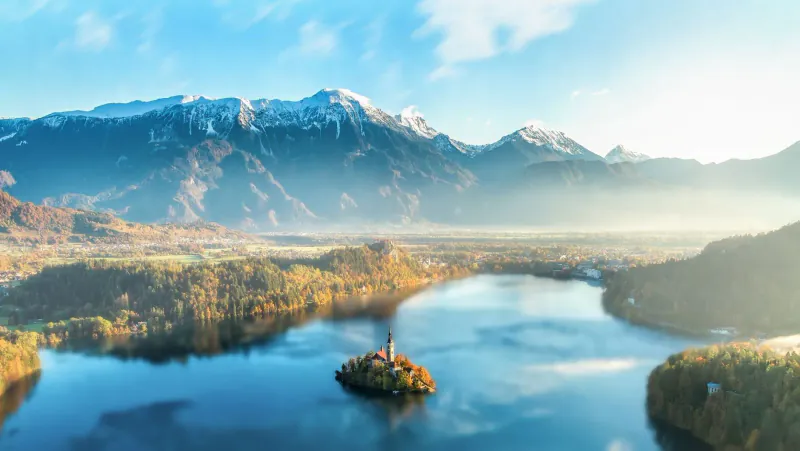
- Lake Bled and beyond: the UNESCO-class natural and cultural landscape within an hour's drive is one of Slovenia's most consistent draws; expats with families rate it exceptionally highly for weekend quality of life
Cost of Living: Cheaper Than Vienna, More Expensive Than Zagreb
Ljubljana is moderately priced by Central European standards - significantly cheaper than Vienna, Munich, or Zurich, comparable to Bratislava and slightly more expensive than Zagreb or Budapest.[40][39]
Single professional monthly budget (Ljubljana):[41][39]
- Total including rent: approximately €1,100-1,500/month (comfortable lifestyle)
- Total excluding rent: approximately €700-950/month
Family of four monthly budget (Ljubljana, excluding international school fees):[41]
- Rent (2-3 BR): €1,200-1,900/month
- Groceries and food: €500-800/month
- Utilities, transport, leisure: €300-500/month
- Total: approximately €2,000-3,200/month (excluding school fees)
Rent by Neighbourhood (Ljubljana, 2026)[42][8][39]
| Neighbourhood | Studio (€/mo) | 1-BR (€/mo) | 2-BR (€/mo) | Character |
|---|---|---|---|---|
| Center (Staro Mesto) | €700-900 | €950-1,400 | €1,400-1,800 | Historic core, castle views, tourist activity, premium pricing |
| Trnovo | €600-750 | €750-1,100 | €1,100-1,500 | Bohemian, river walks, cafés, popular with expats and creatives |
| Bežigrad | €550-700 | €700-950 | €950-1,300 | Residential, north of centre, good U-Bus connections, families |
| Šiška | €500-650 | €650-900 | €900-1,200 | Up-and-coming west side, growing café scene, young professionals |
| Rožna Dolina | €600-750 | €800-1,050 | €1,100-1,500 | Green, quiet, near University, expat/academic community |
| Outer districts (Fužine, Polje, ViÄ) | €400-550 | €550-750 | €750-1,050 | Most affordable, longer commute, car or bus dependent |
Ljubljana's 3% vacancy rate is the key constraint - demand consistently outpaces supply, especially for furnished apartments in the €700-1,100 range. Start the housing search 6-8 weeks before your planned arrival. The main property portals are SS.si and Nepremicnine.net; many quality listings in the expat-favoured neighbourhoods go within days.[8]
Furnished premium: Furnished apartments command 10-15% above unfurnished equivalents - worth paying for the first 3-6 months while you orient yourself.[42]
Daily Expenses (Ljubljana, 2026)[2][39][41]
| Item | Price (€) |
|---|---|
| Meal at inexpensive restaurant | €8-14 |
| Three-course meal for two (mid-range) | €40-65 |
| Coffee (cappuccino or macchiato) | €1.80-3.00 |
| Domestic beer (restaurant) | €3-5 |
| Glass of Slovenian wine (restaurant) | €4-8 |
| Monthly public transport pass | €35 |
| Grocery weekly spend (single person) | €50-80 |
| Gym membership (mid-range) | €25-50/month |
| Petrol (per litre) | €1.50-1.65 |
| Internet (home fibre, 100-300 Mbps) | €20-35/month |
The monthly transport pass at €35 is the single most compelling value proposition in Ljubljana's cost structure - for context, Vienna's annual pass is €365/year (about €30/month). Ljubljana's compact size means you may not need a car at all if you live centrally, which eliminates the €300-500/month car ownership cost that applies to most Austrian or German cities.
Utilities: An average apartment in Ljubljana costs approximately €100-200/month for electricity, heating, water, and waste - meaningfully lower than Western European equivalents due to Slovenia's hydro-dominated electricity grid and regulated heating tariffs.[43]
Which City?
Ljubljana
The capital, home to 300,000 people, and the only realistic base for most professional expats. All international schools are here. All major employers are here. All government services - the Upravna Enota offices for residency registration, ZZZS for health insurance, FURS for tax numbers - are in Ljubljana. The cultural scene is vibrant for a city of its size: Opera, Philharmonic, Slovenian National Museum, and a remarkable independent restaurant and wine bar culture centred on the Metelkova neighbourhood and the old city.[14]
Ljubljana's practical virtue: it is genuinely walkable and cyclable. A 15-minute bike ride connects most residential neighbourhoods to the city centre, offices, and commercial districts. Zero traffic congestion by Western European capital standards.
Maribor
Slovenia's second city (95,000 people), 130 km northeast of Ljubljana in the Styrian wine country. Rents are 30-40% below Ljubljana. The University of Maribor anchors an active student population. Pohorje ski resort is 15 minutes from the city centre. Maribor attracts expats seeking authenticity over international convenience - the English-speaking professional community is smaller, and you will integrate more fully into Slovenian life.[44][14]
No international schools in Maribor. For families with non-Slovene children, this is a meaningful limitation unless language integration is embraced fully and quickly.
Koper and the Adriatic Coast
Koper is the largest Slovenian coastal city - a functioning port town with a Venetian old city and a Mediterranean character distinctly different from inland Slovenia. Portorož, 8 km from Koper, is the resort town of the Slovenian coast. Rents in Koper are 20-30% below Ljubljana; the Adriatic is 5 minutes away; and Italy (Trieste) is 25 minutes by car.[38][14]
The limitation: the job market is almost entirely tourism, logistics (the Port of Koper is Slovenia's only maritime port), and the University of Primorska. For remote workers with a foreign income, Koper is genuinely excellent. For those needing local employment in tech or finance, it is too small.
Kranj
The "Slovenian Alps capital" - situated between Ljubljana (25 km) and Lake Bled (22 km), with the Julian Alps as the immediate backdrop. Rents below Ljubljana; commutable to the capital by train (30 minutes) or car. Best suited to expats who prioritise outdoor access and lower costs and can commute to Ljubljana for work.[45][14]
Piran
A UNESCO-protected medieval coastal town of 3,500 people - one of the most beautiful places in Slovenia by any measure. A base for retirees, remote workers, and academics who value quiet, beauty, and proximity to both Italy and Croatia. No international schools, minimal international job market, summer-heavy tourism. Not a practical base for families with school-age children unless full Slovenian immersion is the plan.[46][45]
City Comparison
| City | 1-BR Rent (€/mo) | Key Sectors | Key Limitation | Best For |
|---|---|---|---|---|
| Ljubljana | €700-1,100 | All sectors, tech, pharma, finance | Tight rental market, 3% vacancy | All expats, families, professionals |
| Maribor | €450-700 | Education, wine industry, university | No international schools | Affordable, wine-country lifestyle |
| Koper / Portorož | €550-800 | Tourism, logistics, coast | Small job market | Remote workers, retirees, Italy access |
| Kranj | €500-700 | Industry, commuter to Ljubljana | Commuter-dependent | Alpine access, affordability |
| Piran | €600-900 (seasonal) | Tourism, remote work | Very small, seasonal, no schools | Retirees, digital nomads |
International Schools: Small Sector, Reasonable Fees
Ljubljana has 7 international schools - a small number compared to Vienna (70+) or Dubai (200+), but consistently high quality and meaningfully affordable by European standards.[47]
Ljubljana International School Fees (2025/26)[48][49][47]
| School | Curriculum | Annual Fees (€) |
|---|---|---|
| British International School of Ljubljana (BISL) | UK National Curriculum, IGCSE, A-Level | €11,600 (EYFS) - €19,300 (Sixth Form) |
| Ljubljana International School (LIS) | IB PYP/MYP/DP, American Diploma | €10,900 - €16,900 |
| Danila Kumar International School (DKIS) | IB PYP/MYP | €6,056 - €8,546 |
| European School Ljubljana | European Baccalaureate | €7,600 (flat) |
| Lycée Français de Ljubljana | French curriculum, DELF | €5,600 - €8,000 |
| Deutsche Schule Laibach | German-Slovene bilingual, Abitur | €6,000 - €8,200 |
Median true annual cost across Ljubljana's international schools (including hidden fees): ~USD 14,700 (~€13,500).[47]
Add: registration fee (€300-1,000 one-off), lunch (€600-1,200/year), materials (€200-500/year). School bus in Ljubljana ranges from €0 (LIS has routes) to €600-1,200/year.
For a family with two school-age children at mid-tier international schools: approximately €18,000-30,000/year total - roughly half the equivalent Vienna cost for IB schools, and one-third of equivalent options in London or Singapore.[47]
Waitlists: BISL and LIS are the most in-demand; applications for September intake are best submitted by January-February. DKIS typically has more availability. The European School in Ljubljana is technically for EU institution staff but accepts a limited number of non-staff pupils where capacity permits.
Slovenia's public school system is free and ranked among the better-performing EU systems on PISA metrics. For children who integrate linguistically (typically 12-18 months for younger children), the public system is a legitimate alternative. Bilingual Slovene-English classes exist in selected Ljubljana primary schools.
Buying Property
The rules differ critically by nationality:[50][51][52]
- EU, EEA, OECD, and EFTA citizens: Full property rights, identical to Slovenian citizens. No additional approvals, no investment thresholds.
- Non-EU from countries with bilateral reciprocity agreements: Can purchase with a Ministry of Justice reciprocity confirmation - adds approximately 60-90 days to the timeline. This includes most Western Balkan countries and some others.[50]
- Non-EU from other countries (including Russia, China, most of Africa, some others): Cannot purchase real property directly. Must establish a Slovenian d.o.o. Company (minimum €7,500 share capital) to hold property. The company-based route works but adds cost and administrative complexity.[51][43]
Property purchase does NOT grant residency. There is no Golden Visa or investor residency programme in Slovenia.[43]
Ljubljana property prices in 2026: Average €4,448/m² in mid-2025, representing a 50% increase since 2018 - one of Central Europe's fastest-appreciating markets. In premium areas (Center, Trnovo, Bežigrad), expect €4,800-6,200/m². Coastal areas (Piran, Portorož): €5,000-7,000/m² for prime seafront.[51][8][29]
Property Transaction Costs (Slovenia, 2026)[53][54][50]
| Cost Item | Rate |
|---|---|
| Real estate transfer tax (secondary market) | 2% of purchase price |
| VAT (new buildings, from developer) | 22% or 9.5% depending on property type |
| Notary fee | ~0.2-0.5% of purchase price |
| Land Registry fee | ~0.01-0.5% of purchase price |
| Agent commission (buyer's share) | 1-2% (negotiable; no longer legally capped) |
| Total buyer-side costs (secondary market) | ~3.5-5.5% of purchase price |
Annual property tax (NUSZ - building land use fee): Set by individual municipalities. For a typical Ljubljana apartment: €200-600/year. For a house: €200-900/year. These are very low figures by Western European standards.[55][53]
Capital gains on property sale (seller): Taxed on the profit - rate starts at 25% if sold within 5 years of purchase, reducing every 5 years: 20% at 5-10 years, 15% at 10-15 years, 0% after 15 years of ownership.[52][43]
Mortgages for foreign buyers: EU citizens access the same terms as Slovenian residents - typically 25-30% down payment, rates approximately 3.5-4.5% for EUR-denominated loans in 2026. Non-EU buyers, if purchasing via company, face 30-50% down payments and rates approximately 0.5-1% higher.[29][51]
Climate: Four Real Seasons, No Extreme Heat, One Microclimate Per Valley
Slovenia sits at the intersection of three climate zones - Alpine, Mediterranean, and Pannonian - within a country the size of Switzerland. The result is genuine climate diversity across short distances.[15]
| Region | Character | Summer | Winter |
|---|---|---|---|
| Ljubljana and central Slovenia | Continental | 20-30°C, thunderstorms common | -2 to 5°C, some snow |
| Julian Alps (Bled, Kranjska Gora) | Alpine | 15-25°C, afternoon storms | -5 to -10°C, heavy snow |
| Adriatic coast (Piran, Koper) | Mediterranean | 25-32°C, dry | 5-12°C, mild and rainy |
| Styria / Maribor | Pannonian | 22-32°C, humid summers | -3 to 4°C |
The practical picture for Ljubljana: winters are cold and grey with occasional snow, but not brutally cold - January averages 1-3°C. Summer is genuinely beautiful - 25-28°C, low humidity compared to the Adriatic coast, long evenings with outdoor dining culture from May to September. The shoulder seasons (April-May, September-October) are arguably the finest months - mild, green, and with the Alps accessible in perfect conditions.
The Bora (strong northeastern wind) and Jugo (warm southerly) are relevant for coastal expats - the Bora on the Slovenian coast can be powerful in autumn and winter; Koper and Piran are affected less severely than the Croatian coast but it is a factor.
Slovenia's position as an outdoor activity hub is not marketing: ski season runs November-April in the Julian Alps, with Kranjska Gora and Vogel as the flagship resorts. Mountain biking and trekking in the Julian Alps and Triglav National Park from May to October are world-class. The SoÄa River valley (1.5 hours from Ljubljana) is one of Europe's premier whitewater kayaking and fly-fishing destinations.
The Slovene Language: Genuinely Necessary, Genuinely Difficult
Slovene is the only official language. It is a South Slavic language with six grammatical cases, dual grammatical number (not just singular and plural - Slovene has a distinct form for referring to exactly two of something), and significant vocabulary difference from Croatian or Serbian despite structural similarities.[15]
In Ljubljana's international community - around Trnovo, the tech cluster, international schools - daily English-language operation is entirely feasible for the first year or two. In government offices, medical appointments (outside private clinics), hardware stores, and interactions outside the expat bubble: Slovene is required.[15]
For citizenship: a Slovene language exam at basic communication level (roughly A2) is mandatory. No formal CEFR level is specified in statute, but "basic communication" in practice means you can handle everyday conversations - shopping, directions, simple administrative interactions - in Slovene.[6][7]
For employment: virtually all local Slovenian employers expect Slovene. The exceptions are international technology companies and the handful of multinationals with Vienna or Munich headquarters that use English as the working language.
Learning resources: The Center za SlovenÅ¡Äino at the University of Ljubljana offers courses from beginner to advanced; courses cost approximately €200-500/semester. Private tutors charge €20-40/hour. The Ministry of Education funds free Slovene integration courses for holders of temporary and permanent residence permits.
Expect 12-24 months of consistent study to reach A2-B1, accounting for the grammatical complexity.
Your First 30 Days: The Checklist
- Register at the Upravna Enota (Administrative Unit) within 8 days of finding accommodation - bring your passport and the rental contract or a written statement from your landlord; EU citizens register free of charge; non-EU nationals submit a full residence permit application (which was ideally initiated before arrival at the Slovenian embassy); the registration confirms your legal presence and enables all subsequent steps[16][15]
- Apply for a tax number (DavÄna Å¡tevilka) at FURS (Financial Administration of the Republic of Slovenia) - bring passport and residence registration proof; issued same day or within a few days; required for opening a bank account, employment contracts, and any financial transaction[15]
- Open a bank account - NLB (Nova Ljubljanska Banka), SKB, NKBM, and N26 or Revolut (fully digital, no physical presence required) are the main options; bring passport, tax number, and proof of address; accounts opened same day or next day; EUR accounts standard given Eurozone membership
- Register for ZZZS health insurance - employees are registered by their employer; self-employed register directly at the nearest ZZZS regional office; bring tax number, registration certificate, and employment or self-employment documentation; E-card issued within 2-4 weeks; until the E-card arrives, keep your original health insurance documentation active[31][34]
- For non-EU nationals on Digital Nomad Permit: maintain your international health insurance for the full 12-month duration - you are not entitled to ZZZS coverage on this permit; confirm your policy explicitly covers Slovenia and includes emergency medical care of at least €30,000[18][19]
- Begin Slovene language study immediately - even A1 level dramatically improves daily life quality; book a beginner course at the Center za SlovenÅ¡Äino or arrange a private tutor; commit to at least 3 hours of structured study per week from day one; the compound advantage of early start is significant over the 2-10 year residency trajectory
- Register children at school - public school assignment is by district of residence (contact the local Å¡ola); for international schools, BISL and LIS applications for September intake are best submitted by January-March of the intake year; mid-year enrolment is possible but requires contacting admissions directly[56][47]
- Get your EMSO (personal identification number) for long-term residents - issued when you receive your residence permit or registration certificate; required for health insurance, utilities registration, and many administrative processes; the Upravna Enota handles this alongside residence registration for non-EU applicants
- Register vehicles if bringing a car from abroad - vehicles registered in another EU country can be driven in Slovenia for up to 6 months after registering your residence; after 6 months, Slovenian registration is required; the DURS (vehicle registration office) handles the process; non-EU vehicles follow a slightly different import procedure
- Understand the rental market and Najemna Pogodba (rental contract) - all rental contracts must specify duration, rent amount, and terms in writing; confirm the contract is registered at FURS (legally required for the landlord); unfurnished apartments are the norm in the standard market - ask explicitly whether white goods, light fittings, and kitchen equipment are included; bring this up before signing, not after
Key Data at a Glance
| Indicator | Value |
|---|---|
| GDP Growth 2026 (European Commission) | 1.9%[10] |
| GDP Growth 2026 (OECD) | 2.4%[12] |
| Personal Income Tax - top rate (above €82,346) | 50%[5][24] |
| Personal Income Tax - entry rate | 16% (below €9,721)[5] |
| Capital gains / dividends / interest / rental income | 25% flat rate[24] |
| Employee social security contributions | 22.1% of gross (capped at €7,500/month from July 2026)[9][28] |
| Mandatory health contribution (flat) | €35/month[27] |
| Employer social security | 16.1%[26] |
| VAT (standard) | 22%[30] |
| VAT (food) | 0% (from 2026)[28] |
| VAT (reduced) | 5% (from 2026)[28] |
| Digital Nomad Permit income threshold | ~€3,200 net/month (twice average net salary)[18][19] |
| Digital Nomad Permit duration | 12 months, non-renewable immediately[20][3] |
| Permanent residency eligibility | 5 years continuous legal residence[15] |
| Citizenship standard route | 10 years (5 years permanent residency + prior 5 years)[6][7] |
| Citizenship language requirement | Basic Slovene communication (approx. A2)[6] |
| Dual nationality | Generally NOT permitted - renunciation required[7] |
| Ljubljana Safety Index (Numbeo 2026) | 80.4 - Very Low crime[1] |
| Ljubljana Crime Index (Numbeo 2026) | 19.6[1] |
| Global Peace Index (Slovenia, 2026) | Top 10 worldwide[1] |
| ZZZS public health - contribution rate (employee) | 6.36% + €35 flat/month[27] |
| Ljubljana 1-BR rent (Centre, 2026) | €950-1,400/month[8] |
| Ljubljana 1-BR rent (outer districts) | €550-750/month[39] |
| Property transaction costs (buyer, secondary market) | ~3.5-5.5% of purchase price[54] |
| Annual property tax (NUSZ, apartment) | €200-600/year[53] |
| International school fees (Ljubljana, mid-tier) | €7,600-16,900/year per child[49] |
| Ljubljana monthly transport pass | €35[39] |
| Emergency number | 112 (all services)[34] |
The Digital Nomad Permit's 12-month non-renewable structure is the key variable most candidates misread. It is a genuine opportunity for a fully-funded year in one of Europe's safest, most beautiful, and most affordable capitals - but it does not build toward permanent residency or citizenship. If your goal is EU residency and eventual citizenship, the d.o.o. Business route or employment-based Single Permit is the only path that counts. Choose your route before you arrive, not after you fall in love with Ljubljana.
References
Is Ljubljana Safe for Tourists? 2026 Safety Guide - Discover if Ljubljana is safe for tourists in this 2026 guide. Learn about local crime rates, nightl...
Ljubljana Cost of Living 2026 - Cost of living in Ljubljana: rent from $325/mo, CoL Index N/A (NYC=100). Prices for rent, food, tran...
Slovenia Visa Options for Expats 2026: Requirements, Costs & How to Apply - Slovenia introduced its Digital Nomad Visa in November 2025, one of the latest EU member states to d...
Slovenia Passport Ranking 2026 - Latitude World - The Slovenia passport is 7th in our Passport Index. Learn more about the visa-free access available ...
Slovenia Progressive Income Tax 2026 - Rates and Brackets - Slovenia operates progressive personal income tax system with 5 brackets ranging 16-50%. Brackets ad...
Passport & Nationality - Slovenian Citizenship (Naturalisation) - Slovenia - Passport & Nationality - Slovenian Citizenship (Naturalisation). Free Nationality Report ...
Housing - Renting in Slovenia 2026 - ExpatLife.Ai - Ljubljana's housing market is one of the tightest in Central Europe, with a vacancy rate of just 3% ...
Slovenia Social Security Contributions 2026 - TaxRavens - Slovenia social contributions fund pension, health, unemployment systems. Employee pays 22.1%, emplo...
Economic forecast for Slovenia - Economy and Finance - The latest macroeconomic forecast for Slovenia. The European Commission publishes a full set of macr...
The economic context of Slovenia - Bank of Scotland - Discover the economic context of Slovenia through the key figures of the economy, the main sectors o...
OECD Economic Outlook, Volume 2025 Issue 1: Slovenia - The global outlook is becoming increasingly challenging. Substantial increases in barriers to trade ...
Slovenia is ranked among the more successful countries in terms of ... - The quality of life in Slovenia remains high and the trend is also positive. According to various gl...
Best Cities in Slovenia to Live in 2026: Complete Expat Guide - Best cities in Slovenia to live in 2026. Complete expat guide comparing Ljubljana, Maribor, Koper, a...
Living in Slovenia: the ultimate expat guide - The living in Slovenia guide, written by expats for expatriates, will help you to settle down in Slo...
Entry and residence - The methods and conditions of entry into the Republic of Slovenia differ depending on whether the pe...
Temporary residence permit for digital nomads - Portal GOV.SI - Slovenia is introducing a temporary residence permit for digital nomads on 21 November 2025.
Slovenia Digital nomad visa: Requirements 2026 - Slovenia Digital Nomad Permit requirements: income, duration, taxes, health insurance - from officia...
Digital Nomad Visa Slovenia - Live and Work Remotely in ... - Learn how to live and work remotely in Slovenia under the new Digital Nomad Visa program. Eligibilit...
Slovenia: The Expat Guide Updated (2026) - Investropa - As of early 2026, the three most popular visa types for expats moving to Slovenia are the single res...
Slovenia Digital Nomad Visa 2026: A Complete Guide for ... - Slovenia digital nomad visa 2026 complete guide. Eligibility requirements, application process, cost...
Slovenia Citizenship: Full Guide to All Legal Paths in 2026 - Discover the various pathways to acquiring Slovenia citizenship, from naturalisation to investment. ...
Citizenship - An individual may acquire Slovenian citizenship by birth, or by naturalisation if they actually resi...
Slovenia - Individual - Taxes on personal income - In 2026, the following tax brackets and tax rates are , and rental income are taxed at a flat rate o...
Slovenia Payroll Changes - 2026 - Native Teams Help Centre - Slovenia Payroll Changes - 2026
Social security and insurance - SPOT - Social security contributions in Slovenia are paid as a withholding tax by the employer and also by ...
Slovenia - Individual - Other taxes - Worldwide Tax Summaries - Social security contributions ; Pension and disability insurance, 15.50, 8.85 ; Health insurance, 6....
SLOVENIA'S 2026 TAX REFORM: 0% VAT ON FOOD, LOWER ... - Social Cap (Socialna kapica): As of July 1, 2026, the maximum monthly base for all social security c...
Property Foreign Ownership Ljubljana (January 2026) - Investropa - What can foreigners own and buy in Ljubljana? We study property rights, visas, buying process, taxes...
Salaries and Taxation - EURAXESS Slovenia - There are also two value added taxation (VAT) rates in Slovenia: the standard rate of 22% and a redu...
Healthcare in Slovenia for Expats 2026: Insurance, Costs & Hospitals - Slovenia operates a compulsory public health insurance system through the ZZZS (Health Insurance Ins...
Slovenia health system information - Virtually every permanent resident in Slovenia is covered under the single, compulsory Social Health...
Health Insurance for Expats in Slovenia (2025 Guide) | Compare Expat Plans - Complete guide to expat health insurance in Slovenia. ZZZS mandatory coverage, complementary insuran...
Healthcare System Guide for Expats in Slovenia - nestfainder.ai - How the healthcare system works, insurance, and access for residents and expats in Slovenia.
Health Insurance in Slovenia | APRIL International - The public healthcare system is not completely free, though some services are covered by the ZZZS ca...
Slovenia - European Health Insurance Card - Slovenian insured persons can apply for an EHIC at Health Insurance Institute of Slovenia's regional...
Expat Life - Slovenia Travel Guide - slovenia-guide.com - Comprehensive guide to living, neighborhoods, and public transport for expats in Slovenia
Cost of Living in Ljubljana 2026 - Expat Guide | WhatLifeCosts - Cost of living in Ljubljana 2026 - rent €700 meals €9, transport €35/month. Complete expat guide.
2026 Cost of Living in Slovenia (Full Breakdown) - Slovenia is a member of the European Union and a country known for some of the most gorgeous tourist...
Cost of Living in Ljubljana, Slovenia in 2026 - This page contains up-to-date cost of living information for Ljubljana, Slovenia in 2026. Compare pr...
Updated Rents in Ljubljana (January 2026) - Investropa - The latest update about rents in Ljubljana. Rents, rental income, rental yields, vacancy, occupancy ...
Countries To Buy A Property... - Detailed guide to investing in apartments & houses in Ljubljana and other cities in Slovenia. How in...
Places to visit, explore and stay in Slovenia - Maribor is a beautiful city filled with lots of friendly people and wonderful sights and monuments. ...
Best Places to Live in Slovenia | Fantastic Removals Blog - Slovenia is a beautiful country located in Central Europe and is preferred by many British expats. S...
International Schools in Ljubljana: Cost, Quality & Market Data (2026) - Ljubljana, Slovenia has 7 international schools. The median true annual cost (including hidden fees)...
Buying Land as a Foreigner in Slovenia (2026) - Investropa - The latest update about buying land as a foreigner in Slovenia. Conditions, eligibility, zones, rest...
Buying property in Slovenia as a foreigner: full guide - Investropainvestropa.com "º blogs "º news "º slovenia-real-estate-foreigner - Get the inside scoop on buying property in Slovenia as a foreigner with this comprehensive guide. Le...
Property Foreign Ownership Slovenia (2026) - Investropainvestropa.com "º blogs "º news "º slovenia-foreigner - What can foreigners own and buy in Slovenia? We study property rights, visas, buying process, taxes,...
The Investor's Guide to Property Taxes & Costs... - Learn how to navigate property taxes and costs in Slovenia 2026. Discover key investor insights to m...
FAQ - Sloveniaestates - In Slovenia property taxes are incredibly low, for an average three bedroom house expect to pay arou...
Expat Education Guide: Schools in Ljubljana, Slovenia | ReloPlanner - Complete expat education guide for Ljubljana. International schools, local school system, tuition co...
Frequently Asked Questions
What are the primary visa and residence options for moving to Slovenia in 2026? (Slovenian limited liability company, equivalent to a GmbH or Ltd) and use it as the basis for a business-purpose temporary residence permit.
How does personal income tax work for expats in Slovenia? Capital gains, dividends, interest income, and rental income from Slovenian property are all taxed at a flat rate of 25% - separate from the progressive income tax schedule.
What is the average cost of rent and living in Slovenia? The monthly transport pass at €35 is the single most compelling value proposition in Ljubljana's cost structure - for context, Vienna's annual pass is €365/year (about €30/month).
How many years of residence are required for citizenship or permanent residency in Slovenia? The critical implication: the Digital Nomad Permit does not count toward the 5-year permanent residency clock or the 10-year citizenship clock.
Want to see how Slovenia stacks up?
Are you seriously considering a move? Use our interactive tools to explore Slovenia's climate, tax brackets, and nomad visas.