Is Uruguay the Best Plan B in 2026? Tax Holiday, Stability, and Citizenship Explained
June 22, 2026
ShareUruguay just extended its foreign-income tax holiday to 10 years for new residents arriving from January 1, 2026 - followed by a 50%-reduced rate for five more years. For a European or North American moving here with offshore income, that means a decade and a half of near-zero personal tax on dividends, rental income, and capital gains earned abroad. No other country in South America offers anything close to that structure.[1][2]
The counter-facts: Montevideo's Numbeo Crime Index sits at 56.36 - elevated by European standards, comparable to major Latin American capitals. The economy grew just 1.8% in 2025 and the IMF has cut the 2026 forecast to 1.8%. Spanish is the sole official language and English proficiency outside tourist zones is genuinely low - you will need it. And while citizenship is accessible in 3-5 years, it requires 183 days of physical presence per year, which disqualifies anyone who travels heavily or keeps a foot in two countries.[3][4][5][6][7][8][9]
Uruguay works extremely well for a specific kind of expat. It does not work for everyone.
The Economy: Stable, Slow, and Seriously Investment-Grade
Uruguay punches well above its weight economically for a country of 3.5 million people. It holds investment-grade credit ratings from Moody's, S&P, and Fitch, maintains some of the lowest sovereign spreads in the entire region, and is the only country in Latin America consistently cited by the IMF for fiscal discipline and institutional strength.[10]
That said: growth is modest. GDP expanded 1.8% in 2025, with 2026 revised down to approximately 1.8-2.2% by the IMF and World Bank, reflecting global trade headwinds rather than domestic weakness. The economy is diversified across agriculture, financial services, technology, tourism, and a growing pharmaceutical and biotech sector.[11][7][10]
Sectors actively hiring or attracting internationally:[12][13]
- Technology and IT: Uruguay has the highest software export density per capita in Latin America; Montevideo has a concentrated tech ecosystem with Mercado Libre, Globant, and over 300 tech companies including Uruguay's homegrown unicorns (dLocal, Tryolabs, Quasar)
- Financial services: Montevideo's financial centre serves Argentine, Brazilian, and regional high-net-worth clients; private banking, asset management, compliance, and fintech are active employers
- Agriculture and agribusiness: Beef, soy, forestry, wine - Uruguay exports to 100+ countries; technical and management roles in agribusiness are consistent hires
- Tourism and hospitality: Punta del Este, Colonia del Sacramento, and the Costa de Oro attract high-end international tourism; hospitality management, gastronomy, and event services
- Remote work / location-independent: Uruguay has positioned itself as one of Latin America's best bases for internationally-employed professionals - excellent internet (fibre is near-universal in Montevideo), political stability, and rule of law that few neighbours can match
For local employment: The Uruguayan job market is small and Spanish-fluent. Without solid Spanish, competing for local roles is difficult. The expat community that thrives here is generally either employed by multinationals with Uruguayan operations, running their own businesses, or working remotely for foreign employers.
The Tax Holiday: The Reason Most Expats Are Here
This deserves its own section because it is the single most important financial reason professionals and retirees choose Uruguay over any other country in the region.
The New 2026 Regime (Law 20.446 and Budget Bill 2025-2029)[2][14][1]
For anyone acquiring Uruguayan tax residency from January 1, 2026:
- Year 0 (year of arrival) + Years 1-10: Pay IRNR (Non-Resident Income Tax) at 0% on most foreign financial income - OR elect the 12% IRNR flat rate to preserve access to treaty benefits
- Years 11-15: Pay IRPF at 50% of the applicable rate (currently: effectively 6% on foreign dividends and interest, instead of the standard 12%)
- Year 16+: Standard IRPF rates apply (12% on foreign dividends and interest; progressive rates of 10-36% on employment income)
The practical effect: a European retiree with €5,000/month in pension, dividends, and rental income from abroad pays zero Uruguayan tax on that income for a decade, followed by a further five-year reduced period.[14][1]
Previous regime (before 2026): The holiday was 5 years. The doubling to 10 years is the single most significant policy change in Uruguay's expat landscape in recent years.[1][2]
The Option to Pay 7% from Day One
New residents can alternatively elect to pay a flat 7% IRPF rate on foreign financial income from their first year - rather than claiming the full holiday. This makes sense in very specific circumstances: if your home country taxes you on worldwide income regardless of residency and you need to show Uruguayan-source tax paid to claim a foreign tax credit. Most expats from countries that use residence-based taxation should default to the 10-year zero rate.[14]
Domestic Income Tax Rates (IRPF 2026)[15][16][14]
| Annual Income Band (UYU) | Rate |
|---|---|
| Up to UYU 0 | 0% (BPC-based threshold) |
| UYU 0 - ~405,000/yr (~USD 10,000) | 10% |
| ~USD 10,000 - ~USD 25,000 | 15% |
| ~USD 25,000 - ~USD 60,000 | 24% |
| ~USD 60,000 - ~USD 120,000 | 25% |
| Above ~USD 120,000 | 36% |
Note: Uruguay's income tax applies only to Uruguayan-source income for non-residents and for new residents within their holiday period. Only when you work locally, earn local business income, or the holiday expires does the progressive scale above apply.[16][14]
VAT: 22% (standard rate) - one of the higher VAT rates in Latin America. Basic food items, medicines, and certain services carry reduced rates of 11%. This is the tax most expats notice in day-to-day life; restaurant bills, clothing, and services are more expensive than they look once IVA is included.[14]
Rental income from Uruguayan property: taxed at 10.5% of gross rent or 12% of net profit for non-resident owners via IRNR.[17]
Capital gains from Uruguayan property sale: 12% for non-residents.[18]
Wealth tax (IRAE-equivalent on individuals): Uruguay imposes a Net Wealth Tax (IP, Impuesto al Patrimonio) annually on net Uruguayan assets above a threshold - roughly 0.1-1.5% on Uruguayan-located assets for individuals, with a threshold of approximately USD 400,000 before it meaningfully bites for middle-class property owners.[14]
Home Country Obligations
Uruguay's zero-tax period does not eliminate what you owe elsewhere. US citizens file US returns regardless of residence. UK residents who leave must formally sever UK tax residency. Germans and French nationals must meet their own exit rules. Uruguay does not have a comprehensive tax treaty network - check treaty status for your specific country before assuming full relief.[16][14]
Visas and Residency: Four Routes That Actually Work
Uruguay's immigration framework is among the most pragmatic in the Americas. No bureaucratic points systems, no waiting periods while on a tourist visa, and in most cases you can apply for permanent residency directly without first obtaining temporary status.[19][20]
Mercosur Fast Track (For South American Passport Holders)
If you hold citizenship from Argentina, Brazil, Chile, Bolivia, Paraguay, Peru, Ecuador, Colombia, Venezuela, Suriname, or Guyana, you qualify for the Mercosur residency pathway. This is the simplest, cheapest, and fastest route - lighter documentation, lower fees, and shorter processing times than the general permanent residency route.[21][22][23]
For everyone else, three main routes apply:
Route 1: Rentista (Passive Income)
The most popular pathway for retirees, financially independent expats, and remote workers with foreign-source income.[24][19]
- Proof of stable monthly income of approximately USD 1,500 from sources outside Uruguay - pension, rental income, dividends, foreign employment contract, freelance contracts
- Income must be documented: bank statements, pension letters, contracts, all apostilled and translated into Spanish
- No minimum investment required
- No property purchase required
- Apply in person at the DNM (Dirección Nacional de Migración) in Montevideo; you must be physically in Uruguay to apply
Process timeline: Expect 4-12 months for the DNM to issue the permanent residency certificate. Upon filing, you receive a "constancia de trámite" that legalises your presence in Uruguay while you wait. Permanent residency once granted is indefinite.[20]
Documents required for all residency applications:[24][25]
- Valid passport (at least 12 months remaining)
- Birth certificate (apostilled, translated into Spanish)
- Police clearance from your country of origin + any country where you lived 5+ years in the last 10 years (apostilled, translated)
- Health certificate from a Uruguayan doctor + vaccination record
- Proof of income and proof of Uruguayan address (rental contract or utility bill)
- Passport-size photos
Document apostilles from your home country take weeks - start this process before you arrive.
Route 2: Pensionista (Retirees)
The same structure as the Rentista but specific to formal pension income. The USD 1,500/month threshold applies in the same way. If your pension is below that amount, applications sometimes succeed with demonstrated supplemental assets - consult an Uruguayan immigration attorney.[26]
Route 3: Investor Residency
Two investment thresholds, both leading to permanent residency directly:[27][28]
| Investment Route | Capital Required (2026) | Physical Presence |
|---|---|---|
| Real estate investment | ~USD 525,000 (3.5M Unidades Indexadas) | 60 days/year |
| Business investment with job creation | ~USD 2.25M (15M Unidades Indexadas) + 15 full-time Uruguayan jobs | 60 days/year |
Important 2026 update: To qualify for the foreign-income tax holiday under the investment pathway, the real estate threshold for tax residency has increased to approximately USD 2 million (separate from the immigration-only threshold). This means: a ~USD 525,000 real estate purchase qualifies for immigration residency, but obtaining the combined immigration + tax residency status at 60 days/year presence requires an approximately USD 2 million investment. For the standard tax residency (not investment-linked), you must spend 183+ days in Uruguay per year.[18]
The Investor Residency is the only route with a 60-days-per-year physical presence requirement rather than 183+ days - making it the only real option for people who need to split their time across countries while maintaining Uruguayan residency.[28][27]
Route 4: Work / Employment (Non-Mercosur)
Non-Mercosur nationals with a local job offer from a Uruguayan employer can apply for temporary residency through the employment route, then transition to permanent residency after 1-2 years. The employer typically initiates the process. Uruguay XXI (the official investment and trade promotion agency) offers a fast-track process for professionals hired by exporting companies.[29][26]
The Cédula de Identidad
Once your residency application is filed, you apply simultaneously for the Cédula - Uruguay's national identity card. This is your key document: without it, you cannot open a local bank account, enrol children in public school, join the mutualista health system, or register for utilities in your name. Processing takes 4-8 weeks. Carry a certified copy of your constancia de trámite in the interim.[24]
Citizenship: 3-5 Years, No Renunciation Required
Uruguay's citizenship pathway is one of the most accessible in the world for a stable, rule-of-law country with a genuinely useful passport.
Timeline[4][5][30]
| Applicant Profile | Residency Required | Physical Presence |
|---|---|---|
| With family constituted in Uruguay (spouse, common-law partner, or dependent children living in Uruguay) | 3 years | 183+ days/year |
| Single / no qualifying family ties | 5 years | 183+ days/year |
| Special merit (approved by General Assembly) | No fixed period | Case-by-case |
The clock starts from your first entry into Uruguay to begin the process - not from the date your residency certificate is formally issued. An absence of more than 6 consecutive months resets the entire counter to zero.[5][30][4]
Requirements at the citizenship interview (Corte Electoral):[31][30][5]
- Proof of legal residency and physical presence record
- Clean criminal record in Uruguay and abroad
- Conversational Spanish - no formal CEFR level test, but you must be able to answer basic questions in Spanish at the interview
- Two witnesses who have known you personally for 3 years (for family applicants) or 5 years (for single applicants) - the witnesses cannot be related to you and must appear in person
- Stable, documented income or employment
The process is free - there is no citizenship application fee in Uruguay.[31]
Dual Nationality: Uruguay Does NOT Require Renunciation
This is the critical difference from Austria or many other countries. Uruguay does not require you to give up your existing citizenship when you acquire Uruguayan citizenship. Whether your home country allows you to hold dual nationality is a separate question governed by your original country's laws - but Uruguay places no obstacle.[5]
The Uruguayan passport: Provides visa-free or visa-on-arrival access to approximately 153+ countries, including the entire EU, UK, Canada, Australia, Japan, and most of South America. For South American travel, it is effectively unlimited. For global mobility, it is a materially strong second passport.[27]
Cost of Living: Affordable by Western Standards, Expensive by Latin American Ones
Uruguay is not the cheapest destination in South America. It is the most stable. Cost of living in Montevideo is significantly above Argentina (in nominal terms), Brazil, Peru, or Colombia - but meaningfully below Western Europe, Australia, Canada, or the US.
Single professional monthly budget (Montevideo):[32][33][34]
- Total including rent: approximately USD 1,600-2,200/month (comfortable lifestyle)
- Total excluding rent: approximately USD 970-1,400/month
Family of four monthly budget (Montevideo, excluding international school fees):[35][32]
- Rent (2-3 BR): USD 1,300-2,200/month
- Groceries and food: USD 700-1,000/month
- Transport, utilities, leisure: USD 400-600/month
- Total: approximately USD 2,500-4,000/month (excluding school fees)
Rent by Neighbourhood (Montevideo, 2026, in USD/month)[36][37][38]
| Neighbourhood | Studio ($/mo) | 1-BR ($/mo) | 2-BR ($/mo) | Character |
|---|---|---|---|---|
| Pocitos | $650-900 | $900-1,300 | $1,400-2,000 | The expat hub - coastal, café-lined, safest feel; most in-demand |
| Punta Carretas | $700-950 | $1,100-1,600 | $1,500-2,200 | Upscale, tree-lined, shopping mall; premium pricing |
| Carrasco | $900-1,200 | $1,400-2,100 | $2,000-3,400 | Top-end residential; embassies, villas, families; quiet |
| Cordón / Parque Rodó | $450-650 | $650-1,000 | $900-1,400 | Central, bohemian, good value; young professionals |
| Malvín / Buceo | $600-800 | $850-1,200 | $1,200-1,800 | Mid-range beach neighbourhood; families |
| Centro / Ciudad Vieja | $350-550 | $500-750 | $700-1,100 | Cheapest options; requires caution after dark |
USD/UYU exchange rate in mid-2026: approximately 40.4 UYU per USD. Most Montevideo leases in expat-frequented neighbourhoods are denominated in USD; peso-denominated leases in outlying areas are indexed to inflation.[39]
Rental deposit and terms: Standard is 2 months deposit in advance; annual or 2-year leases are typical. In contrast to the UAE, there are no multi-cheque requirements - monthly payments by bank transfer are the norm.
Rent in Punta del Este: Significantly higher in summer (December-March) and significantly lower in winter. A furnished 1-BR in Punta proper during high season: USD 1,800-3,500/month. The same apartment off-season: USD 700-1,200/month. Expats who are not tied to full-year leases sometimes structure around this reality.
Daily Expenses (Montevideo, 2026)[40][34][35]
| Item | Price (USD) |
|---|---|
| Meal at inexpensive restaurant | $6-12 |
| Three-course meal for two (mid-range) | $40-60 |
| Coffee (cappuccino) | $4-5 |
| Domestic beer (bar) | $4-6 |
| Glass of Tannat wine (restaurant) | $6-10 |
| Public bus single fare (Montevideo) | ~$1.20 |
| Monthly bus pass (Montevideo) | ~$45-60 |
| Grocery weekly spend (single person) | $80-120 |
| Gym membership (mid-range) | $40-70/month |
| Fuel (petrol, per litre) | ~$1.50 |
One notable advantage: Uruguay's internet infrastructure is exceptional for Latin America - Antel (the state telecom) has deployed fibre broadly across Montevideo and major cities. Standard 1Gbps home fibre: approximately USD 40-60/month. This is a consistent reason remote workers cite for choosing Uruguay over other Latin American options.
Healthcare: The Mutualista System Is One of the Region's Best-Value Options
Uruguay's healthcare system has three tiers: the public ASSE network, the private mutualista system, and fully private clinics.[41][39]
The Three Tiers[42][43][39]
ASSE (Public): Government-run, universal access for all legal residents at minimal or zero cost. Good emergency care; longer wait times for elective and specialist appointments. No restrictions on age or pre-existing conditions.
Mutualistas (Private Non-Profit): The tier where most expats and middle-class residents access healthcare. You join one institution - Asociación Española, CASMU, Médica Uruguaya, Cooperativa Médica, or others - and use their network of clinics, hospitals, specialists, and pharmacies. The key features:[44][42]
- No deductibles, no lifetime caps
- Coverage includes GP, specialists, hospitalization, surgery, dentistry (basic), mental health, and emergencies
- Small co-pays (known as "tickets" and "órdenes") per consultation, typically USD 1-5 per visit
- Monthly membership: USD 50-120 for individuals, depending on age and plan[39][44]
- For employed residents: contributions are deducted through FONASA (the national health fund) automatically
Fully Private Clinics: Premium private hospitals (including the British Hospital in Montevideo - JCI-accredited, English-speaking staff) for those wanting the fastest access and maximum comfort. Add-on private insurance from companies like BlueCross or international insurers runs USD 150-400/month depending on coverage level and age.[44]
Quality Snapshot[42][44]
- Uruguay's life expectancy: approximately 78 years - highest in South America alongside Chile
- Doctor-to-population ratio: 5+ per 1,000 people - among the highest in Latin America
- The British Hospital (Hospital Británico) in Montevideo: JCI-accredited, routinely recommended for English-speaking expats; full English-language service across specialties
- Dental care: excellent and very affordable - a cleaning and exam at a private clinic: USD 30-60[44]
For expats applying for residency: private health insurance is required until you enrol in the mutualista system post-cédula. International plans from IMG, Cigna Global, or Allianz Care are accepted for immigration purposes.[39]
Emergency number: 911 (Ambulance, Police, and Fire - Uruguay consolidated all emergency services to a single number).
Safety: Best in Latin America, Not Europe
Uruguay is the safest country in South America by most credible metrics. The US, UK, and Australian government travel advisories all rate it at normal/exercise standard caution - the same baseline as France or Spain.[45]
Montevideo's Numbeo Crime Index is 56.36 with a Safety Index of 43.64. That's significantly safer than Buenos Aires, São Paulo, Bogotá, or Lima - but meaningfully higher-crime than Vienna, Tokyo, or Abu Dhabi. The dominant crime types are property crimes - bag snatching, opportunistic theft - rather than violent crime.[46][3][45]
Uruguay's Global Peace Index 2026 places it third in South America (behind Chile and Costa Rica) and among the top 60 countries globally. Homicide rate: approximately 11 per 100,000 - higher than Western Europe (where rates are typically 0.5-2), but lower than most Latin American neighbours.[45]
Practical safety picture in Montevideo:[47][45]
- Pocitos, Punta Carretas, Carrasco, Malvín, and Punta Gorda are the safest residential neighbourhoods - expat-concentrated, well-lit, low reported incidents
- Ciudad Vieja (Old City) and Centro require heightened awareness after dark; daytime tourist activity is fine
- Avoid displaying phones, laptops, and jewellery in Centro and on public transport
- The summer surge (December-March): petty theft increases approximately 30% as beach towns fill with Argentine and Brazilian tourists and opportunistic crime follows
The perception of safety in Uruguay - relative to the rest of the continent - is genuinely the strongest non-tax quality-of-life argument for the country. Expats consistently describe feeling far more relaxed walking in Pocitos at 10 PM than they would in comparable cities in Brazil, Colombia, or Peru.
Which City?
Montevideo
The capital and home to approximately 1.6 million people - roughly half Uruguay's total population. Virtually every expat's first landing point and the obvious choice for families, working professionals, and anyone who needs urban infrastructure. Montevideo houses all international schools, all major hospitals, the entire financial and tech sector, all government offices (critical for residency applications), and the best restaurant and cultural scene in the country.[48][12]
Best Montevideo neighbourhoods for expats:[38][49]
- Pocitos: The default expat neighbourhood - coastal, walkable, dense with cafés, restaurants, and the rambla (seafront promenade); highest expat concentration; safe; 1-BR: USD 900-1,300/month
- Punta Carretas: Slightly more upscale than Pocitos, excellent dining scene, near the Punta Carretas Shopping mall; popular with diplomatic families; 1-BR: USD 1,100-1,600/month
- Carrasco: Villa neighbourhood, embassies, greenery, very quiet; best for families with children and strong preference for security; 1-BR/apartment: USD 1,400-2,100/month; car essential
- Cordón and Parque Rodó: Best value in a central, young-professional area; lively bar scene, close to the Old City and Montevideo's main parks; 1-BR: USD 650-1,000/month
- Malvín / Buceo: Mid-range beach area east of Pocitos; solid residential option, slightly lower prices, popular with families
Punta del Este
Uruguay's international beach resort city, 80 miles east of Montevideo on the Costa del Este. The "Monaco of the South" - a gross exaggeration in terms of scale, but accurate as a shorthand for the concentration of wealthy Argentines, Brazilians, and international families who summer here. High-end restaurants, international art gallery, mega-yachts, Argentinian private school system.[49][48]
Punta del Este is a seasonal economy. Summers are vivid, expensive, and socially intense. Winters are quiet to the point of near-closure - many restaurants, shops, and amenities operate May-September on reduced hours or not at all. It works for high-net-worth retirees with the flexibility to travel in winter. It is not a practical year-round base for most working expats.[50]
Infrastructure note: Punta del Este does not have the hospital infrastructure of Montevideo. For complex medical care, you are 80-90 minutes away by car or bus.
Colonia del Sacramento
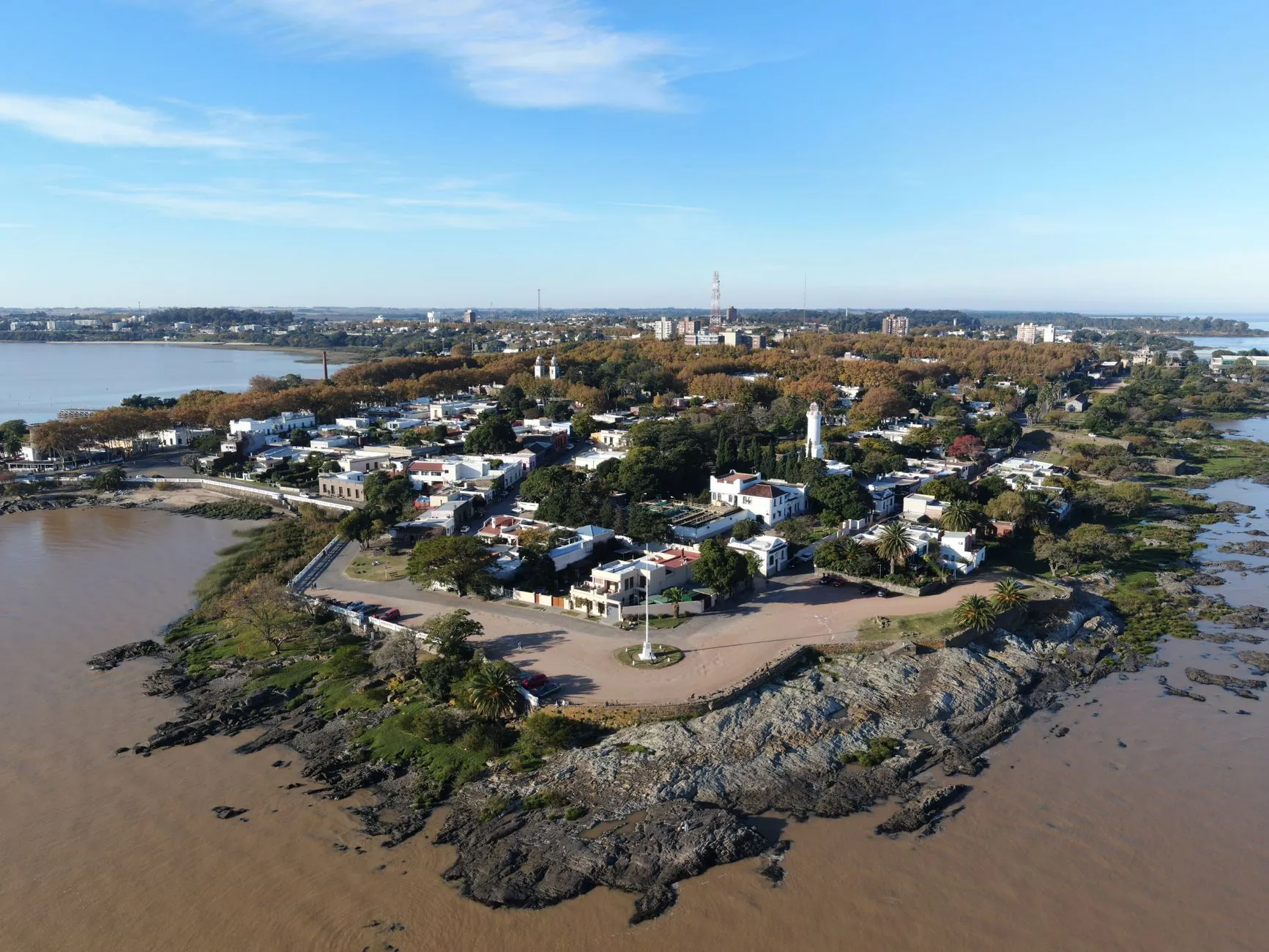
A UNESCO World Heritage colonial city on the Río de la Plata, directly opposite Buenos Aires by ferry. Population: approximately 27,000. The appeal: genuine colonial architecture, cobblestone streets, extreme safety, a small but established expat community of retirees and remote workers, and a 50-minute ferry connection to Buenos Aires for anyone maintaining ties to Argentina.[49]
Cost of living: 20-35% below Montevideo. English is spoken more widely than the national average due to heavy Argentine and Uruguayan tourist traffic. The tradeoff: very limited job market, minimal international schooling, and healthcare only at a basic level locally.
Punta del Diablo / Cabo Polonio / La Paloma
The Atlantic beach towns on Uruguay's eastern coast - wild, bohemian, genuinely beautiful. Popular with digital nomads, artists, and surfers. Not viable for families or professionals needing stable infrastructure - internet is limited in the most remote areas, public services are minimal, and winter depopulation is extreme. Worth knowing about for short stays; not a serious base.
City Comparison
| City | Rent 1-BR ($/mo) | Key Profile | Healthcare | International Schools | Best For |
|---|---|---|---|---|---|
| Montevideo | $900-1,300 (Pocitos) | Full urban service, all sectors | Full (mutualistas, hospitals) | 10+ schools | All expats, families, professionals |
| Punta del Este | $700-1,200 (off-season) | Wealthy seasonal, remote workers | Basic local, Montevideo for serious care | Limited | HNWI, retirees, summer-focused |
| Colonia del Sacramento | $450-700 | Retirees, remote workers, quiet | Basic only | None (Spanish only) | Low-cost retirees, Buenos Aires ties |
| Interior cities (Salto, Rivera) | $250-450 | Local market, agriculture | Public ASSE | None | Cost minimisers, Spanish-fluent |
International Schools: Cheap by Global Standards, Small by Global Standards
Uruguay has approximately a dozen credible international schools, almost all in Montevideo and the Maldonado/Punta del Este area. The sector is small by Dubai, Singapore, or Vienna standards - but the fees are remarkably affordable.[51][52][53]
Montevideo International School Fees (2026)[52][53][51]
| School | Curriculum | Annual Fees (USD) |
|---|---|---|
| GEMS World Academy Montevideo | IB (Early Years-Diploma) | $10,000-$18,000 |
| Uruguayan American School (UAS) | US curriculum, bilingual | $8,000-$14,000 |
| Ivy School | English-medium, bilingual | $6,000-$12,000 |
| Crandon Institute | US/Uruguayan dual diploma, bilingual | $5,000-$10,000 |
| Liceo Francés | French-medium, DELF | $6,000-$12,000 |
| Deutsche Schule Montevideo | German-Spanish bilingual, Abitur | $5,000-$10,000 |
Add registration fee ($500-$1,000 one-off), materials and activities ($200-$500/year).[52]
For a family with two school-age children at a mid-tier international school: approximately USD 16,000-28,000/year total - roughly half the equivalent cost in Vienna, one-third of London, and a fraction of Singapore or Dubai.[53][51]
Uruguay's public school system is genuinely strong - the best in Latin America by UNESCO metrics, with near-universal literacy and free university education. For expat children who arrive with solid Spanish or are young enough to acquire it quickly, the public bilingual track (schools with Spanish-English bilingual programmes exist in Montevideo) offers excellent education at zero cost. Integration timeline for children learning Spanish: typically 6-18 months to conversational fluency.[51]
Application timing: Start by January for the August-September enrolment opening. GEMS and UAS are the most internationally recognised and have more structure for admissions - they fill faster.
Buying Property
Uruguay operates one of South America's most foreigner-friendly real estate markets. There are no nationality-based restrictions on property ownership for private individuals - you buy with identical rights to an Uruguayan citizen.[54][55][18]
No residency required to buy. A valid passport and a Uruguayan RUT tax ID (obtainable from the DGI within days) are all you need to sign a deed. You do not need to be physically present - a notarised power of attorney lets a Uruguayan representative complete the entire process.[56][55]
Property purchase does NOT grant residency. The investment residency pathways (described above) exist for significant capital commitments, not standard housing purchases.[19]
Property Transaction Costs (Uruguay, 2026)[54][17][18]
| Cost Item | Rate | Notes |
|---|---|---|
| Property transfer tax (ITP) | 2% (on fiscal value, not market value) | Effectively lower than stated |
| Notary fee (buyer) | 3% + 22% IVA = ~3.66% of price | The escribano is the central actor |
| Buyer's agent commission | 3% + 22% IVA = ~3.66% | Negotiable |
| Registry and admin fees | ~0.3-0.5% | Fixed administrative costs |
| Total buyer-side costs | ~7-10% of purchase price |
The ITP is calculated on the fiscal value (valor catastral), not the actual market price - a significant saving, as fiscal values are typically well below market in Montevideo's premium areas.[54][18]
Annual property tax (Contribución Inmobiliaria + Primaria): Approximately 0.2-0.35% of market value per year - exceptionally low. An apartment worth USD 250,000 in Pocitos pays roughly USD 500-875/year in annual property taxes.[17][18]
Mortgages for foreigners: Banco Hipotecario del Uruguay (BHU) controls most of the mortgage market. Santander Uruguay offers an explicit "No Residente" mortgage programme. LTV ratios are typically 60-70% for foreign buyers; rates run approximately 5-7% in USD-denominated loans in 2026. Most expats buying in USD use foreign financing or cash purchases.[18]
Rental income tax for non-resident owners: 10.5% on gross rent (IRNR flat rate - simple and predictable).[17]
Climate: Temperate, Four Seasons, No Extremes
Uruguay's climate is temperate oceanic-continental - genuinely four seasons, no tropical heat, no major natural disaster risk.[57]
| Season | Months | Temperature (Montevideo) | Conditions |
|---|---|---|---|
| Summer | Dec-Feb | 22-30°C (peaks to 35°C) | Hot and humid; beach season; peak expat and tourism activity |
| Autumn | Mar-May | 15-22°C | Warm, dry, pleasant; the best season for exploring |
| Winter | Jun-Aug | 7-14°C | Cool and grey; not cold by European standards; rain common |
| Spring | Sep-Nov | 13-22°C | Variable; warming; wildflowers on the coast |
Key reality: Montevideo winters are mild by Central European standards - an Austrian or Polish expat will find the coldest months genuinely comfortable. No snow in Montevideo. No heating infrastructure to match European standards - older buildings are often poorly insulated, so portable heaters and electric blankets are standard in winter. New apartments have split-system air-con/heat that functions adequately.
Uruguay is one of the world's most sustainable energy producers - over 95% of its electricity comes from wind and hydroelectric sources. Power outages are rare and the grid is reliable. This is not a trivial point: electricity for an apartment in Montevideo runs approximately USD 50-80/month year-round, without the dramatic summer spikes that characterise Gulf countries or Southeastern US.
Spanish: Non-Negotiable, and Rioplatense Is Different
Spanish is Uruguay's only official language. English is not widely spoken outside the hotel and tourism sector and among some younger university-educated professionals.[8][9]
The honest assessment: In Pocitos, Punta Carretas, or Carrasco - the expat-concentrated neighbourhoods - you can navigate for weeks on English alone. In a medical consultation, a government office, a public school interaction, or any conversation outside the tourist bubble: Spanish is essential.[58][59]
Rioplatense Spanish (the variety spoken in Uruguay and Argentina) differs meaningfully from Castilian Spanish and from Latin American variants:
- Voseo: The pronoun "vos" replaces "tú" entirely - you use "vos tenés" instead of "tú tienes." This affects all verb conjugations and takes adjustment even for Spanish speakers from Spain or Mexico
- Sh/zh sound: The "ll" and "y" sounds are pronounced like English "sh" (lluvia = "shluvia") - distinct from virtually every other Spanish dialect
- Vocabulary is peppered with Italian, French, and Portuñol (Portuguese-Spanish) borrowings from immigration history
For citizenship: conversational Spanish is tested informally at the Corte Electoral interview - no CEFR level specified, but you must demonstrate that you can carry a basic conversation. Budget 6-12 months of consistent study to reach this level from zero. Formal Spanish schools in Montevideo (Centro Educativo de Idiomas, Instituto Cultural Anglo-Uruguayo) and private tutors are widely available at USD 20-40/hour.[5]
Your First 30 Days: The Checklist
- Arrange temporary accommodation before arrival - Airbnb and furnished apartment services are widely available in Pocitos and Punta Carretas; DNM accepts AirBnb booking confirmations as initial proof of address, which removes the pressure to sign a long-term lease before you know the city[25]
- Begin apostilling your documents in your home country before you leave - police clearance, birth certificate, marriage certificate if applicable; all must be apostilled and professionally translated into Spanish by a certified translator; this takes weeks and is the single most common delay in residency applications[25][24]
- File your DNM application in person - the Dirección Nacional de Migración is at Misiones 1513, Montevideo; you must appear in person with originals; bring a certified translation of everything; the appointment system has backlogs - book online the moment you arrive or even from abroad via the gub.uy portal[20][24]
- Apply for your RUT (Uruguayan tax ID) at the DGI - required for opening a bank account, buying property, signing a lease, and utility connections; bring passport and proof of address; issued same day or within a few days[55]
- Open a bank account - Banco Itaú, BROU (Banco de la República Oriental del Uruguay), Santander, and HSBC Uruguay are the main options; bring passport, RUT, proof of address, and income documentation; USD-denominated accounts are available and commonly used by expats for rent and daily spending
- Arrange private health insurance for the transition period - until you receive your cédula and can enrol in a mutualista, you will need private coverage; bring international insurance documentation; the British Hospital emergency department accepts all insurance and treats uninsured patients for payment[39][44]
- Hire a local gestor or abogado (immigration attorney) - Uruguay's DNM processes are straightforward by regional standards, but document translation requirements, apostille chains, and application nuances justify professional assistance for USD 500-1,500; ask expat community forums (Expats Uruguay Facebook Group, r/uruguay subreddit) for current recommendations
- Establish your Spanish study routine immediately - book a structured course for your first month; immersion begins fast in Montevideo even in English-adjacent neighbourhoods; the more Spanish you acquire in month one, the easier every subsequent interaction becomes[59][58]
- Once you receive your cédula, enrol in a mutualista - choose based on neighbourhood and specialist access (Asociación Española is popular in Pocitos; CASMU has broad coverage; the British Hospital has its own mutualista membership for those wanting English-language care); budget USD 60-120/month depending on age[44][39]
- Register children in school immediately - international school admissions for September intake open January-April; GEMS and UAS are the most internationally structured; public bilingual school enrolment through the ANEP system requires a cédula and is assigned by district of residence; for children arriving mid-year, supplemental Spanish tutoring is the single most useful investment[60][51]
Key Data at a Glance
| Indicator | Value |
|---|---|
| GDP Growth 2025 (actual) | 1.8%[6] |
| GDP Growth 2026 (IMF revised forecast) | ~1.8-2.2%[7][10] |
| Foreign income tax holiday (new residents from Jan 2026) | 10 years at IRNR 0% (+ 5 years at 50% rate)[1][2] |
| Domestic income tax (IRPF) - top rate | 36% (on incomes above ~USD 120,000)[14] |
| VAT (IVA) standard rate | 22%[14] |
| VAT on essential food/medicines | 11%[14] |
| Annual property tax | ~0.2-0.35% of market value[18] |
| Property transaction costs (buyer) | ~7-10% of purchase price[54][18] |
| Rental income tax (non-resident) | 10.5% of gross rent (IRNR)[17] |
| Rentista visa income threshold | ~USD 1,500/month (practical minimum)[24][19] |
| Investor residency - real estate route | ~USD 525,000 (3.5M UI), 60 days/year[27][28] |
| Investor residency - business route | ~USD 2.25M + 15 Uruguayan jobs[27][28] |
| Citizenship - with family | 3 years, 183 days/year, conversational Spanish[4][5] |
| Citizenship - single | 5 years, 183 days/year, conversational Spanish[4][5] |
| Dual nationality required to renounce? | No - Uruguay imposes no renunciation requirement[5] |
| Safety Index (Numbeo, Montevideo) | 43.64 / Crime Index 56.36[3] |
| Global Peace Index (South America rank) | 3rd (behind Chile and Costa Rica)[45] |
| Mutualista health membership | USD 50-120/month[39][44] |
| Montevideo 1-BR rent (Pocitos/Punta Carretas) | USD 900-1,600/month[38] |
| International school fees | USD 5,000-18,000/year per child[51][52] |
| Spanish level for citizenship interview | Conversational (no formal CEFR test)[5] |
| Emergency number | 911 (all services)[39] |
The 183-day physical presence requirement is the make-or-break variable for most expats running Uruguay's citizenship timeline. It is generous enough to allow roughly 6 weeks per year abroad - but not enough for a genuinely split lifestyle. If your life requires frequent multi-month periods in Europe or North America, the investor residency at 60 days/year is the only route that preserves both worlds.
References
Uruguay | Global Mobility Tax | National Budget Bill - Project of Law ... - These individuals will be able to choose to pay Non-Resident Income Tax ("IRNR") at a rate of 12%, r...
Uruguay: Income tax proposals in draft budget bill 2025-2029 - Certain income taxes subject to expanded scope
Crime Comparison Between Montevideo, Uruguay And Berlin ... - Problem people using or dealing drugs. High 66.73 ; Problem property crimes such as vandalism and th...
Uruguay Fast-Track Naturalisation: 3 Years Family / 5 Single - Uruguay 'legal citizenship' 2026: 3 years with family, 5 years single. 183+ days/yr, conversational ...
Uruguay · Residency to Citizenship Pathways - Compare countries, rankings, and citizenship pathways for long-term relocation and future citizenshi...
Uruguay GDP Slows to 1.8% as Fiscal Pressure Builds - Uruguay GDP Slows to 1.8% as Fiscal Pressure Builds. Expert argentina gdp analysis and reporting fro...
Uruguay Targets Global Trade Amid IMF Growth Forecast Cut - Uruguay responds to IMF growth cuts with a $500M hotel investment and pursuit of CPTPP and RCEP trad...
Language in Uruguay - Expat Guide - Emigranto - Spanish is the sole official language and essential for daily life. English proficiency is low outsi...
Do People Speak English in Uruguay? - Polyglot Geek - Uruguay is a country located in South America, near Brazil and Argentina that you may ... Read moreD...
IMF mission praises Uruguay's economy - MercoPress - The International Monetary Fund (IMF) has completed its annual review of the Uruguayan economy, prai...
World Bank Cuts Uruguayan Growth Rate for the Next Two Years - The revision of the Uruguayan growth rate comes amid a wider reassessment of growth prospects across...
Emigrate to Uruguay: Visa Programs, Requirements & Reality (2026) - Complete guide to emigrating to Uruguay in 2026. Compare 4 visa programs, no minimum income requirem...
Uruguay for Digital Nomads: Visas, Cities & Cost of Living - Thinking of working remotely from Uruguay? Discover visa options, best cities like Montevideo and Pu...
Uruguay Tax Residence in 2026 Explained by Experts - Explore Uruguay Tax Residence with our expert guide. Learn the residency criteria, investment thresh...
Taxes in Uruguay: Income Tax, Rates & Expat Rules 2026 - Since April 2011, tax-resident foreigners in Uruguay enjoy tax exemption on foreign-earned income on...
Property Foreign Ownership Uruguay (2026) - TheLatinvestor - What can foreigners own and buy in Uruguay? We study property rights, visas, buying process, taxes, ...
Living in Uruguay as an Expat (2026 Guide) | ExpatLife.Ai - South America's most stable democracy - Atlantic beaches, a 10-year foreign income tax holiday, stra...
Uruguay Permanent Residence 2026: Direct PR for Non-Mercosur - Non-Mercosur nationals can get Uruguayan PR directly (no temporary stage) with stable monthly income...
Preguntas Frecuentes - Migrar a Uruguay - Foreign citizens who are nationals of other countries may apply for either the Common Definitive Res...
Residency in Uruguay: Which Route Fits You - The Rio Times - Uruguay is famously open to newcomers. The difference between temporary and permanent residency, the...
Types of residencies in Uruguay | Ministerio del Interior - In Uruguay, there are two types of residencies: permanent and temporary. The type of residency a per...
Moving to Uruguay 2026: Most Stable in South America | WhereNext - The Rentista visa requires $1,500/month passive income, with permanent residency achievable after 3-...
Moving to Uruguay as an Expat: The Complete Guide - Learn how to move to Uruguay: residency procedures, cost of living, real estate, healthcare, taxatio...
Uruguay Citizenship by Residency 2025: Full Guide - Discover up-to-date travel tips, visa requirements, and destination guides to make your global adven...
Uruguay Investor Visa | Permanent Residency by Investment | MyLatinLife - Uruguay investor visa: permanent residency through qualifying investment. One of the strongest passp...
Uruguay Investor Visa | GoodbyeMatrix - Uruguay Investor Visa offers permanent residency through real estate or job-creating business invest...
Fast Track - Uruguay XXI - Uruguay XXI
Uruguay Citizenship Requirements and Residency Options - Do you want to obtain Uruguayan citizenship? We offer professional assistance at all stages of the p...
Legal citizenship - Live in Uruguay - Eligibility requirements to become a Legal Citizen in Uruguay. Live in Uruguay.
Cost of Living in Montevideo, Uruguay in 2026 - This page contains up-to-date cost of living information for Montevideo, Uruguay in 2026. Compare pr...
Cost of Living in Montevideo (2026) - Digital Nomad Budget Guide - Montevideo costs $1,019/mo (14% below avg). Rent: $712. Meals: $7. Full cost breakdown.
Cost of Living & Prices in Montevideo: rent, food, transport - The average cost of living in Montevideo is $1572, which is close to the world's average cost of liv...
Montevideo: Rental Yields for Apartments Updated (2026) - The latest update about rental yields for apartments in Montevideo. Rents, rental income, vacancy, o...
Apartments for rent in Uruguay - Engel & Và¶lkers - 189 Apartments for rent in Uruguay ✓ exclusive offers ✓ Rent apartment in Uruguay with Engel & Và¶lke...
Uruguay Housing Guide (2026) - ExpatLife.Ai - Montevideo's rental market is well-organized and expat-friendly, with furnished apartments abundant ...
Healthcare in Uruguay for Expats - How healthcare works in Uruguay for expats: the mutualista system, public ASSE and private cover, wh...
Uruguay Travel Budget Guide: Daily Costs and Money Tips - How much does it cost to travel in Uruguay? Daily budget breakdowns for budget, mid-range, and luxur...
Healthcare in Uruguay: A Comprehensive Guide for Expatriates
Uruguay Healthcare Guide for Expats & Investors | 2025 - A guide to Uruguay's affordable healthcare. Learn about the public system, private mutualistas, cost...
Healthcare in Uruguay for Expats 2026: Insurance, Costs & Hospitals - Uruguay's mutualista (IAMC) system delivers comprehensive private hospital-based healthcare with no ...
Uruguay Travel Advisory Warning 2026 - Uruguay ranks third in South America's Global Peace Index for 2026, with authorities warning of seas...
Is Uruguay Safe to Visit? Tips on Crime and Safety - World Nomads - Like all large urban centres, Montevideo has its fair share of crime. But in general, criminals rare...
How unsafe is Uruguay actually? : r/asklatinamerica - Reddit - The homicide rate is much higher than most of its peers, and even double the US which compared to al...
How Expats Enjoy Living in Uruguay - International Living - About half the population of Uruguay, and most of the expats, live in the capital city of Montevideo...
The Best Places to Live in Uruguay for Every Budget - Discover the best places to live in Uruguay - from Montevideo apartments to quiet beach towns - with rea...
Living in Uruguay: A Complete Guide for Foreigners 2026 - Is Uruguay worth living in? A complete guide for foreigners: advantages, disadvantages, cost of livi...
Schools in Uruguay for Expat Families 2026: Costs & Options - Uruguay has the strongest public education system in Latin America, with near-universal literacy and...
Best International Schools in Montevideo - Discover the best International Schools in Montevideo in this 2026 guide. Explore top-rated schools,...
What Kind Of Foreigners... - Moving to Uruguay? Cost of living, monthly budget, schools, hospitals, visas, etc.
Buying Land as a Foreigner in Uruguay (2026) - TheLatinvestor - The latest update about buying land as a foreigner in Uruguay. Conditions, eligibility, zones, restr...
Buying Property in Uruguay: The Complete American Guide (2026)
Can foreigners buy property in Montevideo? (2025) - Authored by the expert who managed and guided the team behind the Uruguay Property Pack Yes, the ana...
Climate & Weather Guide for Expats in Austria - nestfainder.ai - Seasons, temperatures, rainfall and what to pack - climate guide for Austria.
Montevideo, Uruguay - How much of the local language do you ... - Montevideo, Uruguay - How much of the local language do you need for daily living? Are local languag...
Expat Education Guide: Schools in Montevideo, Uruguay - Complete expat education guide for Montevideo. International schools, local school system, tuition c...
Frequently Asked Questions
What is the income requirement for remote workers and rentistas in Uruguay? Applicants generally need to prove stable monthly income of at least USD 1,500 to USD 2,000 per month (plus additional reserves for dependents) to secure legal residency.
How does Uruguay's 11-year tax holiday work for new tax residents? New tax residents in Uruguay can choose between an 11-year complete tax exemption on foreign investment income (dividends and interest) or a permanent flat 7% tax rate.
How long does it take to obtain permanent residency in Uruguay? Permanent residency applications can be submitted upon arrival; applicants obtain provisional legal status immediately, with final approval typically taking 6 to 12 months.
How many years of residency are required for citizenship in Uruguay? Uruguay grants citizenship after 3 years of legal residency for married couples/families, or 5 years for single individuals, without requiring military service or renouncing prior nationality.
Cover photo by Ezequiel Barroso on Pexels.
Want to see how Uruguay stacks up?
Are you seriously considering a move? Use our interactive tools to explore Uruguay's climate, tax brackets, and nomad visas.
Head-to-Head Relocation Comparisons
Compare taxes, safety, and living costs of Uruguay against top alternatives.