Moving to Finland in 2026: 8-Year Citizenship Clock, Work Permits & Property Market
June 10, 2026
ShareFinland just ran two major immigration overhauls in thirteen months. First, in October 2024, the citizenship residency requirement jumped from 5 to 8 years. Then, on January 8, 2026, the permanent residence rules were rewritten: 6 years of continuous residence required (up from 4), plus a language test and 2 years of employment history. If you assumed Finland was an easy path to a Nordic passport, the political direction has changed sharply.[1][2][3]
What hasn't changed: Finland remains one of the safest, most digitally advanced, and socially coherent societies in the world. The economy is growing again after two consecutive years of contraction. The key employee tax regime - now a flat 25% for up to 7 years - is among the most competitive expat tax structures in the EU. And unlike Sweden, Finland imposes no restrictions on EU citizens buying property, and only a Ministry of Defence permit requirement on non-EU buyers purchasing land plots. This guide gives you the honest numbers.[4][5][6]
The Economy: Out of Recession, Cautious Recovery
Finland's GDP contracted by 0.1% in 2024 - its second consecutive year in recession - and grew by an anaemic 0.2% in 2025. The recovery is underway, but it's modest.[7][4]
| Institution | 2025 GDP | 2026 Forecast | 2027 Forecast |
|---|---|---|---|
| European Commission (May 2026) | 0.2% | 0.8% | 1.4% |
| OECD (June 2025) | 0.7% | 1.1% | - |
| Bank of Finland (Dec 2025) | 0.2% | 0.8% | 1.7% |
Growth is driven by domestic demand: lower interest rates, significant wage increases agreed for 2025-27 (totalling approximately 8%), and a rebound in private consumption after three years of decline. Inflation is forecast at 2.4% in 2026. Unemployment sits at 9.7% in 2025 and is projected to rise marginally to 10.1% in 2026 before declining - a labour market picture that is notably weaker than Sweden or Denmark.[8][4]
Finland's macroeconomic position carries one structural headache: public debt is projected to reach 93% of GDP by 2027, and the government deficit remains above 4% of GDP. Fiscal consolidation is ongoing. This affects the public sector - a significant share of Finland's workforce - through spending restraint and hiring freezes in some areas.[4]
Key sectors for expat professionals in 2026:
- Technology and IT: Nokia's global R&D, Supercell, Wolt, and a dense startup cluster in Helsinki's Punavuori-Kamppi corridor. Tampere has a strong engineering and gaming tech ecosystem.
- Engineering and manufacturing: Finland's industrial base - forestry, paper, steel, and heavy machinery - drives continuous demand for mechanical, electrical, and process engineers. Wartsila, Kone, and Outokumpu are major employers.
- Games industry: Finland has the highest density of game developers per capita in Europe. Supercell (Clash of Clans), Rovio (Angry Birds), and dozens of smaller studios are active Helsinki employers.
- Life sciences and clean technology: Strong academic-industry links around University of Helsinki, University of Tampere, and Aalto University. Forest bioresources, cleantech, and circular economy are priority sectors for investment and hiring.
- Defence: From 2026 onwards, defence spending is surging - Finland reached NATO's 2% GDP target in 2024 and is increasing further. This creates sustained demand for engineers, logistics professionals, and cybersecurity experts.
- Healthcare: Finland's wellbeing services counties (hyvinvointialueet) are the largest employers in many regions. Nursing, GP, and specialist shortages are structural. Non-EU healthcare professionals need credential validation through Valvira, which can take 6-24 months.
Average monthly gross salary (Statistics Finland, Q1 2026): à¢"š¬4,269 - a preliminary figure covering full-time wage earners across all sectors. Median monthly full-time salary: approximately à¢"š¬3,700-3,900/month, extrapolated from recent wage growth data.[9][10]
Visas and Residence Permits: Two Tiers, Clear Thresholds
EU/EEA Citizens
Full freedom of movement. Register with the Finnish Population Register Centre (Digi- ja và¤està¶tietovirasto / DVV) within 3 months of arrival for a personal identity code (henkilà¶tunnus) - the Finnish equivalent of a social security number, without which daily life is substantially harder: no bank account, no Kela card, no phone contract on standard terms. Registration requires a valid EU passport, proof of employment or sufficient funds, and an address in Finland.[11]
Residence Permit for Employed Person (Oleskelulupa)
The standard non-EU work permit. Employer-sponsored; applied for at enterfinland.fi before arriving in Finland.
- Confirmed job offer from a Finnish employer
- Salary meeting the minimum income requirement based on region:
| Place of Residence | Minimum Net Monthly Income |
|---|---|
| Helsinki metropolitan area (Espoo, Helsinki, Kauniainen, Vantaa) | à¢"š¬1,210/month net |
| Other large municipalities (Tampere, Turku, Oulu, etc.) | à¢"š¬1,090/month net |
| Other municipalities | à¢"š¬1,030/month net |
- Employment must be full-time, on terms meeting applicable collective agreements (TES)
- Proof of accommodation in Finland
- Valid passport
Application fee: à¢"š¬750 (online) / à¢"š¬950 (paper). Processing times at Migri (Finnish Immigration Service): 1-3 months for straightforward cases. Applications for renewals submitted before permit expiry do not require leaving Finland.[14]
This is a Continuous (A) permit - valid for up to 4 years; renewable. The continuous permit is what counts toward permanent residence and citizenship timelines.
Specialist Permit
The high-skill track for professionals in expert roles.
- A job offer in specialist/expert duties requiring special expertise
- Gross salary of at least à¢"š¬3,937/month (updated January 1, 2026)
- Higher education degree, or documented equivalent expertise through experience
- Valid passport
Application fee: à¢"š¬530 (online) / à¢"š¬630 (paper).[14]
The specialist permit offers faster processing at Migri (often 2-4 weeks for straightforward cases). Fringe benefits - car, phone, meals - cannot be counted toward the à¢"š¬3,937 floor; it must be base salary.
EU Blue Card
For highly qualified non-EU professionals with higher education qualifications.
Requirements:[14]
- Higher education degree (bachelor's equivalent or above)
- Employment contract of at least 1 year
- Salary of at least à¢"š¬3,937/month (same threshold as specialist permit)
- Role corresponding to the applicant's qualifications
Application fee: à¢"š¬530 (online). EU Blue Card validity: up to 4 years. The Blue Card allows free movement to take up employment in other EU member states after 18 months; the Finland-based time partially counts toward EU-wide Blue Card PR calculations.[14]
Researcher Permit
For academics and researchers working at Finnish universities, research institutes, or R&D organisations.
Requirements:[14]
- Hosting agreement with a Finnish research organisation
- Salary meeting the applicable collective agreement, or a minimum of à¢"š¬1,463/month if no agreement applies
- Application fee: à¢"š¬380 (online)
The researcher permit is the most affordable and often the fastest permit category. Universities of applied sciences (AMK), traditional universities, and VTT (Technical Research Centre of Finland) are all eligible hosting organisations.
Family Members
Spouses and minor children of permit holders can apply for their own continuous permit (oleskelulupa). Application fee: à¢"š¬750 (online) for spouse, à¢"š¬400 for child. The sponsor must meet income sufficiency requirements covering the whole family.[14]
Permanent Residence: The January 2026 Overhaul, Explained
Finland rewrote its permanent residence rules effective January 8, 2026. This is the most significant change to the Aliens Act in a decade, and it applies to all applications submitted on or after that date.[2][1]
The Five Routes to PR
Route 1 - Standard (new general rule):[15][1][2]
- 6 years of continuous residence under a continuous (A) permit
- Finnish or Swedish language proficiency at A2 level (satisfactory)
- 2 years of work history in Finland within the 6-year period
- No more than 3 months of unemployment benefit or social assistance during the work history period
Route 2 - Faster: 4 years if you meet ONE of the following:[1][15]
- Annual income of à¢"š¬40,000 or more (no language or work requirement)
- A master's degree or higher recognized in Finland, plus 2 years of Finnish work history (no language requirement)
- C1-level Finnish or Swedish proficiency plus 3 years of Finnish work history
Route 3 - Graduate Fast-Track:[15][1]
- Completed a bachelor's or higher degree in Finland - no residency time required
- Note: a bachelor's from a University of Applied Sciences (AMK) does not qualify; must be from a Finnish university
- Basic language skills (A2) required; no work history requirement
Route 4 - P-EU Permit (EU Long-Term Resident):[1]
- 5 years of legal residence; language and financial requirements apply
- No work history requirement for the P-EU permit specifically
- Blue Card holders can count time in other EU states toward the 5 years
Application fee for permanent residence permit: à¢"š¬380 (online) / à¢"š¬600 (paper).[14]
The language requirement in practice: The standard UKI test (Yleinen kielitutkinto) is the most common way to prove language level. A2 corresponds to approximately 60-80 hours of structured Finnish study. Finnish is a famously difficult language for speakers of Indo-European languages - but A2 is achievable with consistent effort over 12-18 months of serious study.
Gaps warning: A prison sentence resets the continuous residence clock entirely. Unregistered address gaps also interrupt the calculation. Keep every address change registered with DVV in real time.[15][1]
Citizenship: Eight-Year Standard Rule, Test Coming in 2027
Finnish citizenship rules have tightened in three phases since 2024. The current requirements reflect changes from October 2024 and December 2025, with a citizenship test scheduled for early 2027.[3][16]
Current Requirements (2026)
Standard route: 8 years[17][3]
- 8 years of continuous legal residence under a residence permit
- Total time abroad: maximum 365 days across the 8-year period; no more than 90 days in the final year before the citizenship decision
- Finnish or Swedish language skills required (level depends on circumstances)
- Financial self-sufficiency: must not have used unemployment benefit or social assistance for more than 3 months total in the last 2 years; must provide documented proof of livelihood[18]
- Clean integrity record: criminal offences impose waiting periods of 1-8 years depending on severity[18]
- Established identity (valid national passport required for most applicants)
- Applicants meeting the language proficiency requirement can apply after 5 years
- This is the most accessible shorter route for committed language learners
Other accelerated routes:[17]
- Nordic citizens: 2 years via notification procedure
- Spouses of Finnish citizens: 3-4 years (after October 2024 amendment)
- Children of permanent residents: shorter periods apply
- Young adults (18-22) who grew up in Finland: notification procedure
Citizenship test (from 2027):[19][16] Finland's Interior Ministry confirmed on February 28, 2026 that a computer-based citizenship test covering Finnish society, history, constitutional rights, and civic obligations will become mandatory for most naturalization applicants from January 2027. Study materials will be provided. Exemptions apply for those who completed the Finnish matriculation exam (ylioppilastutkinto) or comparable Swedish-language upper-secondary studies.
Dual citizenship: Fully permitted. Finland does not require renunciation of your original nationality. A Finnish passport provides visa-free access to approximately 193 countries - one of the most powerful passports in the world.
Application: Through enterfinland.fi. Processing times have been long - plan for 12-24 months from application to decision.
Cost of Living: Helsinki is Expensive, Tampere and Turku Are Excellent Value
Finland is cheaper than Sweden on rent, comparable on food and services, and significantly cheaper than Norway. The biggest cost driver is housing, particularly in Helsinki. Tampere and Turku offer competitive salaries relative to Stockholm or Oslo, with substantially lower living costs.
Monthly Rent by City (2026)
| City | 1-BR Centre | 1-BR Outside Centre | Studio (centre) |
|---|---|---|---|
| Helsinki | à¢"š¬1,000-1,500[20][21] | à¢"š¬750-1,100[20] | à¢"š¬700-950[21] |
| Tampere | à¢"š¬700-900[20][22] | à¢"š¬530-700[20] | à¢"š¬500-700[22] |
| Turku | à¢"š¬650-850[20][22] | à¢"š¬500-680[20] | à¢"š¬500-650[22] |
| Oulu | à¢"š¬425-600[20] | à¢"š¬298-450[20] | à¢"š¬380-500 |
| Jyvà¤skylठ | à¢"š¬400-550 | à¢"š¬280-400 | à¢"š¬350-450 |
Helsinki's free-market rents average à¢"š¬21-22/mà‚² monthly. A 1-bedroom of 50 mà‚² in central Helsinki therefore runs à¢"š¬1,050-1,100/month at the market average; premium central neighbourhoods (Punavuori, Ullanlinna, Kamppi) push that to à¢"š¬1,500+.[21][23]
Finland has a subsidised housing system (ARAVA loans / ARA housing) with long waiting lists. As a newly arrived expat, you are overwhelmingly paying free-market rates. Platforms: Vuokraovi.fi, Etuovi.fi, Oikotie.fi.
Monthly Budget (Single Professional, Helsinki 2026)
| Item | Monthly Cost (à¢"š¬) |
|---|---|
| 1-BR apartment (mid-market, city) | à¢"š¬1,000-1,200 |
| Utilities (electricity, heating, water) | à¢"š¬116-200[24] |
| Groceries | à¢"š¬300-420 |
| Public transport (Helsinki, HSL monthly card) | à¢"š¬72[24] |
| Phone plan | à¢"š¬15-30 |
| Gym | à¢"š¬30-60 |
| Eating out 2àƒ - /week | à¢"š¬200-350 |
| Total (excluding rent) | ~à¢"š¬730-1,060 |
| Total (with rent) | ~à¢"š¬1,730-2,260 |
Single person estimated monthly costs in Helsinki (all-in): approximately à¢"š¬2,420-2,488, excluding rent.[25][24]
At a gross salary of à¢"š¬4,000/month (roughly net à¢"š¬2,700 after tax at standard municipal rate), Helsinki is tight but liveable. At à¢"š¬5,500+/month gross, comfortable.
Daily Expenses
| Item | Price (à¢"š¬) |
|---|---|
| Meal at inexpensive restaurant | à¢"š¬15-20[24] |
| Three-course dinner for two (mid-range) | à¢"š¬50-120[24] |
| Coffee (cappuccino/latte) | à¢"š¬3.50-5.50 |
| Domestic beer (bar) | à¢"š¬7-10[24] |
| Fuel (95 unleaded, per litre) | à¢"š¬1.65-1.90 |
| Weekly groceries (single) | à¢"š¬65-100 |
| HSL monthly public transport card (Helsinki) | à¢"š¬72[24] |
| Fast food combo meal | à¢"š¬10-14[24] |
| New compact car (VW Golf equivalent) | ~à¢"š¬32,700[24] |
The HSL monthly transport card at à¢"š¬72 is exceptional value - one of the lowest-priced monthly metro/bus/tram passes among Scandinavian capitals. The Helsinki regional network (HSL) covers Helsinki, Espoo, Vantaa, Kauniainen, Sipoo, Kirkkonummi, and Tuusula on a single zone-based tariff.[24]
Taxes: High Marginal Rates, Transformed by the Key Employee Regime
Standard Income Tax (2026)
Finland uses a dual income tax system: earned income (salary, business income) is taxed progressively by both the state and the municipality; capital income (dividends, capital gains, interest) is taxed at a flat rate.[26][27]
Earned income - combined marginal rates (2026):[27]
- State income tax: 0% up to the standard deduction threshold, then progressive (approximately 5%-20% in 4 brackets, up to around 44% state-level marginal at the highest incomes)
- Municipal tax: flat, averaging ~20-22% (set by each municipality; Helsinki 18%, Vantaa 19.5%, Tampere 21.5%)
- Employee social contributions: 8.65% total (pension 7.15% for under-53, unemployment 0.79%, health insurance 0.84%)
- Combined effective top marginal rate: approximately ~52% for high earners, reduced from 58%+ in prior years[27]
Real-world take-home examples (Helsinki, 2026):
- Gross à¢"š¬3,500/month: Net approximately à¢"š¬2,500-2,600/month
- Gross à¢"š¬5,000/month: Net approximately à¢"š¬3,300-3,500/month
- Gross à¢"š¬8,000/month: Net approximately à¢"š¬4,800-5,000/month
Capital income: 30% flat up to à¢"š¬30,000; 34% on the portion above à¢"š¬30,000.[26][27]
No wealth tax, no inheritance tax, no gift tax in Finland (inheritance tax on gifts exists but was abolished for standard inheritance in most cases under current rules - verify with a local tax adviser for large estates).
The Key Employee Tax Regime (Avainhenkilà¶laki) - The Most Important Tax Fact for Expats
Finland's key employee regime offers a flat 25% withholding tax on Finnish employment income for up to 84 months (7 years) - and it was just made significantly more attractive.[5][28]
Effective January 1, 2026:[29][5]
- Tax rate reduced from 32% to 25% on employment income
- Regime extended to cover returning Finnish nationals (previously excluded), subject to a 5-year lookback period
- For non-Finnish expats: full 84-month (7-year) benefit period
- For returning Finnish citizens: capped at 60 months (5 years)
- Salary of at least à¢"š¬5,800/month (this is a hard threshold - not negotiable)
- The role requires special expertise (broadly interpreted - most senior professional roles qualify)
- Not a Finnish citizen (or, from 2026, a returning citizen meeting the lookback rule)
- Not been a Finnish tax resident during the previous 5 calendar years
- Application must be submitted to Vero (Finnish Tax Administration) at the start of employment; approval is required before the employer applies the flat rate
At à¢"š¬6,000/month gross: under the standard system, effective tax is approximately 32-35%; under the key employee regime, 25%. Monthly difference: approximately à¢"š¬420-600/month - over 7 years, tens of thousands of euros.
The application is submitted jointly by the employer and employee to Vero. There is no grace period if you miss the application window.
Yle Tax (Public Broadcasting Fee)
Finland's unique public broadcasting tax: 2.5% on all income (capital and earned) exceeding à¢"š¬15,150/year, capped at à¢"š¬160/year. This is modest but universal for all Finnish tax residents above the threshold.[26]
Tax Year
Finland's tax year is the calendar year (January 1 - December 31). Employees receive an auto-assessment (pre-completed tax return) from Vero in March-April. Verify and amend via vero.fi by the May deadline. Most employees with straightforward income do not need to file anything if the pre-completed return is correct.
Healthcare: Universal, Affordable, Kela-Backed
Finland's public healthcare system is funded by taxes and administered by wellbeing services counties (hyvinvointialueet) - 21 regions created in the 2023 reform that took over responsibility from municipalities. All legal residents registered in Finland are entitled to public healthcare. Quality is high; life expectancy ranks among Europe's best.[30][31]
Access for Expats
Once you have a henkilà¶tunnus (Finnish personal identity code) and are registered in the population register, you receive a Kela card - proof of entitlement to National Health Insurance and reimbursement rights.[32][31]
Non-EU workers with a permit valid for 12 months or more are entitled to full Kela coverage. EU/EEA citizens can use their EHIC card for necessary care before Finnish registration is complete.[11]
Kela (Kansanelà¤kelaitos - Social Insurance Institution of Finland) provides partial reimbursement for approved healthcare costs including private clinic visits, prescription medications, and travel to healthcare.[33][32]
Costs (2026)
| Service | Patient Fee |
|---|---|
| GP visit (public health centre) | ~à¢"š¬30 per visit[30] |
| Nurse consultation (public) | Free in most municipalities[30] |
| Hospital stay (per day, public) | ~à¢"š¬50/day[30] |
| Basic dentist visit (public) | ~à¢"š¬10[30] |
| Annual healthcare fee cap (Kustannuskatto) | à¢"š¬900/year (then free) |
| Private specialist (20-min appointment) | à¢"š¬50-250[30] |
| Prescription medications (annual cap) | à¢"š¬572/year (then 1.50à¢"š¬/item) |
The maximum annual healthcare cost cap (kustannuskatto) for public services: à¢"š¬900/year - after which all public healthcare is free for the remainder of the calendar year. Prescription co-payment is also capped annually.[30]
Occupational healthcare (Tyà¶terveys): Every employer in Finland is legally required to provide preventative occupational healthcare for all employees. In practice, most employers go beyond the legal minimum and offer full GP, specialist, and sick-leave cover through private providers (Terveystalo, Mehilà¤inen, Pihlajalinna). For most expats employed full-time in Finland, your employer's occupational healthcare package is your primary healthcare access point - faster, more convenient, and fully covered by the employer.[30]
Emergency: 112. Non-emergency health advice: 116117 (equivalent to Finland's Pà¤ivystysapu line).[30]
Mental health: Expanding access. Kela covers psychotherapy reimbursements for residents meeting diagnostic criteria. Wait times for publicly funded psychotherapy are long - 6-18 months for initiated therapy. Private therapists: à¢"š¬80-150/session.
Safety: One of the Safest Countries in Europe
Finland's national Crime Index (Crowdsourced Data 2026): 24.44 - Low. This places Finland among the five safest countries in Europe. Safety when walking alone during daylight: 85.4% - Very High. Safety walking alone at night: 66.9% - High.[34]
Helsinki ranked 41st safest city in the world in the Crowdsourced Data Safety Index 2026. Context: Vantaa (part of the Helsinki metropolitan area), Jyvà¤skylà¤, and Tampere are Finland's least safe cities by the police disturbance index - but "least safe in Finland" still means exceptionally safe by European or global standards.[35][36]
What the data captures for daily expat life:
- Property crime (bicycle theft, car break-ins): rated Low
- Violent crime (assault, robbery): Very Low in most residential areas
- Drug-related crime: Low
- Corruption: Very Low - Finland consistently ranks in the top 5 globally on Transparency International's Corruption Perceptions Index
The realistic risk profile for a professional expat living in Helsinki, Tampere, or Turku: bicycle theft is the most common nuisance. Violent crime affecting foreigners outside of specific late-night hotspots is rare.[34]
Which City?
Helsinki
Finland's capital and by far its largest city - metropolitan area of approximately 1.5 million people across Helsinki, Espoo, Vantaa, and Kauniainen. The commercial, financial, and cultural centre. Headquarters of Nokia, Kone, Wà¤rtsilà¤, Supercell, Wolt, and effectively all Finnish financial institutions. Helsinki-Vantaa Airport connects to major European hubs, Dubai, and select Asian routes.[35]
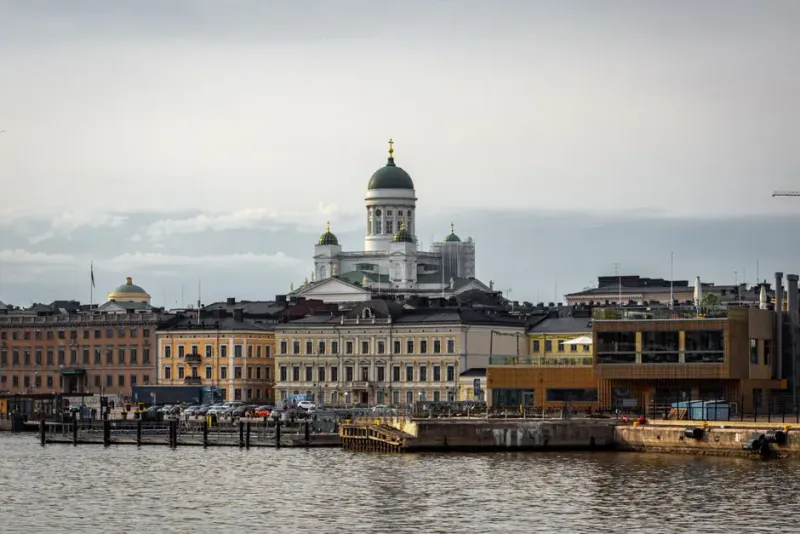
Helsinki is architecturally striking: Senate Square, the Market Square by the harbour, the Temppeliaukio church carved into bedrock, and the Helsinki Cathedral. The sea is everywhere - the South Harbour, Kauppatori, and archipelago ferry routes to Suomenlinna are daily life, not tourist highlights.
The winters are real. January average temperature: à¢Ë†'4à‚°C. Darkness from November through January is significant - about 6 hours of daylight in December. But the city functions smoothly year-round, with ice skating rinks, sauna culture, and one of the most liveable winter city environments in the world.
Best Helsinki neighbourhoods for expats:
- Tà¶à¶lච/ Etu-Tà¶à¶lච- classical architecture, well-established professional community, Sibelius Park nearby; expensive but authentic residential Helsinki
- Punavuori / Ullanlinna - design district, independent cafes, galleries; the most sought-after inner neighbourhood for young tech and creative professionals
- Kallio - formerly working-class, now densely populated young-professional neighbourhood; best bar scene in Helsinki, excellent restaurants, lower rents than the design district
- Kamppi / Ruoholahti - central, excellent transport links, closer to Aalto University Tà¶à¶lචcampus; slightly more urban than leafy
- Espoo (Tapiola, Otaniemi) - Aalto University main campus; R&D corridor; larger apartments; good schools; lower rents than inner Helsinki
Tampere
Finland's second-largest city; population approximately 400,000 in the metro area. Built between two lakes (Nà¤sijà¤rvi and Pyhà¤jà¤rvi) with the Tammerkoski rapids running through the centre - a city that consistently ranks among the most liveable in Finland. The industrial heritage is everywhere (old factory districts now converted to restaurants, museums, and tech offices), and the city has reinvented itself as a gaming, ICT, and engineering hub.[35]
Tampere is approximately 25% cheaper than Helsinki on rent. High-speed rail to Helsinki: 1 hour 23 minutes from Tampere Central Station. The city's size makes daily logistics easy in a way Helsinki doesn't: no congestion charge, short commutes, walkable city centre.[20]
Best for: engineering professionals, gaming industry workers, Tampere University researchers, families seeking a lower cost of living within easy reach of Helsinki.
Turku (à…bo)
Finland's oldest city; population approximately 330,000 metro. Sweden's former capital of Finland - bilingual city with both Finnish and Swedish official status. The University of Turku and à…bo Akademi (Swedish-language university) make it a strong academic centre. A developing biotech corridor supports life sciences hiring. Ferry connections to Stockholm and Tallinn via the harbour.
Turku is approximately 33% cheaper than Helsinki on rent. Known for arguably the best restaurant scene relative to city size in Finland.[20]
Best for: academics, researchers, bilingual professionals (Finnish-Swedish), maritime industry workers.
Oulu
Northern Finland's largest city; population approximately 250,000 metro. A significant tech hub - Nokia's largest R&D site globally, and a dense 5G/telecom engineering cluster. Oulu University is a major employer. Latitude 65à‚°N means extreme winters (à¢Ë†'25à‚°C days in January) and midnight sun in summer. The cycling culture is extraordinary - Oulu has the highest bicycle commuting rate in Finland even in winter.
Oulu is approximately 57% cheaper than Helsinki on rent. Best for: telecom engineers, IT professionals, academics, anyone who wants significantly lower costs and doesn't mind the latitude.[20]
Lund-equivalent in Finland: Tampere or Espoo
For those coming from Sweden's university city context: Tampere most closely parallels the Lund/Gothenburg model - sized right, strong university, excellent quality of life, lower costs than the capital.
City Quick Reference
| City | 1-BR Rent (Centre) | Key Sector | Crime Context | Best For |
|---|---|---|---|---|
| Helsinki | à¢"š¬1,000-1,500[20] | Tech/Finance/All | Safe (national avg Low)[34] | HQ roles, expat base |
| Tampere | à¢"š¬700-900[20] | Engineering/Gaming | Safe | Families, engineers |
| Turku | à¢"š¬650-850[20] | Academia/Biotech | Safe | Researchers, bilingual |
| Oulu | à¢"š¬425-600[20] | Telecom/IT | Safe | Tech, low-cost living |
Climate: Brutal Winters, Short Spectacular Summers, Darkness You Must Prepare For
Finland spans from 60à‚°N (Helsinki, same latitude as St Petersburg) to 70à‚°N (Utsjoki, in the Arctic). The climate variation is substantial.[8]
| City | Summer (Jun-Aug) | Winter (Dec-Feb) | Notes |
|---|---|---|---|
| Helsinki | 18-25à‚°C | à¢Ë†'4 to +2à‚°C | 6 hours daylight in Dec; 19 hours in June |
| Tampere | 17-24à‚°C | à¢Ë†'6 to 0à‚°C | Reliable snow December-March |
| Turku | 17-24à‚°C | à¢Ë†'3 to +2à‚°C | Maritime; milder winters |
| Oulu | 17-25à‚°C | à¢Ë†'12 to à¢Ë†'3à‚°C | Extreme cold; midnight sun June |
The polar night (kaamos): In Helsinki, it doesn't get fully dark in summer and barely gets light in deep winter. This is the single greatest adjustment challenge. Seasonal Affective Disorder is common among expats from southern latitudes. Finns have adapted with sauna culture, outdoor ice swimming (avanto), vitamin D supplements, and light therapy lamps - all of which are recommended. The Finnish approach to winter is fundamentally active, not avoidant.
Midnight sun: North of the Arctic Circle, the sun doesn't set for weeks in June. In Helsinki, June twilight is so pale it never fully darkens. This is extraordinary to experience.
Sauna: Not a spa amenity. Sauna is a fundamental part of Finnish social and health culture. Almost every residential building has a shared sauna; many apartments have their own. Sauna invitations from Finnish colleagues are meaningful - accepting them matters for integration.
Internet and Infrastructure
Finland's digital infrastructure is world-class. The country ranks in the global top 10 for internet speed and connectivity penetration.[37]
- Broadband: Fiber connections (100 Mbps-1 Gbps) widely available; providers include Elisa, Telia, DNA. Monthly cost: approximately à¢"š¬25-50/month
- Mobile: Elisa, Telia, and DNA are the three main networks. Monthly plans with unlimited data: à¢"š¬15-40/month - among the lowest prices in Europe
- 5G: Finland has comprehensive 5G coverage in all cities and major towns; Nokia technology deployed domestically
- BankID equivalent - Finnish Bank ID (Pankkitunnus): Used for all government digital services, tax returns, permit renewals at enterfinland.fi, and most e-commerce authentication. Issued by Finnish banks once you have an account and henkilà¶tunnus. Without this, Finnish digital life is significantly harder.
Public transport:
- Helsinki (HSL): Metro, tram, bus, and suburban rail. Monthly card: à¢"š¬72 - covers all HSL zones. The network is clean, punctual, and well-integrated. Night buses run on weekends.[24]
- Tampere: Tram network opened 2021 (expanded 2022), bus network. Monthly pass approximately à¢"š¬60
- VR (national rail): Helsinki-Tampere 83 minutes on high-speed rail; Helsinki-Turku 2 hours; Helsinki-Oulu 3.5 hours by Pendolino. Comfortable, reliable, and affordable.
Cars: Driving on the right. Finnish licence required after 2 years of residence. Winter tires are legally mandatory from November through March - not optional. Ice and snow driving requires adjustment for expats from southern climates. EV charging infrastructure in cities is good but thinner than Sweden.
Buying Property: Open for EU Buyers, Permit Required for Non-EU Land Purchases
Finland is largely open to foreign property buyers, with one meaningful restriction.
EU/EEA citizens: Can buy all types of property - apartments and land plots with houses - with no restrictions whatsoever. Same rights as Finnish citizens.[6]
Non-EU/EEA citizens: Can buy apartments (osakehuoneisto, an apartment share in a housing company) freely. To purchase a land plot (kiinteistච- a detached house or plot of land), a permit from the Ministry of Defence is required. The application is handled via the Ministry of Defence (email: [email protected]). Approvals for residential purchases are generally granted, but the process adds time.[38][6]
Important: Property ownership in Finland does not lead to residency or citizenship. There is no Golden Visa program.[39]
Buying Process[40][39]
- Find property on Oikotie.fi or Etuovi.fi (the two dominant portals), or through a licensed real estate agent (kiinteistà¶nvà¤littà¤jठ/ LKV)
- Non-EU buyers purchasing land: apply to Ministry of Defence first
- Submit binding offer (tarjous) through the agent; conditional on financing and inspections
- Sign preliminary contract (kauppakirja) - typical 10% deposit at signing
- Final purchase transaction at a bank before a public purchase witness (julkinen kaupanvvahvistaja) - notary equivalent; appointment required
- Pay transfer tax (varainsiirtovero): 4% of transaction value for land/houses; 2% for apartment shares (osakkeet)[39]
- Registration fee: 0.05%[39]
- Register ownership in the Land Register (Lainhuutotodistus) via the Digital and Population Data Services Agency (DVV)
Helsinki apartment prices (2026):[23]
- City centre (Punavuori, Kamppi, Ullanlinna): à¢"š¬4,000-6,000/mà‚² for studios/1-BRs
- Tà¶à¶là¶, Etu-Tà¶à¶là¶: à¢"š¬4,000-5,500/mà‚²
- Kallio, Alpilla: à¢"š¬3,500-4,500/mà‚²
- Tampere: à¢"š¬2,500-3,500/mà‚²
- Turku: à¢"š¬2,000-3,000/mà‚²
- Oulu: à¢"š¬1,500-2,200/mà‚²
Annual property tax: 0.93-2% of cadastral (assessed) value, set by each municipality. Finnish property is taxed on a cadastral value that is typically below market value, so the actual annual cost is modest. An apartment with a market value of à¢"š¬300,000 might have a cadastral value of à¢"š¬200,000 and an annual tax bill of à¢"š¬1,860-4,000.[39]
Mortgage financing:
- Major lenders: OP (Osuuspankki), Nordea, Danske Bank, Savings Banks (Sà¤à¤stà¶pankki)
- Standard deposit requirement for residents: 15-20%
- Non-residents without henkilà¶tunnus: typically 30-40% deposit required
- Mortgage rates (June 2026): approximately 3.0-3.8% on 12-month Euribor-linked or fixed rates
Your First 30 Days: The Checklist
Register with the Finnish Population Register (DVV - Digi- ja và¤està¶tietovirasto) - visit in person at a DVV service point (magistraatti); bring your residence permit, passport, and proof of address; you will receive your henkilà¶tunnus (personal identity code) either immediately or within a few days; this 11-digit code is your master key - without it, no bank account, no Kela card, no phone contract on standard terms, and no access to most government digital services; DVV offices in Helsinki, Espoo, Tampere, Turku, and other major cities; book an appointment online at dvv.fi
Apply for your Kela card - once registered in the population register, apply at kela.fi or at a Kela service point; the Kela card certifies your right to National Health Insurance and entitles you to reimbursement of approved healthcare costs; without it, you pay full private rates; processing: 1-2 weeks
Open a Finnish bank account - major banks: OP (most branch-accessible), Nordea, Danske Bank, Handelsbanken; some banks accept applications with a henkilà¶tunnus and passport before the Kela card arrives; for those still waiting on henkilà¶tunnus: Revolut and Wise accept Finnish residents and are functional for daily use in the interim; internet banking and mobile app are the default - branch visits are for account opening only
Get your Finnish Bank ID (Pankkitunnus) - activated through your bank's internet banking once your account is open; this is the authentication method for enterfinland.fi (permit renewals), vero.fi (tax returns), kela.fi, DVV services, and most government portals; without it, you fill in paper forms; with it, almost everything is digital and efficient
Apply for key employee tax regime within the first weeks of employment - if you qualify - salary threshold: à¢"š¬5,800/month gross; role must require special expertise; apply jointly with your employer to Vero.fi immediately after starting work; there is no flexibility on timing; missing this window means standard progressive taxation for the duration of your Finnish employment; at à¢"š¬6,000/month gross, the 25% flat rate saves approximately à¢"š¬500-700/month versus standard tax[5][28]
Register at a health centre (Terveysasema) in your municipality - used for GP appointments within the public system; find your nearest centre at hyvis.fi or your municipality's website; register as a patient before you need it, not when you are sick; public GP appointments: typically available within 14 days by law; for faster access, use your employer's occupational healthcare (tyà¶terveys)[33]
Confirm your occupational healthcare coverage with your employer - Finnish law requires all employers to provide preventative occupational healthcare; most employers provide comprehensive private GP and sick-leave care; ask HR specifically which provider is used (Terveystalo, Mehilà¤inen, or Pihlajalinna are the main private chains) and how to book your first appointment; this is often the fastest healthcare access for the first months after arrival
Enrol in the unemployment fund (Tyà¶ttà¶myyskassa) - voluntary but critical; monthly membership fee: approximately à¢"š¬4-8 (varies by fund); after 6 months of membership, you become entitled to earnings-related unemployment benefit if you lose your job (80% of previous salary up to a ceiling, for up to 400 days); without membership, you receive only the basic Kela allowance (approximately à¢"š¬37/day); most sector-specific unions run their own kassat - find the right one at tyj.fi
Buy winter tyres if you drive - legally mandatory from November 1 to March 31 (approximately); Finnish road law requires winter tyres on all vehicles in winter conditions; studded (nastarengas) or friction tyres both acceptable; factor tyre costs into your car purchase; fines for driving without winter tyres: à¢"š¬40-200 depending on enforcement
Start Finnish language study as soon as you arrive - not optional if you want permanent residence under the standard route (A2 required), or citizenship (higher level required); most municipalities and employers offer sponsored Finnish courses; free online resources: Finn.fi (beginner), YLE Oppiminen, Yle Kielikoulu; the earlier you start, the lower the A2 requirement becomes a practical constraint; Finnish is genuinely one of the harder languages for English speakers - budget 100-200 hours for functional A2 competence
Key Data at a Glance
| Indicator | Value |
|---|---|
| GDP Growth 2026 (EC forecast) | 0.8%[4] |
| GDP Growth 2026 (OECD) | 1.1%[7] |
| GDP Growth 2027 | 1.4-1.7%[4][8] |
| Inflation 2026 | 2.4%[4] |
| Unemployment 2026 | 10.1%[4] |
| Average monthly gross salary (Q1 2026) | à¢"š¬4,269[9] |
| Employed person permit - minimum salary (Helsinki metro) | à¢"š¬1,210/month net[12] |
| Specialist / EU Blue Card - minimum salary | à¢"š¬3,937/month gross (from Jan 1, 2026)[13][14] |
| Key employee regime flat tax rate (from Jan 1, 2026) | 25% for up to 7 years[5] |
| Key employee salary threshold | à¢"š¬5,800/month gross[28] |
| Standard income tax top marginal rate | ~52% (state + municipal + social)[27] |
| Capital gains / capital income tax | 30% (up to à¢"š¬30k) / 34% (above à¢"š¬30k)[26] |
| No wealth tax, inheritance tax | Confirmed[27] |
| Permit fees - specialist (online) | à¢"š¬530[14] |
| Permit fees - employed person (online) | à¢"š¬750[14] |
| Permanent residence (standard route) | 6 years + A2 language + 2yr work history (from Jan 8, 2026)[1] |
| Permanent residence (fast track) | 4 years if income à¢"°¥à¢"š¬40,000/yr or qualifying degree[2] |
| PR fee (online) | à¢"š¬380[14] |
| Citizenship residency requirement | 8 years (from Oct 2024)[3] |
| Citizenship (language track) | 5 years with language proficiency[3] |
| Citizenship test | Planned January 2027[19] |
| Dual citizenship | Permitted - no renunciation required |
| National Crime Index (Crowdsourced Data 2026) | 24.44 - Low[34] |
| Helsinki safety ranking (global 2026) | 41st safest city worldwide[36] |
| Helsinki 1-BR rent (centre) | à¢"š¬1,000-1,500/month[20] |
| Tampere 1-BR rent (centre) | à¢"š¬700-900/month[20] |
| Helsinki apartment price per mà‚² (centre) | à¢"š¬4,000-6,000/mà‚²[23] |
| Property transfer tax (apartments) | 2% of transaction value[39] |
| Property transfer tax (land/houses) | 4% of transaction value[39] |
| Foreign buyer restriction (non-EU, land plots) | Ministry of Defence permit required[6] |
| Annual healthcare cost cap (public) | à¢"š¬900/year[30] |
| GP visit (public health centre) | ~à¢"š¬30/visit[30] |
| Annual prescription cap | à¢"š¬572/year[30] |
| HSL monthly transport card (Helsinki) | à¢"š¬72[24] |
| Emergency | 112 |
| Non-emergency medical | 116117 |
The January 2026 permanent residence changes landed hard. Anyone who arrived in Finland in 2022 expecting a 4-year PR timeline now faces 6 years, language tests, and employment documentation requirements they may not have planned for. The only escape hatch: earn above à¢"š¬40,000/year (the high-income fast track still runs at 4 years with no language requirement), or hold a qualifying Finnish graduate degree. If neither applies, start Finnish language study now - A2 is achievable, but it takes consistent effort across 12-18 months. Waiting until year five of your permit to think about it will create real pressure.[2][1][15]
References
Finland Tightens Permanent Residence Rules Effective 2026 - Finland introduces stricter residency, language, and work history requirements for permanent residen...
Stricter conditions for permanent residence permits as of 8 January - The conditions for obtaining a permanent residence permit will be tightened. For example, the contin...
Longer period of residence required for citizenship - Valtioneuvosto - The period of residence required for acquiring Finnish citizenship will be extended as of 1 October ...
Economic forecast for Finland - Economy and Finance - The latest macroeconomic forecast for Finland. The European Commission publishes a full set of macro...
Finland - Amended Expatriate Tax Regime Expands Scope and ... - Effective January 1, 2026, Finland amended the Law on Withholding Tax on Expatriates (Law 1144/2025)...
Authorisation to non-EU and non-EEA buyers to buy real estate
OECD Economic Outlook, Volume 2025 Issue 1: Finland - The global outlook is becoming increasingly challenging. Substantial increases in barriers to trade ...
Finnish economy's recovery moving modestly forward - The Finnish economy is moving out of a sluggish growth phase, but there is no strong growth anticipa...
Index of wage and salary earnings | Statistics Finland - The index of wage and salary earnings measures the development in the average earnings of full-time ...
Average annual wage in Finland 1990-2024 - Statista - The average annual wage in Finland amounted to 49,020 Euros in 2024. Between 1990 and 2024, the aver...
THE SOCIAL SECURITY AND HEALTHCARE SYSTEM IN FINLAND - People living or working in Finland are entitled to use benefits granted by Kela, which is the Finni...
Residence permit application for persons employed as a specialist - Apply for a residence permit with this application if you work as a specialist, a consultant, a teac...
Mikko Loikkanen's Post - LinkedIn - à°Å¸"· Update: Finnish residence permit salary thresholds and application fees in 2026 As of 2026, the Fi...
Finland's NEW RESIDENCY RULES for Expats (2026) - à¢Å“"¦ Avoid BIG Mistakes When Moving to Finland https://www.youtube.com/watch?v=xqNc36QdtAg à¢Å“"¦ Make your ...
Reform of the Citizenship Act - Ministry of the Interior - Sisà¤ministeriච- Interoperability
Finland: New Citizenship Requirements | Envoy Global, Inc - The government of Finland will introduce new citizenship requirements and timelines beginning 1 Octo...
Amendments to the Citizenship Act in December 2025 - The Finnish Parliament has approved a set of amendments to the Citizenship Act that will enter into ...
Finland moves ahead with mandatory citizenship test for ... - VisaHQ - "¢ On 28 Feb 2026 the Interior Ministry outlined a computer-based citizenship test that will become m...
Finland Cost of Living 2026 - Expat Data | WTE - Detailed cost of living comparison across 4 cities in Finland. Rent, monthly budgets for singles and...
Updated Rents in Helsinki (2026) - Investropa - As of early 2026, average Helsinki rent is 23 to 25 euros per square meter monthly (25 to 27 USD or ...
Gross rental yields in Finland: Helsinki and 4 other cities - What rental returns (yields) do residential investments in Finland earn? Research on average incomes...
Cost of Living in Helsinki. Jun 2026. Prices in Helsinki - The estimated monthly costs for a family of four are $4,236.9 (à¢"š¬3,664.6), excluding rent. The estima...
Cost of Living in Helsinki. Updated Prices Jun 2026. - Expatistan - Family of four estimated monthly costs: à¢"š¬4,539 Single person estimated monthly costs: à¢"š¬2,488 . List ...
Finland Tax Calculator 2026 - Net Income & Tax Rates Online - Official 2026 rates. Free Finland salary calculator: estimate take-home pay, effective tax rate, exp...
Finland's Expat Tax Regime - 2025 Guide - Northern Partners - Flat 32% tax rate for international professionals working in Finland under the key employee regime (...
Finland - Individual - Significant developments - Detailed description of significant developments in individual taxation in Finland
Healthcare in Finland - Work in Finland - Like many Nordic nations, Finland's public healthcare system is tax-funded and accessible to anyone ...
Healthcare System in Finland: Benefits to enjoy after citizenship! - The healthcare system in Finland provides Kela cards to its citizens as proof of eligibility for Nat...
Right to healthcare services in Finland - The Nordic Co-operation - The Kela card proves that you are entitled to health insurance benefits in Finland. You need the car...
Finland Healthcare System - Insurance Options for Expats - In Finland, those who have a valid Kela card are entitled to get partial reimbursement for private h...
Crime in Finland - Cost of Living - Crime rates in Finland ; Worries being mugged or robbed. 22.50 ; Worries car stolen. 16.43 ; Worries...
Here are the least safe cities in Finland, based on police data - Yle - Vantaa, Jyvà¤skylà¤, and Tampere are currently Finland's most unsafe cities, according to the latest f...
Top 50 Most Safest Cities in 2026 1. Qingdao, China 2. Abu ... - Top 50 Most Safest Cities in 2026 1. Qingdao, China 2. Abu Dhabi, United Arab Emirates 3. Doha, Qata...
Moving to Sweden: Registration Guide for Expats - MoveToEU - à°Å¸""¹12 registration steps covered in this guide. Sweden's 10-digit personal identity number, Activation...
Buying Land as a Foreigner in Finland (2026) - Investropa - The latest update about buying land as a foreigner in Finland. Conditions, eligibility, zones, restr...
Finland Real Estate Investment for Foreigners 2026 - Immigrant Invest - Detailed guide to investing in apartments & houses in Helsinki and other cities in Finland. How inve...
Buying Selling Finland Property As A Foreigner - Finland, with its stunning natural landscapes, deep cultural heritage, and welcoming atmosphere, pre...
Cover photo by Vish Pix on Pexels.
Frequently Asked Questions
How long is the new permanent residence requirement in Finland? The permanent residence rules now require 6 years of continuous residence (up from 4).
What are some key sectors for expat professionals in 2026 according to the guide? Key sectors include technology and IT, engineering and manufacturing, games industry, life sciences and clean technology, and defence.
Is there any restriction on EU citizens buying property in Finland as mentioned in the text? No, unlike Sweden, Finland imposes no restrictions on EU citizens buying property.
Want to see how Finland stacks up?
Are you seriously considering a move? Use our interactive tools to explore Finland's climate, tax brackets, and nomad visas.