Moving to Belize in 2026: The $2k Retirement Visa, 0% Tax, and the Brutal Reality
July 24, 2026
ShareBelize offers one of the simplest, cheapest retirement residency programs anywhere in the Americas - a $2,000/month income requirement and 30 days a year buys permanent tax-free status - but the country also carries one of the highest national homicide rates in the hemisphere, concentrated almost entirely in one city most retirees never actually live in. English is the official language, the currency is pegged to the US dollar, and land ownership rights for foreigners are genuinely equal to citizens. This is everything you need to know before you move.[1][2][3]
The Economy: Eyes Open
Belize's economy is small and tourism-dependent, and forecasts through 2026 point to modest but improving growth. The UN's Economic Commission for Latin America and the Caribbean (ECLAC) projects 2.5% GDP growth for 2026, up from an estimated 1.6% in 2025 - placing Belize among the countries expected to record moderate gains next year, and running slightly above the broader Caribbean regional average of 1.7%. A separate Central America Economic Review analysis pegs the range at 2.5-2.7%, supported by tourism, services, and remittance inflows, describing the outlook as "cautiously positive."[4][5][6]
This is genuinely modest growth by regional standards - Belize isn't posting Panama or Indonesia-style expansion - but it reflects a small, stable economy anchored by tourism (the dominant sector), agriculture, and a currency pegged 1:2 to the US dollar since 1976, which removes currency volatility entirely for dollar-based expats and retirees. The 2026/2027 national budget, presented in March 2026, continues prioritizing tourism infrastructure and fiscal stability rather than any dramatic policy shift.[7][6][1]
Visas and Residency: What Changed in 2026
The Qualified Retired Persons (QRP) Program: Central America's Simplest Path
Belize's flagship residency vehicle, the Qualified Retired Persons Program, is widely described as one of the most efficient residency-by-retirement pathways anywhere in the Americas. It requires no minimum age beyond 40, and financial qualification is refreshingly simple.[8]
| Requirement | Detail |
|---|---|
| Minimum age | 40 years old[9] |
| Minimum income | US$2,000/month or US$24,000/year from a source outside Belize[9] |
| Approved currencies | US Dollar, Pound Sterling, Euro, Canadian Dollar[9] |
| Minimum annual presence | 30 consecutive days per year[9] |
| Dependents included | Spouse and children under 18 (up to 23 if enrolled full-time in university)[8] |
Application Costs
| Fee | Amount |
|---|---|
| Application fee | US$150[1] |
| Principal applicant approval fee | US$1,000[1] |
| Per dependent | US$750[1] |
| ID card, per person | US$200[1] |
| Annual renewal | US$25[1] |
The Real Benefits
QRP status grants a genuinely generous package: permanent exemption from Belizean income tax, capital gains tax, and inheritance tax on income and assets sourced outside Belize, duty-free import of household effects, one motor vehicle no older than five model years (replaceable every three to four years upon proper disposal of the previous one), a boat, and light aircraft under 17,000 kg. Notably, QRP members are not permitted to seek employment in Belize, though voluntary work and business investment remain open.[9][1][8]
The QRP Investor Track
For those wanting to combine retirement residency with active business involvement, the QRP Investor route requires a formal business plan, proof of investment capital of at least BZ$1,000,000 (~US$500,000), at least 90 non-consecutive days of Belize residence, and the business employing at least five Belizean citizens. This track leads to full permanent residency after five years as a QRP-Investor.[1][8]
Permanent Residency (Non-QRP Route)
For those under 40 or not meeting QRP income thresholds, standard Permanent Residency requires 12 consecutive months of legal residence with no more than 14 total days of absence during that year, financial stability documentation, and interviews with both Immigration and the Police Special Branch. A separate Temporary Residence track exists for investors depositing at least BZ$500,000 in Belize who cannot maintain continuous physical presence.[1]
The 2026 Tax Relief Update
Regular Belize-sourced income is taxed at 25%, but relief introduced starting in 2025 softened this meaningfully: annual income of BZ$29,000 or less is untaxed, income up to BZ$32,000 receives partial credits, and earners above that threshold can claim BZ$20,000 in personal relief. This applies to local income only - QRP members' foreign-sourced retirement income remains fully exempt regardless.[1]
Documentation Checklist
Required paperwork includes a notarized birth certificate and marriage certificate for each family member, an original police record issued within one month of application, a complete color passport copy (every page, notarized), medical examination plus HIV/AIDS test for each family member, and multiple passport-style photographs.[8]
Path to Citizenship
QRP status does not itself lead to citizenship - it is a permanent residency-equivalent status renewed annually via a simple bank-statement compliance check. Standard naturalization to Belizean citizenship generally requires several years of continuous permanent residency plus additional government requirements, separate from the QRP track entirely.[8][1]
Cost of Living: The Real Numbers
Belize delivers genuinely affordable Caribbean living. The average monthly cost for a single person across Belizean cities runs $1,766 including rent, or $1,116 excluding rent. Budget-conscious singles can manage on roughly $905.50/month including rent, while comfortable-to-luxury living reaches $3,381/month.[10]
Monthly Expenses (Belize, 2026)
| Item | Cost (USD) |
|---|---|
| Monthly rent, primary residence | $650 (range $380-$1,100)[10] |
| Electricity | $60 (range $35-$100)[10] |
| Water | $30 (range $15-$48)[10] |
| Broadband internet + cable | $88 (range $60-$128)[10] |
| Average monthly salary (local) | $1,400[10] |
Family and Couple Budgets
| Household | Monthly Cost (incl. Rent) |
|---|---|
| Single person | $1,766[10] |
| Couple | $2,463.90[10] |
| Family of four | $3,444.90[10] |
Belize's average local monthly salary of $1,400 runs 25.4% above the average single-person cost of living, though this reflects local wage levels rather than what most relocating expats or retirees would rely on. Belize's infrastructure carries real limits worth noting: only about 601 of 3,281 kilometers of roads are paved (roughly 18%), which slows travel meaningfully during the rainy season, and median fixed internet speed sat at 48.04 Mbps in early 2025, with weaker performance in rural areas.[10][1]
Taxes: What You Actually Pay
Belize's tax framework for QRP retirees is genuinely favorable - foreign-sourced retirement income, capital gains, and inheritance all fall entirely outside the Belizean tax net.[1]
| Tax Category | Rate |
|---|---|
| Foreign-sourced income (QRP members) | 0%[1] |
| Belize-sourced personal income | 25%, with 2025+ relief bands[1] |
| Tax-free income threshold | BZ$29,000/year[1] |
| General Sales Tax (GST) | 12.5%[1] |
| Property transfer stamp duty (foreign buyers) | 8%[3] |
| Property transfer stamp duty (Belizean/CARICOM citizens) | 5%[3] |
| First $10,000 USD of property value | Exempt from stamp duty[3] |
| Annual property tax | ~$100/acre/year, based on market value, roughly 0.75-1.5% for residential parcels[11] |
Belize's stamp duty structure genuinely disadvantages foreign buyers relative to citizens and CARICOM nationals - the 8% rate applies specifically to non-Belizean purchasers, and some buyers offset this by structuring purchases through an International Business Company (IBC).[3]
Healthcare: Public vs. Private
Belize runs a mixed public-private system. National Health Insurance (NHI) covers primary care in major towns, but public NHI coverage on the outer islands, including Ambergris Caye, only expanded starting in 2024 - meaning many long-term residents there still rely primarily on private clinics or travel for more complex needs. The World Bank's latest figures put physician density at roughly 1.1 physicians per 1,000 people, with specialist care concentrated almost entirely in Belize City.[1]
For anything beyond routine care, many residents - particularly those on the islands or in smaller inland towns - travel to Mexico (commonly Chetumal or Cancún) for specialist treatment. Medicare generally does not cover care outside the US except in narrow, specific circumstances, and Medigap policies typically offer only limited foreign emergency benefits - meaning American retirees need dedicated international health insurance rather than assuming Medicare travels with them.[1]
Safety
This is the section requiring the most direct honesty, because Belize's national crime statistics and the on-the-ground reality for most expats diverge dramatically by location - more sharply than almost any other country in this guide series.
The National Numbers Are Genuinely Concerning
Belize's homicide rate stands at 28.06 per 100,000 (2022, the latest year UNODC data covers via World Bank) - among the highest rates tracked in the Americas, and multiple government travel advisories (US, UK, Canada) explicitly flag high levels of violent crime. The UK Foreign Office has specifically noted a 30-day State of Emergency declared in parts of Belize City.[2]
But It's Almost Entirely Concentrated in One Place
The crucial context: 57 murders occurred in Belize in 2023, and 66% of them happened in Belize City alone. A regional safety breakdown across Belize's districts shows the disparity starkly:[2]
| District/Area | Safety Grade | Composite Score |
|---|---|---|
| Corozal | Leading region | 83.8/100[2] |
| Ambergris Caye / San Pedro region (Belize District, aggregated) | F | 3.1/100 (driven by Belize City, not the island itself)[2] |
| National aggregate | F | 46.0/100[2] |
The data source itself flags an important caveat: Ambergris Caye / San Pedro is genuinely a much lower-violence sub-area than the district-level statistic suggests, but island-specific homicide data isn't separately published, so the aggregate district score unfairly drags down what residents on the ground consistently describe as a comparatively low-crime tourist and expat hub.[2][1]
On-the-Ground Reality from Long-Term Residents
A resident of nearly 19 years on Ambergris Caye describes the island as "safe to visit" with the consistent caveat that basic street-smart precautions matter - most crime, including drug-trade-related violence, concentrates in Belize City and rarely spills over to the islands. The US State Department's Level 2 advisory ("Exercise Increased Caution") applies to Ambergris Caye specifically, with "most higher risks outside the island" according to expat-focused retirement guides.[12][1]
Practical Precautions
- Avoid walking alone on dark beaches or roads at night, even on lower-crime islands[12]
- Take taxis rather than walking in Belize City, day or night, unless very familiar with the area[12]
- Keep bags and phones attended at all times on beaches and in golf carts (a common local mode of transport)[12]
- Be vague with strangers about your accommodation details and daily schedule[12]
- Avoid drug transactions entirely - Belize sits directly on the South America-to-US drug trafficking corridor, and most serious crime traces back to this trade[12]
English in Everyday Life
Belize is the only Central American country with English as its official language - genuinely differentiating it from every Spanish-speaking neighbor and removing the language barrier that complicates daily life, banking, healthcare, and government interactions elsewhere in the region.[1]
Which Region?
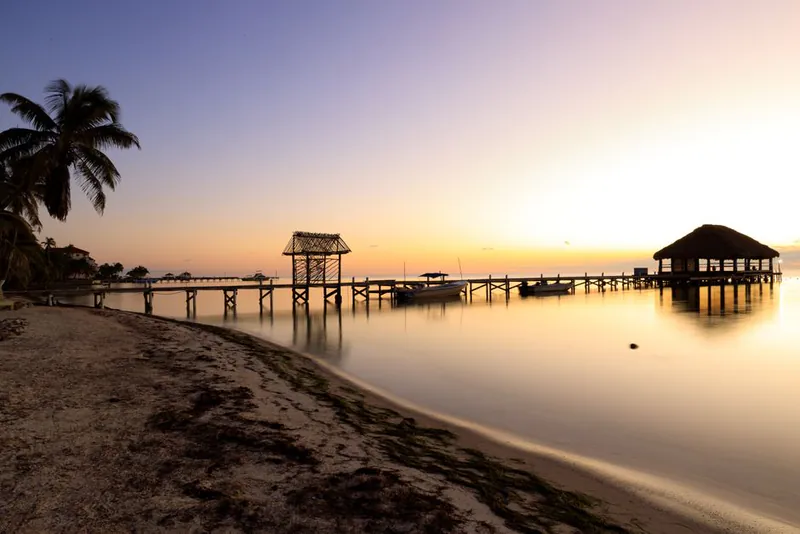
Ambergris Caye (San Pedro Town)
Belize's most popular expat destination, with nearly 12,000 residents at last census and steady ongoing development. Home to the Hol Chan Marine Reserve and Shark Ray Alley, offering some of the best snorkeling and diving access anywhere in the Caribbean. Reliable infrastructure and a vibrant, established expat community make it the default choice for most American and Canadian retirees, despite the island falling within a district-level crime statistic that overstates its actual on-the-ground risk.[1]
Corozal
The safest district in Belize by composite safety score, located in the north near the Mexican border. Quieter and less developed than Ambergris Caye, appealing to those prioritizing safety and lower cost over beach-resort infrastructure.[2]
Belize City
Belize's largest urban center and the country's one genuine urban crime hotspot, accounting for roughly two-thirds of national homicides. Most retirement guides explicitly recommend against residing here, treating it instead as a transit point (airport, ferry terminal) rather than a destination.[2]
Cayo District (San Ignacio, Belmopan)
The inland capital region, offering a cooler climate, lower cost of living than the islands, and access to Maya ruins and jungle lodges - popular with retirees seeking a quieter, more rural lifestyle away from coastal tourism.
Placencia
A laid-back southern peninsula village popular with a smaller, tight-knit expat community seeking beach access without Ambergris Caye's relative development and price growth.
Climate: Tropical with Clear Seasons
Belize's average yearly temperature runs around 84°F (29°C), with a clear dry-and-wet seasonal pattern shaping daily life rather than dramatic temperature swings.[1]
| Season | Months | Character |
|---|---|---|
| Dry season | Late November - May | Lower humidity, most popular tourist and relocation-scouting period |
| Wet season | June - November | Heavy rainfall, hurricane risk peaks August-October |
Belize sits within the Caribbean hurricane belt, and the wet season carries genuine storm risk - insurance and building standards should factor this into any property decision, particularly on the more exposed cayes.[1]
Buying Property
This is one of Belize's most genuinely investor-friendly features: foreign ownership of real estate, including land, is unrestricted - foreigners hold the same property rights as Belizean citizens and can acquire land under Absolute Title. There are no squatter's rights in Belize; if title is demonstrated, police will remove trespassers.[13][11][3]
The Four Types of Land Title
| Title Type | Where Used |
|---|---|
| Deed of Conveyance | Islands and unregistered/undeclared locations - most common form[3] |
| Land Certificate | Government-surveyed land in urban areas and developed islands, under the 1977 Registered Land Act[3] |
| Transfer Certificate of Title | Previously registered properties[3] |
| Minister Fiat Grant | Unregistered government land; foreigners can purchase but not receive directly[3] |
Property Cost Stack
| Cost | Amount |
|---|---|
| Stamp duty (foreign buyers) | 8% of property value[3] |
| Stamp duty (Belizean/CARICOM buyers) | 5%[3] |
| First $10,000 USD exempt from stamp duty | - [3] |
| Annual property tax | ~$100/acre (rural); 0.75%-1.5% of market value for developed/residential[11] |
The Due Diligence Warning
Multiple current guides flag the same core risk: undeclared land - parcels not yet surveyed or registered - is cheaper but genuinely riskier, since there's no government guarantee the seller actually holds valid title. An exhaustive title search through a real estate professional or land consultant, and registration of every land transfer through the Land Registry under the Ministry of Natural Resources, are treated as essential, non-optional steps by every serious property guide covering Belize.[3][1]
Important: property ownership itself confers no residency or citizenship rights - the QRP program's "ease of purchasing land" benefit is a facilitation perk for those already holding QRP status, not a standalone residency pathway.[9]
Your First Steps: The Checklist
- Confirm you meet the QRP's core threshold: age 40+, and US$2,000/month (US$24,000/year) in foreign-sourced retirement income - the simplest, cheapest path in the region if you qualify[9]
- Budget the real QRP cost: $150 application + $1,000 principal approval + $750 per dependent + $200 per ID card, plus $25 annual renewal[1]
- Gather notarized documents well in advance: birth and marriage certificates, a police record issued within the past month, full notarized passport copy, and medical/HIV exams for every family member[8]
- Plan your annual presence around the 30-consecutive-day minimum to maintain QRP status - genuinely one of the lightest physical-presence requirements of any residency programme covered in this series[9]
- Choose your location using district-level, not just national, safety data - Ambergris Caye and Corozal carry materially lower on-the-ground risk than the national aggregate suggests, while Belize City should generally be treated as a transit point, not a destination[2][12]
- Arrange dedicated international health insurance rather than relying on Medicare - US Medicare generally does not cover care abroad except in narrow circumstances[1]
- Identify your nearest adequate healthcare option before committing to a remote location - specialist care concentrates in Belize City, and many islanders travel to Mexico for complex treatment[1]
- Hire a local real estate lawyer and demand a full title search before any land purchase, avoiding undeclared/unsurveyed land unless you fully understand and accept the risk[3]
- Budget the 8% foreign-buyer stamp duty into any property purchase, and explore IBC structuring with a Belizean attorney if that materially changes your total cost[3]
- Factor hurricane season (August-October) into both your relocation timing and any property insurance decisions, particularly for caye and coastal properties[1]
Key Data at a Glance
| Indicator | Value |
|---|---|
| GDP Growth Forecast 2026 (ECLAC) | 2.5%[4] |
| GDP Growth 2025 (estimated) | 1.6%[4] |
| Caribbean Regional Average 2026 | 1.7%[5] |
| Currency Peg | 1 USD = 2 BZD (fixed since 1976)[1] |
| QRP Minimum Age | 40[9] |
| QRP Minimum Income | US$2,000/month or $24,000/year[9] |
| QRP Minimum Annual Presence | 30 consecutive days[9] |
| QRP Foreign Income Tax | 0%[1] |
| Belize-Sourced Income Tax | 25%, with 2025+ relief bands[1] |
| General Sales Tax | 12.5%[1] |
| Foreign Buyer Stamp Duty | 8%[3] |
| Foreign Land Ownership | Unrestricted, equal to citizens[3] |
| National Homicide Rate (2022, UNODC) | 28.06 per 100,000[2] |
| Belize City Share of National Murders (2023) | 66%[2] |
| Safest District (Composite Score) | Corozal, 83.8/100[2] |
| Single Person Monthly Cost (national avg.) | $1,766 incl. Rent[10] |
| Average 1-BR Rent | $650/month (range $380-$1,100)[10] |
| Paved Roads | ~18% (601 of 3,281 km)[1] |
| Physicians per 1,000 People | 1.1[1] |
| Official Language | English (only Central American country)[1] |
Belize in 2026 offers a genuinely rare combination for the right profile: retirees who can meet a modest $2,000/month income bar get one of the simplest, cheapest, and most tax-favorable residency paths anywhere in the Americas - provided they settle in Ambergris Caye, Corozal, or another expat-established area rather than Belize City, and go in with realistic expectations about healthcare access and infrastructure outside the main tourist hubs.
References
Retire in Belize: 2026 guide to visas, costs & taxes | TfE - More Americans are choosing to retire in Belize, and this complete guide covers costs, healthcare, v...
Belize Safety Score - sourced crime and advisory grade · CrossingHQ - Belize carries one of the highest homicide rates covered - 28.06 per 100,000 (2022, the latest year ...
Property Taxes - Belize is a magnificent nation in Central America that is well-known for its varied wildlife, gorgeo...
ECLAC Projects Stronger Growth for Belize in 2026 - The latest economic outlook from the United Nations Economic Commission for Latin America and the Ca...
ECLAC Warns of Sluggish Caribbean Growth - The United Nations Economic Commission for Latin America and the Caribbean (ECLAC) has released its ...
Belize Economic Outlook 2026, Growth Forecasts and Policy Analysis - Explore Belize’s 2026 economic outlook, including growth forecasts, sectoral trends, and policy reco...
Belize QRP Requirements 2026 | Wrobel & Co., Attorneys-at-Law - Qualified Retirement Program requirements, income thresholds, and application process - explained by...
Retire in Belize | travelbelize.org - Retirement in Belize never looked so good. Bountiful beauty, adventure, laid-back atmosphere and inv...
Cost Of Living in Belize in 2026 - This page contains up-to-date cost of living information for Belize in 2026. Compare prices for rent...
BP&CLDC - FAQ - Frequently asked questions
Is Belize Safe To Visit? 2026 Update From Someone Who Lives Here - Belize is considered generally safe for travel but there are some precautions to take...see my list ...
Frequently Asked Questions
What are the primary visa and residence options for moving to Belize in 2026? Notably, QRP members are not permitted to seek employment in Belize, though voluntary work and business investment remain open.
How does personal income tax work for expats in Belize? Belize's tax framework for QRP retirees is genuinely favorable - foreign-sourced retirement income, capital gains, and inheritance all fall entirely outside the Belizean tax net.
What is the average cost of rent and living in Belize? Budget-conscious singles can manage on roughly $905.50/month including rent, while comfortable-to-luxury living reaches $3,381/month.
How many years of residence are required for citizenship or permanent residency in Belize? Standard naturalization to Belizean citizenship generally requires several years of continuous permanent residency plus additional government requirements, separate from the QRP track entirely.
Cover photo by Roy Serafin on Pexels.
Want to see how Belize stacks up?
Are you seriously considering a move? Use our interactive tools to explore Belize's climate, tax brackets, and nomad visas.