Saint Lucia in 2026: The 'Secret' 0% Tax Caribbean Haven with No Income Floor
July 11, 2026
ShareSaint Lucia levies zero capital gains tax, zero inheritance tax, and zero tax on foreign-sourced income - and its "Live It" digital nomad program has no fixed income floor, making it the most accessible legal long-stay Caribbean arrangement available in 2026. Costs run 40% below New York City. The currency is pegged to the US dollar. English is the official language. Between the twin Piton peaks and a Citizenship by Investment program starting at $240,000, this 617 km² island punches far above its size for globally mobile expats.[1][2][3]
The Economy: Eyes Open
Saint Lucia's economy is small, open, and tourism-dependent - and that means volatility is real. The IMF's January 2026 assessment put GDP growth at 1.7% in 2025, following a strong 4.7% expansion in 2024 driven by tourism. Growth is expected to rebound in 2026 as tourism picks up, converging back toward a medium-term potential rate of 1.5% per annum as new infrastructure and tourism projects are completed.[4]
Inflation turned negative in 2024 from falling global food and energy prices, then ticked back up modestly in H1 2025. For 2026, the inflation rate is approximately -0.1% to flat - one of the most stable price environments of any Caribbean nation. Public finances have improved, with the government running primary budget surpluses for three consecutive years. High public debt remains the main vulnerability, with large rollover requirements.[2][4]
GDP is small - approximately $2.77 billion - with the economy effectively running on tourism, construction, and offshore financial services. For expats earning outside St. Lucia, this is irrelevant. The local economy doesn't need to perform for you to live well here. What matters is the pegged currency (XCD fixed at 2.70 to the US dollar since 1976), territorial taxation, and a cost base that rewards foreign income earners.[5][1][2]
Visas and Residency: Your Options in 2026
Visitors from Key Countries
Citizens of the US, Canada, the UK, all EU member states, and most Commonwealth nations do not require a visa to enter Saint Lucia for up to 42 days (6 weeks). They must complete the St. Lucia Electronic Immigration Form before or on arrival - available at govt.lc - and receive a QR-code receipt presented at border control.[6]
Extensions are possible: apply to the Immigration Department before the initial period expires, at approximately $75 USD ($200 XCD) per 30 days per person. Extensions are discretionary and based on an interview.[3]
The "Live It" Digital Nomad Extended Stay Program
Saint Lucia's "Live It" Extended Stay is the island's answer to digital nomad demand. Administered jointly by the Saint Lucia Tourism Authority and the Immigration Department, it grants 12 months of legal residence to location-independent workers with income from outside the island.[3]
Key 2026 requirements:[3]
- Income must come entirely from offshore sources - no St. Lucian employers or clients, no exceptions
- No fixed minimum income floor - the Immigration Department assesses based on "totality of financial health," looking for stability rather than a single high balance
- Provide at minimum 3-6 months of bank statements, payslips, or active client contracts
- International health insurance covering hospitalisation and medical repatriation
- Clean criminal record - police clearance certificate from home country
- Passport valid at least 6-12 months beyond intended departure
- Proof of accommodation for the first 14 days at a certified hotel or villa (non-negotiable)
Application process:[3]
- Complete the online form at govt.lc
- You are paired with a "Live It" Island Specialist who vets your documentation
- Application fee: $47 USD (125 XCD / ~€43)
- Official processing: 5-7 business days; real-world: up to 3 weeks during peak season
- On arrival, you must spend 14 days in certified accommodation
- On Day 15, you receive a physical long-stay identifier bracelet - standard protocol since 2025/2026
What the "Live It" program does NOT give you:[3]
- Right to work for any St. Lucian employer or client - zero
- Voting rights or any path to political participation
- Path to permanent residency - time spent on "Live It" status does not count toward the 5-year PR or 7-year citizenship requirements
- Right to open a business competing with local artisans or small businesses
No fixed income floor sounds liberating. The catch: approval is entirely discretionary. Bank statements showing frequent low-balance dips, irregular income, or sudden high deposits get rejected. The Immigration Department wants to see stable, recurring offshore income above the local cost of living.[3]
Standard Residency Permits
For those pursuing long-term settlement without the CBI route:[7][8]
- Temporary Residency: Renewable annually. Required documents include proof of sufficient funds (no fixed threshold), clean police record, original birth certificate, and a letter of purpose. Fee: approximately XCD 1,050 (~$390 USD)
- Permanent Residence: Available after 5 years of continuous legal residence. No right to work without a separate work permit. Fee: approximately XCD 2,550 (~$945 USD)
- Citizenship by naturalisation: After 7 years of continuous legal residence. This period may be reduced in exceptional circumstances by Cabinet approval - rare in practice
To work for a St. Lucian employer, any non-citizen requires a work permit sponsored by the local employer. The employer must demonstrate that no qualified St. Lucian national can fill the role - a bureaucratic process that typically takes weeks to months.
Citizenship by Investment (CBI)
The St. Lucia Citizenship by Investment Programme is the fastest legal route to permanent status. Administered by the Citizenship by Investment Board (CIAB), it grants full citizenship - no residency requirement before, during, or after the process.[9][6]
| Route | Minimum Investment | Notes |
|---|---|---|
| National Economic Fund (NEF) donation | $240,000 USD | Non-refundable; most popular route |
| Approved real estate | $300,000 USD | Held minimum 5 years |
| Government bonds | $300,000 USD | Non-interest-bearing; held 5 years; St. Lucia is the only Caribbean CBI with this option |
| Enterprise project | $3.5M USD (or $1M in joint venture) | Minimum 3 full-time jobs created |
Processing time: 4-10 months, with mandatory interviews for all applicants aged 16 and over (harmonised rule introduced under ECCIRA in 2026). UK visa-free access was removed in March 2026 - the St. Lucia passport no longer grants visa-free entry to the UK; Schengen (26 countries) is retained.[10][11]
The CBI passport gives visa-free or visa-on-arrival access to approximately 140-146 countries. CBI citizens are exempt from the Alien's Landholding Licence (a 10% of value fee non-nationals must pay to buy property), and have full right to work.[10][9][1]
All five OECS Caribbean CBI programmes now operate under ECCIRA (Eastern Caribbean Citizenship by Investment Regional Authority), launched April 2026, which harmonised due diligence standards across St. Lucia, Dominica, Grenada, St. Kitts & Nevis, and Antigua & Barbuda.[1]
Cost of Living: The Real Numbers
Saint Lucia is not the cheapest Caribbean island - it's more expensive than the Dominican Republic, cheaper than Bermuda or the Cayman Islands. For expats earning Western salaries remotely, it represents exceptional value. Imported goods carry import duties of 5-35% plus 12.5% VAT, which inflates grocery bills. Local produce from markets - mangoes, plantains, breadfruit, fresh fish - is cheap.[1]
The XCD (East Caribbean Dollar) is pegged to USD at 2.70:1.00, a fixed rate in place since 1976. Currency risk does not exist for USD earners.[1]
Monthly Budget by Lifestyle (Single Expat, 2026)
| Lifestyle | Monthly Cost (USD) | What it covers |
|---|---|---|
| Frugal | $1,200-$1,800 [2][3] | Shared or basic apartment, local market food, minibus transport, minimal dining out |
| Comfortable | $2,500-$4,500 [1][2] | 1-BR in Rodney Bay, regular dining out, car, imported groceries |
| Western premium | $5,000-$8,000+ [1] | Luxury villa (Cap Estate/Marigot Bay), private medical, international school |
Rent by Location (2026)
| Neighbourhood | 1-BR Apartment | 3-BR Villa/House |
|---|---|---|
| Rodney Bay (expat hub) | $1,200-$2,000/mo [1] | $3,000-$5,000+/mo |
| Cap Estate (luxury north) | $2,000-$3,500/mo [1] | $3,500-$6,000+/mo |
| Castries (capital, city centre) | $400-$600/mo [2] | $800-$1,500/mo |
| Marigot Bay (scenic, quiet) | $1,500-$3,000/mo [1] | $3,500-$6,000/mo |
| Soufrière (south, authentic) | $300-$700/mo [1] | $600-$1,500/mo |
Daily Expenses
| Item | Cost (USD) |
|---|---|
| Inexpensive restaurant meal | $8-$15 [1][12] |
| Mid-range dinner for two | $50-$80 [1] |
| Coffee (café) | $2-$4 [12] |
| Monthly groceries (single, mixed local/imported) | $400-$700 [1] |
| Electricity (monthly, 85m² apartment) | $150-$350 [1][13] |
| Internet (60 Mbps+ unlimited) | $75-$150/mo [13] |
| Monthly broadband + cable TV | ~$105/mo [13] |
| Fuel (per litre) | ~$2.05 (~5.54 XCD) [12] |
| Private health insurance (per person/month) | $200-$500 [1] |
Electricity is the single most underestimated expense. St. Lucia runs on imported diesel, pushing electricity rates above $0.35 per kWh - roughly double the EU average. Air conditioning in tropical heat can make monthly bills brutal. Long-term expats increasingly install solar panels, which can cut bills by 40-60%.[1]
Taxes: What You Actually Pay
The Territorial System
Saint Lucia operates a territorial tax system. Only income derived from within Saint Lucia is subject to local income tax. Foreign-sourced income - investment returns, dividends, rental income from overseas properties, capital gains from foreign assets - is not taxed locally, regardless of residency status.[14][1]
Zero capital gains tax. Zero inheritance tax. Zero wealth tax. Zero gift tax. These are not loopholes - they are the structural features of Saint Lucia's fiscal framework.[14][1]
Income Tax on Local Income
If you earn income within St. Lucia (from a local employer, local clients, or locally-sourced business), the following brackets apply:[15][16]
| Chargeable Income (XCD) | Equivalent (USD approx.) | Rate |
|---|---|---|
| 0-18,400 | 0 - $6,815 | 0% (personal allowance) |
| 18,401-30,000 | $6,815-$11,111 | 15% |
| 30,001-50,000 | $11,111-$18,519 | 20% |
| Above 50,000 | Above $18,519 | 30% |
Sources: PwC Tax Summaries, IRD Saint Lucia, WhereToemigrate.io[17][16][15]
For "Live It" program participants earning entirely offshore, effective local tax rate: 0%.[14][3]
Corporate Tax
Non-resident companies doing business through a Saint Lucia permanent establishment: 33.3% corporate tax. Residents from outside through a non-permanent establishment: 25% withholding tax.[16]
For remote workers and location-independent entrepreneurs earning outside St. Lucia, there is no corporate structure required and no local tax liability on foreign income.[3]
VAT
Standard rate: 15%, included in most consumer prices. Hotel accommodation: 10%.[17][16]
US Expats
Saint Lucia maintains double taxation agreements with a number of countries, though no DTA exists with the United States. US citizens remain subject to US global taxation regardless of residency. The Foreign Earned Income Exclusion (FEIE) for 2026 allows exclusion of up to $132,900 of foreign-earned income. US citizens should consult a dual-filer specialist before moving - the territorial benefits apply at the St. Lucia level, but US filing obligations are unchanged.[3]
Healthcare: Public vs. Private
The Public System
St. Lucia's public healthcare is centred on Victoria Hospital in Castries - the main government hospital - plus a network of district health centres and polyclinics across the island. Emergency services: dial 999.[18][1]
The system is accessible to residents at low or no cost. Healthcare quality index: 71/100 (WHO-aligned), indicating adequate general quality. Life expectancy: 72.7 years. Government healthcare spending per capita: approximately €655 (~$720)/year - low by Western standards.[18]
The honest picture: Victoria Hospital handles emergencies and routine care competently, but specialist capacity is limited. Wait times for non-urgent specialist consultations can stretch to weeks or months. For complex medical situations - cardiac procedures, oncology, serious injuries - the standard practice is medical evacuation to Barbados, Martinique, Trinidad, or Miami.[1]
Private Healthcare
The main private facility is Tapion Hospital near Castries - a small but functional private hospital with English-speaking doctors, shorter wait times, and basic specialist services. Private clinics operate in Rodney Bay and Castries.[1]
International health insurance with medical evacuation cover is not optional - it is essential. Private coverage runs $200-$500/month per person depending on age and plan scope (Cigna, Allianz, Bupa, SafetyWing are widely used). Plans covering evacuation to Miami or Barbados for serious conditions are standard practice in the expat community.[18][1]
"Live It" program applicants must submit proof of international health insurance including hospitalisation and repatriation as a mandatory document.[3]
Dental Care
Dental services are available at private practices in Castries and Rodney Bay. Costs are moderate by Caribbean standards but generally above what you'd pay in Eastern Europe. Most comprehensive international insurance plans include basic dental; verify specialist dental cover separately.[1]
Safety
Saint Lucia is generally safe - particularly in the north of the island where most expats live. Numbeo's 2024/2025 Castries data shows a Safety Index of approximately 65/100. Walking alone during the day rates as relatively comfortable in tourist and residential areas; night-time awareness is more important.[19][20]
Violent crime concentrated in St. Lucia is primarily concentrated in specific low-income areas of Castries (notably certain parts of the Marchand and Marchand/Castries inner districts) and Vieux Fort - zones that have no reason to concern expats living in Rodney Bay, Cap Estate, or Marigot Bay. Petty theft - bag snatching, vehicle break-ins - is the primary risk in tourist-heavy areas.[20][21]
Gated communities in Cap Estate and waterfront developments in Rodney Bay operate active neighbourhood watch schemes and private security. The expat community's concentrated presence in the north creates a self-reinforcing security environment. The Royal Saint Lucia Police Force is the primary law enforcement body.[1]
Natural hazards are real: Saint Lucia sits in the Atlantic hurricane corridor. Hurricane season runs June - November, with peak risk in August - October. The island has volcanic activity - the Sulphur Springs at Soufrière is an active drive-in volcano. Both hazards are part of island life and are managed rather than feared.[1]
English in Everyday Life
English is Saint Lucia's official language and the sole language of government, business, law, and formal education. Saint Lucian Creole (Kwéyòl) - a French-based patois - is spoken informally among locals and is a source of cultural pride. You do not need Kwéyòl for daily life, banking, or dealing with authorities.[1]
The expat community (estimated 5,000-8,000 foreign residents concentrated in the north) is predominantly English-speaking: US, Canadian, British, and increasingly Middle Eastern and East Asian. Social infrastructure - yacht clubs, beach bars, the Rodney Bay Marina community, various charity and cultural groups - is English-native and welcoming to newcomers.[1]
Where to Live
Rodney Bay and Gros Islet
The undisputed hub of expat life. Rodney Bay has the island's densest concentration of restaurants, supermarkets, shops, a large marina, and a stretch of accessible beach at Reduit. The Baywalk Mall covers familiar retail needs. Rodney Bay Marina hosts an active international yachting community - a social ecosystem in itself.[1]
Best for: anyone arriving without a local network, digital nomads, those who want immediate access to English-speaking services. One-bedroom furnished apartments: $1,200-$2,000/month.[1]
Cap Estate
St. Lucia's most exclusive residential area, on the northernmost tip. High-end villa communities, the Sandals Golf & Country Club, panoramic views to Martinique. Gated, quiet, and expensive. Three-bedroom villas: $3,500-$6,000+/month. This is where most CBI citizens who actually relocate choose to base themselves.[1]
Best for: high earners, retirees with capital, CBI investors who want maximum security and prestige.
Marigot Bay
Alfred Hitchcock once called it "the most beautiful bay in the Caribbean." Twenty minutes south of Castries, it remains quiet and secluded with a small collection of luxury apartments and hillside villas anchored by the Capella resort. The expat community here is smaller and more privacy-focused.[1]
Best for: those who want natural beauty, privacy, and a slower pace than Rodney Bay.
Castries
The capital. Commercial centre, government offices, the main hospital. Also the most urban and the least scenically appealing part of St. Lucia. Rents are cheapest here - 1-BRs from $300-$600/month - but the neighbourhood quality varies considerably by area.[2]
Best for: those working locally or needing daily access to government services and administration.
Soufrière and the South
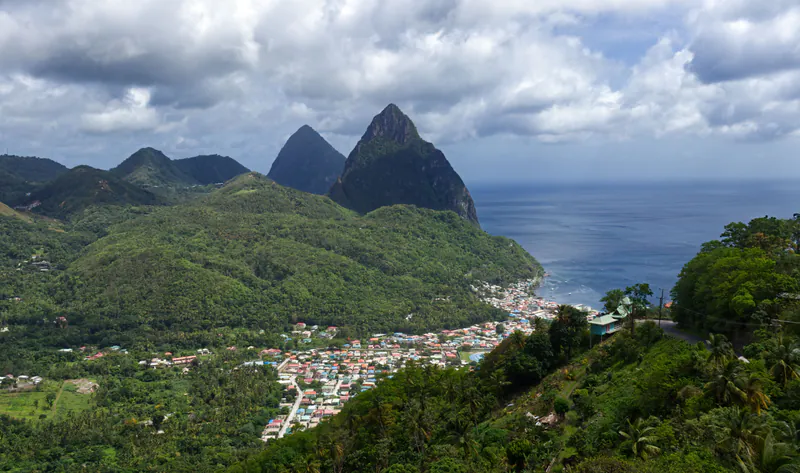
Dramatic natural beauty - the Pitons are a UNESCO World Heritage site, with sulphur springs, waterfalls, and dense rainforest. Far from the tourist infrastructure of the north. Smaller, quieter expat community; more artists and people deliberately seeking isolation. Lower property prices. Infrastructure (roads, internet, healthcare access) is more limited.[1]
Best for: those seeking authentic Caribbean immersion, artists, people willing to trade convenience for extraordinary scenery.
City Comparison
| Area | 1-BR Rent | Monthly Budget | Best For |
|---|---|---|---|
| Rodney Bay / Gros Islet | $1,200-$2,000 [1] | $2,500-$4,500 | Expat community, nomads, arrivals |
| Cap Estate | $2,000-$3,500 [1] | $4,500-$8,000+ | Luxury, CBI residents, retirees |
| Marigot Bay | $1,500-$3,000 [1] | $3,500-$6,500 | Privacy, scenery |
| Castries | $300-$600 [2] | $1,500-$2,500 | Budget, local workers |
| Soufrière/South | $300-$700 [1] | $1,500-$3,000 | Authenticity, isolation |
Climate: One Season with Variations
Saint Lucia has a tropical maritime climate - warm year-round with a dry season and a wet season.
| Season | Months | Temperature | Notes |
|---|---|---|---|
| Dry season | December - May | 24-30°C (75-86°F) | Best weather; peak tourism; higher rental demand |
| Wet/hurricane season | June - November | 26-32°C (79-90°F) | Afternoon rain showers; hurricane risk Aug - Oct |
The island sits at approximately 14° North latitude, meaning temperatures vary less by season than by elevation. The leeward (western) coast - where Castries, Rodney Bay, Marigot Bay, and Soufrière sit - is drier. The windward (eastern) coast is wetter and wilder.
The dry season (December - May) is the quality time to arrive and settle in. The wet season isn't unpleasant - rain is typically short and intense rather than all-day - but hurricane precautions and insurance are realities to plan around.[1]
Internet and Remote Work Infrastructure
Broadband fibre-optic connections from Flow (C&W) and Digicel are available in urban and northern areas, delivering 100-300 Mbps speeds. Monthly cost: $75-$150 USD ($203-$405 XCD).[13][1]
Connectivity drops meaningfully outside Castries, Rodney Bay, and Gros Islet. Remote southern areas (Soufrière, Vieux Fort) and smaller interior communities rely on slower connections. The rule: the further from the north, the more you should test before committing to a long-term lease.[1]
Mobile broadband from Digicel and Flow provides reasonable LTE coverage in populated areas as a backup.[3]
Coworking spaces are nascent by European or Southeast Asian standards. Rodney Bay has a small but growing collection of short-term workspaces, and several hotels offer day-pass working arrangements. This is not Bali or Lisbon - bring your own discipline.
Buying Property
Non-nationals wishing to buy property in St. Lucia must obtain an Alien's Landholding Licence from the Ministry of Legal Affairs before completing a transaction. The fee:[1]
- Residential land and property: 10% of property value
- Commercial property: 30% of property value
CBI citizens holding a St. Lucian passport are exempt from the Alien's Landholding Licence - a meaningful financial saving on any significant transaction.[1]
Property Prices 2026
| Location | Price Range |
|---|---|
| Rodney Bay / Gros Islet (luxury condos) | $300,000-$700,000+ USD [22] |
| Cap Estate (villas) | $500,000-$2,000,000+ USD [22] |
| Castries (apartments, land) | $100,000-$400,000 USD [22] |
| Soufrière / South (houses) | $100,000-$400,000 USD [22] |
Price per m² in the Numbeo dataset: approximately $143-$162/m² (city centre and outside centre average) - deceptively low because most high-end properties are priced per parcel or per unit, not per m².[23]
Transaction Taxes and Costs
| Cost | Rate |
|---|---|
| Alien's Landholding Licence (non-citizens) | 10% of value (residential)[1] |
| Transfer tax / stamp duty (buyer) | 2% [1] |
| Transfer tax / stamp duty (seller) | 2% [1] |
| Legal fees (attorney) | 2-3% [1] |
| Capital gains on sale | 0% [14] |
| Annual property tax | Ad valorem (low, based on estimated market value)[16] |
| Annual property tax (foreign income funding purchase) | 0% - no tax on foreign-sourced funds used for purchase[14] |
| Mortgage rate (20-year fixed) | ~7.00% [23] |
Total acquisition costs for a non-citizen: 14-15% above purchase price (Alien's licence + stamp duty + legal fees). For CBI citizens: approximately 4-5%.
Property ownership does not automatically grant residency.[1]
Banking and Financial Setup
Opening a local bank account in St. Lucia is possible but involves extensive documentation - Saint Lucia follows FATF-aligned anti-money laundering (AML) protocols, and the process is more demanding than in most European jurisdictions.[1]
Major local banks: Bank of Saint Lucia (BOSL), First Citizens Bank, Scotiabank, RBC Royal Bank. Required documents: valid passport, proof of address (utility bill or lease), police clearance certificate or reference letter, proof of income or funds source.[1]
The Eastern Caribbean Dollar (XCD) is pegged to USD at XCD 2.70 = USD 1.00 - no currency risk for US earners, and full predictability for exchange calculations. Euros and British pounds are exchangeable at airports and banks but are not the working currency of daily life.[1]
Most expats maintain their primary financial relationships offshore (US, Swiss, Singapore, or UAE accounts) and keep a local XCD account for rent, utilities, and day-to-day spending. Wise and Revolut are usable for transfers but less pervasive in daily merchant transactions than in Europe.[1]
Your First 30 Days: The Checklist
- Complete the Electronic Immigration Form at govt.lc before or on arrival - required for all air passengers[6]
- Apply for "Live It" program before arrival if planning a 12-month stay - processing takes 1-3 weeks; the 14-day certified accommodation rule starts from day one of arrival[3]
- Book 14 days in certified accommodation - hotels or villas on the approved list; Airbnbs may not qualify; check before booking[3]
- Arrange international health insurance before departure - covering hospitalisation and medical repatriation; required for "Live It" applications and essential for general safety[3][1]
- Organise police clearance certificate from your home country before leaving - takes days to weeks to apostille; don't leave this for last[3]
- Bring 3-6 months of bank statements (PDF or certified paper copy) showing stable offshore income - the immigration department reviews these carefully[3]
- Plan your initial vehicle situation - a car is essential outside Castries/Rodney Bay; obtain a temporary local driving permit (~$20 USD) on arrival; drives on the left[1]
- Identify a local attorney early - needed for property purchases, AML banking setup, and any residency applications beyond the "Live It" permit[1]
Key Data at a Glance
| Indicator | Value |
|---|---|
| GDP Growth (2024) | 4.7%[4] |
| GDP Growth (2025) | 1.7% (IMF)[4] |
| GDP Growth (2026 forecast) | Rebounding toward 2.5%+ as tourism picks up[4] |
| Inflation (2026) | ~-0.1% to flat[2] |
| Currency | East Caribbean Dollar (XCD), pegged at 2.70:1 USD since 1976[1] |
| Capital gains tax | 0%[14] |
| Inheritance tax | 0%[14] |
| Foreign income tax | 0% (territorial system)[14] |
| Income tax on local earnings | 15-30% progressive[15] |
| VAT (standard rate) | 15%[17] |
| "Live It" nomad visa min. Income | None fixed (stable offshore income required)[3] |
| "Live It" duration | 12 months (renewable; does not count toward PR)[3] |
| "Live It" application fee | $47 USD / ~€43[3] |
| CBI minimum investment | $240,000 USD (NEF donation)[9] |
| CBI processing time | 4-10 months[1] |
| CBI visa-free countries | ~140-146[9] |
| UK visa-free access (CBI passport) | Removed March 2026[11] |
| Schengen visa-free access (CBI passport) | Retained[11] |
| Path to Permanent Residence | 5 years continuous residence[7] |
| Path to Citizenship (naturalisation) | 7 years continuous residence[7] |
| Healthcare quality index | 71/100[18] |
| Alien's Landholding Licence | 10% of value (residential, non-citizens)[1] |
| Monthly budget (comfortable, single) | $2,500-$4,500 USD[1] |
| Expat community size | ~5,000-8,000 residents[1] |
| Official language | English[1] |
| Emergency number | 999[18] |
The case for Saint Lucia in 2026 is simple: zero tax on foreign income, zero capital gains, a hard-pegged currency, and English as the official language - all on an island that looks exactly like the screensaver you've been staring at for years. The friction points - limited healthcare capacity, the alien landholding licence, electricity costs, and restricted internet outside the north - are real. So is the trade-off: in exchange, you get a genuine territorial tax haven inside a stable, functional Eastern Caribbean democracy.
References
Living in St. Lucia 2026: Expat Life, Cost & Community - Living in St. Lucia 2026: expat costs from $2,500/mo, tax advantages, top neighbourhoods & CBI from ...
Saint Lucia Cost of Living 2026 - Cost of living in Saint Lucia 2026: CoL Index 60.0 (NYC=100). Budget $1,200-$2,400/month. Rent, food...
Saint Lucia Digital Nomad Visa 2026: What Nobody Tells You ... - A comprehensive 2026 guide to Saint Lucia's 'Live It' digital nomad program: exact requirements, cos...
St. Lucia: 2025 Article IV Consultation-Press Release; and Staff Report - St. Lucia staged a robust recovery after the pandemic, buoyed by tourism rebound. The economy is pro...
St. Lucia GDP: $2.77B | Population - Statistics of the World - St. Lucia · GDP: $2.77B · Population: 179,744. 440+ indicators with charts. Source: IMF & World Bank...
St Lucia Immigration: An Overview for Travelers and Expats - Learn more about St Lucia immigration, including the electronic entry form and obtaining citizenship...
Guide to Migrating to St Lucia Caribbean - Upon entering Saint Lucia, here is a comprehensive guide to migrating to St Lucia Caribbean. Realty ...
Saint Lucia Citizenship by Investment 2026: Costs, Requirements ... - Official 2026 update on Saint Lucia CBI: minimum NEF contribution $240,000, real estate and bonds fr...
Saint Lucia CBI 2026: Regulatory & Compliance Update - Saint Lucia CIP 2026: OECS-harmonized $240,000 minimum, mandatory interviews for 16+, extended proce...
St. Lucia Citizenship by Investment 2026 | Mirabello - St. Lucia CBI from $240,000 lost UK visa access March 2026. Schengen retained. Unique refundable bon...
Cost of living in Saint Lucia - full breakdown - nestfainder.ai - Rent, food, transport, utilities - what a month in Saint Lucia actually costs, with regional differe...
Cost Of Living in Saint Lucia in 2026 - This page contains up-to-date cost of living information for Saint Lucia in 2026. Compare prices for...
St. Lucia Tax Benefits for New Citizens 2026: Territorial Ta - St. Lucia tax benefits 2026: 0% capital gains, inheritance & foreign income tax. CBI from $240K in 4...
Saint Lucia - Individual - Taxes on personal income - Saint Lucia income tax is imposed on the following: Personal income tax rates. Tax rates on chargeab...
Tax System in Saint Lucia 2026 - whereTOemigrate.io - Understanding Saint Lucia's tax system as an expat in 2026: income tax brackets, VAT, special regime...
Healthcare in Saint Lucia 2026 - WhereToEmigrate - Complete guide to healthcare in Saint Lucia for expats in 2026: system type, insurance, costs, emerg...
Crime in Castries - Information about crime in Castries, Saint Lucia. Shows how much people think the problem in their c...
Is St Lucia Safe? Safety Guide for Visitors and Residents - Discover if St Lucia is safe for visitors and residents. Learn about crime rates, natural hazards, a...
Is St Lucia Safe for Tourists... - Wondering if Saint Lucia is safe to live in or visit? Discover essential safety tips for travelers, ...
Property for Sale in St. Lucia - Find Property for sale in St. Lucia. Search for real estate and find the latest listings of St. Luci...
Property Prices in Saint Lucia - Average property prices and property investment indexes in Saint Lucia.
Frequently Asked Questions
What are the primary visa and residence options for moving to Saint Lucia in 2026? No right to work without a separate work permit.
How does personal income tax work for expats in Saint Lucia? Lucia (from a local employer, local clients, or locally-sourced business), the following brackets apply: Sources: PwC Tax Summaries, IRD Saint Lucia, WhereToemigrate.io For "Live It" program participants earning entirely offshore, effective local tax rate: 0%.
What is the average cost of rent and living in Saint Lucia? Lucia runs on imported diesel, pushing electricity rates above $0.35 per kWh - roughly double the EU average.
How many years of residence are required for citizenship or permanent residency in Saint Lucia? For those pursuing long-term settlement without the CBI route: Temporary Residency: Renewable annually.
Cover photo by Simon Hurry on Pexels.
Want to see how Saint Lucia stacks up?
Are you seriously considering a move? Use our interactive tools to explore Saint Lucia's climate, tax brackets, and nomad visas.