Moving to Singapore in 2026: COMPASS Visa Framework, Low Taxes & Rent Realities
June 6, 2026
ShareSingapore is ranked #1 in the world's safest cities index and #1 on the WhereNext Global Relocation Index 2026 - and it just recorded 5.0% GDP growth in 2025, the fastest rate since the post-pandemic rebound in 2021. The world's fastest broadband at an average of 372 Mbps, a top marginal income tax of 24% that most expats never reach, and English as the primary business language. The tradeoff is direct: you pay Western salaries and live on Asian prices - except when it comes to housing.[1][2][3][4][5]
Here is everything you actually need to know before you move.
The Economy: Why Singapore Still Wins
Singapore's economy grew 5.0% in 2025 - the full-year figure surpassed even the government's own preliminary estimates. In Q4 2025 alone, GDP surged 6.9% year-on-year. MTI upgraded its 2026 forecast in February from "1-3%" to "2.0-4.0%", driven by strong manufacturing, AI investment, and resilient modern services.[6][4][7]
The city-state hosts the regional headquarters of hundreds of multinationals: Google, Meta, DBS, JPMorgan, and virtually every major bank and tech firm have significant Singapore operations. The job market is strongest in technology, financial services, biotech, and advanced manufacturing - sectors where Employment Pass-level salaries are standard. Average expat salaries for mid-level tech and finance roles run S$80,000-S$150,000/year.[8]
One caveat: the economy is trade-dependent and external risk is real. DBS maintains a more conservative 2026 forecast of 1.8%, flagging that above-trend growth will be hard to sustain under a protectionist global environment. MTI itself acknowledged significantly risen downside risks in its May 2026 statement, including the US-Israel-Iran conflict.[9][7]
Visas and Residency: The 2026 Changes You Need to Know
Employment Pass (EP)
The Employment Pass is the primary route for foreign professionals, managers, and executives. Minimum qualifying salary: S$5,600/month for the general sector; S$6,200/month for financial services. Employers must advertise on MyCareersFuture and demonstrate fair consideration of local candidates before applying.[10][11]
Since September 2023, all EP applications are assessed through the COMPASS (Complementarity Assessment Framework) - a 100-point scoring system. From 1 January 2026, MOM updated two key COMPASS components:[12][13]
- C2 (Qualifications): Refreshed lists of top-tier institutions (20 pts) and degree-equivalent qualifications (10 pts); some universities have shifted between categories[12]
- C5 (Skills Bonus/Shortage Occupation List): New healthcare roles added; Cyber Risk Specialist and Product Manager (Digital) removed from the shortage list[12]
- New sector-specific salary benchmarks apply: tech mid-career (35-44 yrs) benchmark at S$7,200/month; manufacturing at S$6,800/month[11]
- Companies where more than 25% of PMETs come from a single non-Singaporean nationality face a scoring penalty[11]
COMPASS renewals under the new rules apply from 1 July 2026. Processing time: 3-8 weeks.[14][13]
EP holders earning at least S$6,000/month can apply for Dependent Passes for spouses and children. EP holders earning S$6,000+ can additionally sponsor parents on Long-Term Visit Passes.[14][10]
S Pass
For mid-skilled workers. Minimum salary: S$3,300/month. Subject to quota limits by sector and company size.[15]
Tech.Pass
For founders, senior executives, and technical experts at established tech companies. Eligibility: meet any two of three criteria - last drawn monthly salary of at least S$22,500; 5+ years in a leadership role at a tech company valued at USD 500M+ or with USD 30M+ funding raised; 5+ years in a leadership role developing a product with 100,000+ MAU or USD 100M+ revenue. Pass holders have full flexibility: start companies, hold executive roles, invest, mentor, and lecture simultaneously. Limited to 500 places globally.[16]
Global Investor Programme (GIP)
Permanent residency via investment. Minimum: S$10M into a new business entity or GIP-approved fund; or S$25M in a single family office with AUM of at least S$200M. Business owners must demonstrate a revenue of at least S$200M/year in the last year and a 3+ year entrepreneurial track record. Processing: approximately 26 weeks.[17][18]
Permanent Residency (PR)
EP holders can apply for PR after 2+ years of working in Singapore. No guaranteed path - ICA assesses economic contribution, family ties, and commitment to Singapore. Success rate varies; high earners and those in priority sectors have better odds. After holding PR for 2+ years, citizens hip eligibility opens - though Singapore requires renouncing other citizenships. PR holders must maintain a valid Re-Entry Permit (REP) when travelling; losing PR status is possible if you leave without one.[19][20][8][14]
Cost of Living: The Real Numbers
Singapore is expensive by Asian standards. Budget unrealistically and you'll struggle. Budget correctly and you'll live extremely well.
A single expat living in a private condo spends S$5,000-S$8,000/month comfortably - rent included. Without rent, monthly living costs (food, transport, entertainment, utilities) run approximately S$1,500-S$3,000/person. The WhereNext index estimates a single-person total at around USD $2,250/month.[21][8][1]
The one genuinely affordable daily cost: hawker centres. Singapore's network of government-run food courts serves complete meals for S$5-S$12 - Hainanese chicken rice, laksa, char kway teow, and hundreds of other dishes at prices that haven't moved much in a decade.[8]
Rent by Property Type (2026)
| Property Type | Monthly Rent (SGD) |
|---|---|
| HDB 3-room flat (central) | S$3,200-S$3,500[22] |
| HDB 4-room flat (central) | S$3,500-S$5,300[23] |
| Private condo 1-bedroom | ~S$3,900 (island avg)[24] |
| Private condo 2-bed (city fringe) | S$4,500-S$6,000[22] |
| Private condo 2-bed (Core Central) | S$7,000-S$8,000+[22] |
| Landed house (Districts 10/15) | S$10,000+[22] |
Rent growth has slowed sharply - ~3% year-on-year in 2026, versus double-digit increases in 2022-2023. The private residential vacancy rate sits at around 7%, meaning landlords are competing for tenants. Properties within walking distance of an MRT station rent 10-15% faster and command a premium. Furnished apartments add S$300-S$500/month.[24]
Important housing rule for foreigners: EP and S Pass holders can rent any private residential property - HDB and private. EP holders cannot purchase residential property; buying requires specific pass conditions and is subject to ABSD.[25]
Daily Expenses
| Item | Price (SGD) |
|---|---|
| Hawker centre meal | S$5-12[8] |
| Inexpensive restaurant meal | S$12.75[26] |
| Mid-range dinner for two | S$80[26] |
| Monthly public transport pass | S$128[26] |
| Cappuccino | S$6.03[26] |
| Milk (1 liter) | S$3.83[26] |
| Eggs (12) | S$4.51[26] |
| Bottle of wine (mid-range) | S$30[26] |
Alcohol is Singapore's one genuine shock. GST (9%) and service charges (10%) - the "plus plus" - are added at most restaurants on top of listed prices.[27]
Taxes: What You Actually Pay
Residency Trigger
You are a Singapore tax resident if you are physically present in or exercise employment in Singapore for 183 days or more in a calendar year.[2]
Personal Income Tax Rates 2026
Singapore uses progressive rates from 0% to 24% - with the top rate only kicking in above S$1 million/year. Most mid-career expats on EP salaries (S$80,000-S$160,000/year) pay effective rates of 7-15%.[28][29][2]
| Annual Taxable Income (SGD) | Rate |
|---|---|
| 0 - 20,000 | 0%[2] |
| 20,001 - 30,000 | 2%[2] |
| 30,001 - 40,000 | 3.5%[2] |
| 40,001 - 80,000 | 7%[2] |
| 80,001 - 120,000 | 11.5%[2] |
| 120,001 - 160,000 | 15%[2] |
| 160,001 - 200,000 | 18%[2] |
| 200,001 - 320,000 | 19-20%[2] |
| 320,001 - 500,000 | 22%[2] |
| 500,001 - 1,000,000 | 23%[2] |
| Over 1,000,000 | 24%[30] |
Source: PwC Singapore Tax Summaries / IRAS, Year of Assessment 2026[2]
No capital gains tax. No inheritance tax. No dividend tax. These are not loopholes - they are features of the system. Tech.Pass holders explicitly benefit from no taxation on capital gains or shareholder dividends.[16]
Non-resident EP holders taxed at 15% flat on employment income, or graduated rates with personal reliefs - whichever is higher.[2]
CPF: Not Your Money (Yet)
Expats on EP and S Pass are not required to contribute to CPF (Central Provident Fund). CPF is mandatory only for Singapore citizens and PRs - which is why EP salaries are effectively higher take-home than they look on paper compared to Singapore citizen colleagues at the same gross salary.[31]
Once you become PR, CPF contributions become mandatory. Employer contribution: up to 17% of salary; employee: up to 20%. These go into your own account (not general taxation), but the funds are largely locked for housing and retirement.[31]
Healthcare: World-Class, But Not Free for Expats
The System
Singapore consistently ranks among the top 5 healthcare systems globally. Care is delivered through polyclinics (primary care, subsidised for residents) and restructured public hospitals (KKH, SGH, NUH), alongside a robust private sector.[31]
Expats on Employment Passes are not covered by MediShield Life - Singapore's national health insurance scheme. MediShield Life covers only citizens and PRs.[32][33]
What this means in practice:[31]
- Most employers provide group health insurance as part of the employment package - negotiate this explicitly
- If your employer's coverage is thin, buy a supplementary international health plan
- Without employer insurance, you pay full (unsubsidised) rates at public hospitals and standard private rates elsewhere
- Emergency: 995 (ambulance) / 999 (police)
Private Healthcare Costs
Private specialist consultations: S$100-S$350 per visit. Day surgery at a private hospital: S$3,000-S$15,000 depending on procedure. Comprehensive expat health insurance: S$1,000-S$3,000/year. Many expats use the Integrated Shield Plans (IPs) once they become PRs - these top up MediShield Life with private hospital ward coverage.[34][33][8]
Safety
Singapore has the lowest crime index of any city above 5 million population globally - a Crowdsourced Data Crime Index of 22.1 and a Safety Index of 77.7 as of 2026. The violent crime rate runs at 0.2 per 100,000 residents annually - compared to 4.9 for New York and 1.8 for London on the same per capita basis.[3][35]
Walking alone at 3am in any part of Singapore is genuinely safe. The property crime rate (95 per 100,000) is 15à - lower than New York's equivalent (1,470 per 100,000). Singapore has held the #1 position in the EIU Safe Cities Index continuously since 2017.[3]
The downside: the rule of law here is real. Chewing gum is technically prohibited in many public places. Drug offences carry mandatory death penalties. Jaywalking is enforced. Rules are not decorative.[8]
English in Everyday Life
English is one of Singapore's four official languages - and the primary language of government, business, education, and law. Singapore ranks #1 globally on the EF English Proficiency Index among non-native English-speaking countries. Every MRT announcement, government form, hospital, school, and court operates in English as the default. You will never need a translator.[1][8]
The linguistic quirk to know: Singlish - a creole of English, Mandarin, Malay, and Tamil - is pervasive in informal conversation. You will understand it within weeks; speaking it takes longer and is entirely optional. Most Singaporeans switch fluently between formal English and Singlish depending on context.
Which Neighbourhood?
Singapore is 734 km² - roughly the size of Chicago. Every part of the island is connected by the MRT. Neighbourhood choice comes down to lifestyle, proximity to international schools, and budget.
Orchard Road / Tanglin (District 9-10)
The premium expat classic. Embassy row, luxury condos, walking distance to Orchard MRT. Most executives and diplomats base themselves here. Most expensive rental market in Singapore - private condos S$7,000-S$12,000+/month for 2-3 bedrooms. Best for: senior executives, diplomats, those on full relocation packages.[36][37]
Holland Village / Buona Vista (District 10-5)
The expat "village" - café culture, international restaurants, MRT access, walkable streets. Lower-key than Orchard, still premium. Strong school cluster (Singapore American School, United World College nearby). 2-bed condos: S$5,000-S$7,500/month. Best for: young professionals, creative sector, families.[38]
River Valley / Robertson Quay (District 9)
Central, quiet residential enclave next to Clarke Quay. Easy walk to the CBD. Popular with younger finance expats who want to be close to bars without living above them. 1-bed condos: S$3,500-S$5,000/month.[38]
East Coast (District 15-16)
Seafront, low-rise feel, strong expat community, access to ECP cycling and beachside restaurants. Good international school options. Rents 20-30% below Orchard equivalents. Best for: families, outdoor lifestyle, those who commute east or to Changi.[39]
Queenstown / Novena (District 3 / 11)
Best-performing rental neighbourhoods in 2026 for professional families. HDB flats available for lower budgets; new-build condos for mid-range. Novena has excellent medical hub (Health City Novena). 1-bed condos: S$3,500-S$4,500/month.[24]
Neighbourhood Comparison
| Neighbourhood | Typical 2-BR Condo (SGD/mth) | Vibe | Best For |
|---|---|---|---|
| Orchard/Tanglin | S$7,000-S$12,000+[36] | Luxury, central | Senior executives |
| Holland Village | S$5,000-S$7,500[38] | Artsy, walkable | Young professionals, families |
| River Valley | S$5,000-S$7,000[38] | Central, riverside | Finance sector, CBD workers |
| East Coast | S$4,000-S$6,000[39] | Coastal, suburban | Families, outdoor lifestyle |
| Queenstown/Novena | S$4,000-S$5,500[24] | Practical, connected | Mid-budget professionals |
Climate: No Seasons, Only Humidity
Singapore sits 1.5 degrees north of the Equator. There are no seasons. The temperature range for the entire year is roughly 24°C to 32°C, with almost no variation month to month.[40][41]
| Period | Conditions |
|---|---|
| Dec - Mar (NE Monsoon) | Heaviest rainfall; occasional prolonged rain[41] |
| Mar - Jun (Inter-monsoon) | Hottest and most humid period (to 34°C)[42] |
| Jun - Sep (SW Monsoon) | Moderate rain; potential haze from Sumatran fires[43] |
| Sep - Nov (Inter-monsoon) | Most pleasant period; less rain, lower humidity[41] |
Annual rainfall: ~2,200mm. Rain is almost daily - intense, short bursts rather than grey drizzle. Carry a small umbrella always. Air conditioning is ubiquitous in every indoor space; most long-term residents find the indoor-to-outdoor temperature shock (from 20°C air-conditioned offices to 32°C streets) the hardest adjustment of all.[40][8]
The best months to visit before committing: February-April - the inter-monsoon dry period with the most stable weather.[41]
Internet and Remote Work Infrastructure
Singapore has the fastest broadband internet in the world - averaging 372 Mbps with 1 Gbps connections available in more than 85% of households. The government is investing S$100 million to roll out 10 Gbps capability to homes from 2025 onwards, with 500,000+ households expected to subscribe by 2028.[44][5]
Monthly home broadband (1 Gbps): approximately S$50-S$80/month. Mobile internet plans: S$20-S$50/month for unlimited data. Singapore ranks #1 in Asia for fixed broadband and is consistently #1 or #2 globally on the Speedtest Global Index.[45][21]
Coworking infrastructure is mature and dense - JustCo, WeWork, The Hive, and dozens of independent spaces operate across the CBD and Orchard. Marina Bay and One North are particularly well-served for tech sector workers.
Buying Property
Foreigners face a 60% Additional Buyer's Stamp Duty (ABSD) on the purchase of any residential property in Singapore. This is not a typo. It was doubled from 30% to 60% in April 2023 and remains in place as of 2026 - with property industry players actively lobbying for a rollback.[46][47]
Exceptions under Free Trade Agreements: Nationals and PRs of Iceland, Liechtenstein, Norway, and Switzerland, and nationals of the United States, receive the same stamp duty treatment as Singapore citizens - meaning 0% ABSD on their first property purchase.[48]
For almost all other expats: rent, don't buy, until you have PR. Once you hold PR, ABSD drops to 5% on your first property and standard rates apply on subsequent purchases.[47]
Singapore condo prices in the Core Central Region range from S$2,500-S$5,000+/sqm. A 70 sqm 2-bedroom unit in Orchard typically transacts at S$2.5M-S$4M. The 60% ABSD on top makes property investment unviable for most expats on a standard package.[24]
Your First 30 Days: The Checklist
- Start your EP application before you arrive - employers apply on your behalf via EP Online (EPOL); you can only enter Singapore on a tourist pass while waiting for EP approval[10]
- Use MOM's Self-Assessment Tool (SAT) at mom.gov.sg before your employer submits - check your COMPASS score in advance[49]
- Open a bank account immediately - DBS, POSB, OCBC, and UOB are expat-friendly; most require your EP card + passport; Revolut works as a bridge
- Arrange health insurance - don't rely solely on employer coverage; confirm what's covered, especially for hospitalisation and specialists[33][31]
- Get an EZ-Link card for public transport (MRT + buses) - S$12 initial card, top up anywhere; monthly pass around S$128[26]
- Find housing on PropertyGuru or 99.co - budget 1-2 months' rent as deposit; short-term serviced apartments are available for the first 30-60 days while you find permanent housing[8]
- Register your address with IRAS after moving in - required for tax purposes
- Negotiate your relocation package hard: housing allowance, school fees (international schools cost S$25,000-S$50,000/year), health insurance, and annual flights home are standard components for senior hires[50]
Key Data at a Glance
| Indicator | Value |
|---|---|
| GDP Growth (2025) | 5.0%[4] |
| GDP Forecast 2026 | 2.0-4.0% (MTI)[6][7] |
| GDP Growth Q1 2026 | 6.0% YoY[7] |
| EP Minimum Salary (General) | S$5,600/month[10] |
| EP Minimum Salary (Financial Services) | S$6,200/month[11] |
| Tech.Pass Min. Salary | S$22,500/month[16] |
| Top Income Tax Rate | 24% (>S$1M)[30] |
| Capital Gains Tax | None[16] |
| Dividend Tax | None[16] |
| Foreign Buyer ABSD | 60%[46] |
| Crime Index (2026) | 22.1[3] |
| Safety Index (2026) | 77.7[35] |
| Broadband Speed (avg) | 372 Mbps[5] |
| Expat Population (2026) | ~1.77M non-residents[25] |
| Median Private Condo Rent | S$4,300/month[22] |
| Monthly Public Transport Pass | S$128[26] |
| Annual Temperature Range | 24°C-32°C[40] |
| EF English Proficiency Rank | #1 globally (non-native)[1] |
Singapore doesn't compete on cost. It competes on efficiency, safety, rule of law, and access - and it has no real rival in Southeast Asia on any of those dimensions. The expats who thrive here are the ones who come in eyes open: rent is high, ABSD locks you out of property, and the hawker centre will save your grocery budget every single day.
References
- Singapore Relocation Guide 2026 - WhereNext
- Singapore - Individual - Taxes on personal income
- The 25 Safest Cities in 2026 - everycity.guide
- Singapore raises 2026 growth forecast on global economic ...
- Singapore has the world's fastest internet speed.
- MTI Upgrades 2026 GDP Growth Forecast to "2.0 to 4.0 Per Cent"
- Performance of the Singapore Economy
- Why Singapore is the Ultimate Destination for Expats in 2026
- Singapore: A strong end to '25 implies a good start to '26 - DBS
- Employment Pass - MOM
- Employment Pass Framework Changes 2026
- COMPASS Updates: Revised Qualification Lists & Shortage ...
- Singapore - Reminder on COMPASS and Work Pass Updates ...
- Singapore Employment Pass Explained (2026)
- Work passes - MOM
- Singapore Tech.Pass
- Global Investor Programme (GIP) - Singapore Visa Guide 2026
- How to get a Singapore PR through the GIP
- Apply for/Renew Re-Entry Permit - Singapore - ICA
- Future-Proof Your Status: Applying Early for Singapore PR
- Cost of Living Insights for New Residents in Singapore 2026
- Singapore Rental Market Trends 2026
- Singapore Cost of Living Analysis 2026
- Updated Rents in Singapore (2026)
- Singapore Expat Relocation Guide 2026
- Cost of Living in Singapore - Crowdsourced Data
- How Much Does Singapore Cost?
- Budget 2026 Tax Changes Singapore
- Tax in Singapore | Singapore Tax Guide
- Singapore Personal Income Tax Rate
- An Expat's Guide To Health Insurance In Singapore
- MediShield Life - Singapore - CPF
- Best Expat Health Insurance Singapore 2026
- About Integrated Shield Plan - Singapore
- Crime Comparison Between Singapore And Poland
- Best Neighbourhoods for Expats in Singapore
- The non-Native Dream: Expat Neighborhoods Around Singapore
- Most Popular Neighbourhoods for Expats in Singapore in 2025
- Best Places For Expats To Live In Singapore
- The Climate of Singapore
- Yearly & Monthly weather - Singapore
- Climate in Singapore
- Singapore Weather & Climate
- 10 times faster home broadband speeds to be rolled out from 2025
- ASEAN Internet Speed Rankings 2026
- Property players call for lower ABSD on foreign buyers
- ABSD Singapore Rates (2025)
- Foreigners Eligible for ABSD Remission under Free Trade Agreements
- Criteria details - MOM
- Moving to Singapore | Singapore Country Guide
Frequently Asked Questions
How much is the minimum qualifying salary for the Employment Pass (EP)? The minimum qualifying salary for the general sector is S$5,600/month, while for financial services it is S$6,200/month.
What changes were made to the COMPASS components under the new rules starting from 1 January 2026? Changes include updates to C2 (Qualifications), which includes refreshed lists of top-tier institutions and degree-equivalent qualifications; C5 (Skills Bonus/Shortage Occupation List) has added new healthcare roles and removed Cyber Risk Specialist and Product Manager (Digital) from the shortage list. Additionally, sector-specific salary benchmarks have been introduced, with tech mid-career benchmark at S$7,200/month and manufacturing at S$6,800/month, and companies where more than 25% of PMETs come from a single non-Singaporean nationality face a scoring penalty.
How long does the processing time for COMPASS renewals under the new rules take? The processing time for COMPASS renewals under the new rules is 3-8 weeks.
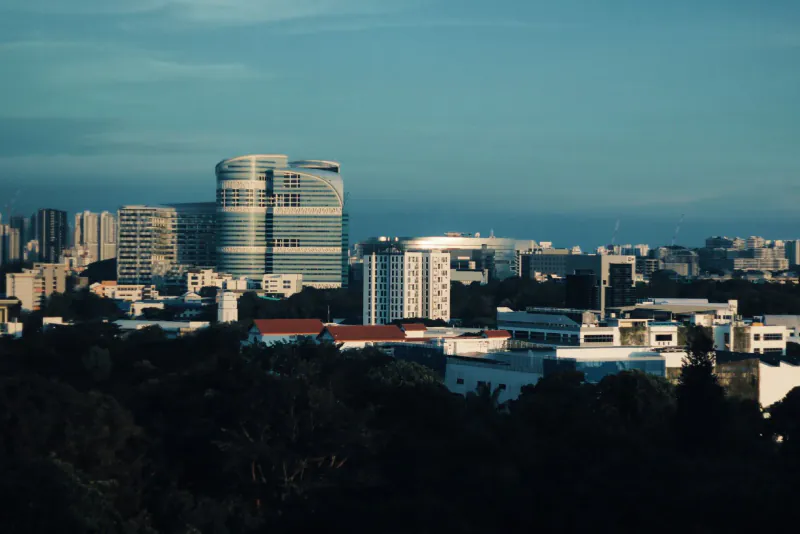
Cover photo by Song Kaiyue on Pexels.
Want to see how Singapore stacks up?
Are you seriously considering a move? Use our interactive tools to explore Singapore's climate, tax brackets, and nomad visas.
Head-to-Head Relocation Comparisons
Compare taxes, safety, and living costs of Singapore against top alternatives.