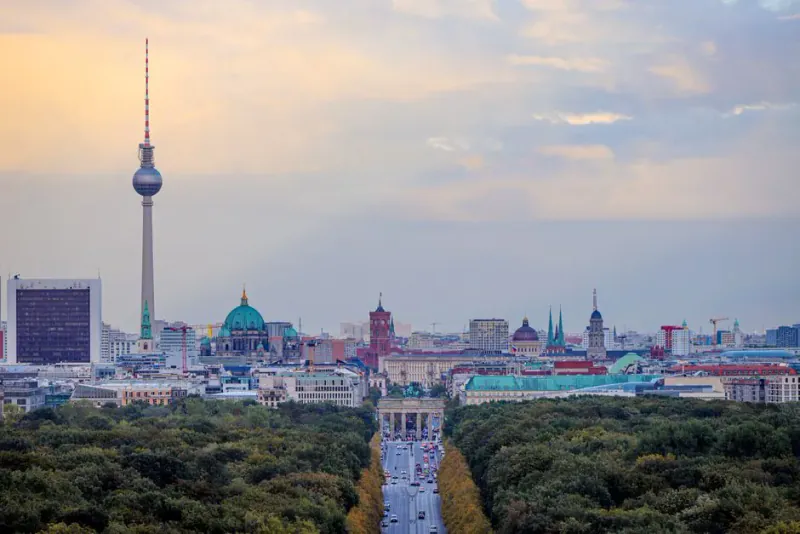
Germany in 2026: The EU Blue Card, Social Security at 40% of Your Salary, and Citizenship That Now Takes Five Years
June 14, 2026
ShareGermany has a skills shortage so severe that it built an entirely new immigration category - the Opportunity Card (Chancenkarte) - to let qualified foreigners move here before they have a job offer. The country added over 600,000 skilled worker vacancies in 2025, concentrated in IT, engineering, healthcare, and trades. The EU Blue Card salary threshold just rose to €50,700 for 2026 - but for shortage occupations including IT, engineering, and healthcare, the bar drops to €45,934.20. Germany wants you. It just wraps the welcome in paperwork that will test your patience.[1][2][3]
What the government brochures leave out: social security contributions take approximately 20-22% of your gross salary on top of income tax, bringing total deductions to 35-45% for most professionals. The GDP grew just 0.3% in Q1 2026; forecasts for the year range from 0.5% to 1.0% - a fragile recovery after two consecutive years of recession. Finding an apartment requires a SCHUFA credit check, salary proofs, and a landlord willing to rent to someone without a German employment history. And German bureaucracy - the Bürgeramt queues, the Auslà¤nderbehà¶rde appointments, the form-driven logic of every process - is real, not exaggerated.[4][5][6]
None of this negates the case for Germany. Free public healthcare. Free public schools. One of Europe's best Schengen gateway locations. A social safety net that genuinely works. And a path to dual citizenship after five years. This guide covers all of it honestly.
The Economy: Recovery After Two Recessions, Skills Shortage Still Acute
Germany contracted in 2023 and 2024, and grew only 0.2% in 2025. The 2026 recovery is real but slow - GDP growth forecasts for 2026 range from 0.5% (German Council of Economic Experts, revised downward due to Iran conflict energy shock) to 1.0% (European Commission), with the IMF previously projecting approximately 1%. Unemployment rose to 6.3% nationally in recent months before falling slightly to 2.95 million unemployed in May 2026.[7][5][8]
The jobs story is more complex than the headline numbers suggest. Manufacturing is shedding workers - automotive sector restructuring, energy cost impacts, and competition from Chinese industry are the main drivers. But public services, healthcare, education, IT, and logistics are all actively hiring. The skills shortage is structural and demographic - Germany has an aging population and insufficient domestic talent pipeline for technical and healthcare roles, which is precisely why the Skilled Immigration Act was overhauled and the Opportunity Card created.[9]
Sectors actively hiring internationally in 2026:
- IT and software: Software engineers, cloud architects, AI specialists, cybersecurity - no degree recognition requirement for experienced IT professionals seeking EU Blue Card or skilled worker visa; consistent demand across all city hubs[10]
- Engineering: Mechanical, electrical, civil, and industrial engineers; recognition of non-EU engineering degrees often required; strong demand in automotive supply chain, renewables, and infrastructure
- Healthcare: Nurses and doctors in acute shortage across all 16 Bundeslà¤nder; federal programmes supporting credential recognition; some Bundeslà¤nder offer direct fast-track placement programmes for foreign nurses[7]
- Trades and vocational skilled workers: Germany's Handwerk sector (plumbers, electricians, construction) has a 200,000+ vacancy overhang; recognition pathway is demanding but the Opportunity Card was partly designed for this group
- Finance and professional services: Frankfurt is the EU's financial hub post-Brexit; demand for compliance, risk management, and quantitative finance professionals
- Research and academia: Strong university sector; J-equivalent researcher visa route; recognised contributions in STEM attract Golden Visa-equivalent senior pathways
Visas and Residency: Five Routes That Matter
Germany fundamentally restructured its skilled immigration system in 2023-2024 with the Skilled Immigration Act (Fachkrà¤fteeinwanderungsgesetz). The result: more pathways, lower barriers for experienced IT workers without formal degrees, and the entirely new Opportunity Card. The system still demands qualification recognition (Anerkennung) as its bedrock - this is the step most people underestimate.
EU Blue Card - The Premium Work Visa
The flagship residence permit for highly qualified non-EU professionals. No lottery, no annual cap. Issued within weeks of job offer confirmation.[11][2]
- University degree from a recognised institution (or equivalent qualification)
- Valid employment contract with a German employer
- Standard threshold: gross annual salary of €50,700 (raised 1 January 2026)
- Shortage occupation threshold (IT, engineering, natural sciences, healthcare, mathematics): gross annual salary of €45,934.20
- New graduate threshold (degree obtained within last 3 years): €45,934.20
Why the Blue Card matters strategically:
- Permanent residence after 21 months (with B1 German) or 27 months (with A1 German) - the fastest route to settlement available[12][13]
- Settlement permit (Niederlassungserlaubnis) in 21-27 months vs. 5 years for standard skilled workers - a 3-year time advantage for permanent residency[13]
- Family members can join immediately; spouse gets immediate work authorisation[11]
- Holders can move to another EU country for work for up to 90 days without a new visa[9]
- Leads to citizenship after 5 years of residence (with B1 German and other standard criteria)[14]
The qualification recognition step (Anerkennung): For most professions outside IT, Germany requires your foreign degree to be formally recognised as equivalent to a German qualification. The Central Office for Foreign Education (anabin database) lists which degrees from which countries are automatically recognised and which require case-by-case assessment. Start the recognition process before applying for the visa - it takes 2-6 months and is the single most common cause of delayed Blue Card applications. For IT professionals, the 2024 Skilled Immigration Act removed the degree requirement for experienced specialists - demonstrated professional skills are sufficient.[10][9]
Opportunity Card (Chancenkarte) - Job Seeker Entry
Launched mid-2024, the Opportunity Card allows you to move to Germany for up to 12 months to find a job, without a prior offer. This is the most significant immigration reform Germany has made in decades - and it is genuinely accessible.[15][16]
Two routes to qualify:
Route 1 - Skilled Worker: You have a university degree or vocational qualification already recognised (or recognisable) in Germany. No points calculation needed.
Route 2 - Points System: Score at least 6 points from the following grid:[16][17][18]
| Criterion | Points |
|---|---|
| Degree/vocational qualification recognised in home country | 1-3 |
| German language: A1 = 1pt; B2+ = 3pts | 1-3 |
| English language at B2 level | 1 |
| Age under 35 | 1 |
| Prior work experience in Germany, or recognised German qualification | 1 |
| Spouse also meeting the skilled worker criteria | 1 |
Financial requirement: proof of funds covering your stay - €13,092 for 12 months, held in a blocked account (Sperrkonto) or equivalent guarantee.[18][16]
Application fee: €75. Processing time: 3-5 months.[16]
During the Opportunity Card stay: you can work up to 20 hours/week in any job (including unrelated to your field) and do work trials (Probearbeit) of up to 2 weeks with potential employers - a provision explicitly designed to let employers test candidates before committing to full sponsorship.[9]
If you find a job: convert to a standard skilled worker permit or apply for the EU Blue Card at the local Auslà¤nderbehà¶rde. The card can be extended for up to 2 more years if you have a job offer but are still in the recognition process.[9]
Standard Skilled Worker Visa (Work Experience Route)
For professionals without a formal recognised degree but with work experience. Requirements:[10]
- Foreign degree or at least 2 years of vocational training recognised in the home country
- At least 2 years of relevant work experience within the last 5 years
- Binding employment offer with minimum annual gross salary of €45,630 (2026)[10]
- German language: generally B1 for most roles; IT sector often exempt
Family Reunification
Spouses and minor children of residence permit holders can join. Key requirement for spouses from non-EU countries: A1 German language proof before entry in most cases (family of Blue Card holders is exempt from this requirement). Children under 16 join without language requirement and integrate into the German school system.[19][20]
Freelancer / Self-Employed Visa (§21 AufenthG)
For self-employed professionals and entrepreneurs. Requires demonstrating economic interest (the activity benefits Germany's economy), sufficient income prognosis, and professional qualifications. Processed case-by-case. Harder to obtain than an employment-based permit; requires a solid business plan and evidence of clients. Healthcare and artistic freelancers have additional routes through professional chambers and the Künstlersozialkasse respectively.[21]
Permanent Residence (Niederlassungserlaubnis): The Real Timelines
The Niederlassungserlaubnis (NE) is Germany's permanent residence permit - open-ended, not time-limited, employer-independent. The timeline depends heavily on which visa you hold.[22][23][12]
| Route | Minimum Residence Before NE | Language Required |
|---|---|---|
| EU Blue Card + B1 German | 21 months | B1 CEFR |
| EU Blue Card + A1 German | 27 months | A1 CEFR |
| Graduated in Germany (skilled work visa) | 2 years | German integration proof |
| Standard skilled worker visa | 5 years (3 years if paid 36 months pension) | B1 CEFR |
| All others (general rule) | 5 years + 60 months pension contributions | B1 CEFR |
Additional requirements for all NE applicants:[12][22]
- Financial self-sufficiency - no receipt of Bürgergeld (welfare) or social assistance
- Adequate housing (at least 9 m² per adult, 6 m² per child)
- Clean criminal record
- Basic knowledge of Germany's legal and social system - proven by passing the "Leben in Deutschland" test (33 questions, need 17/33 correct) or the naturalization test
- Valid pension contribution history (Versicherungsverlauf from Deutsche Rentenversicherung)
The practical implication: an EU Blue Card holder who arrives in Germany at age 30, reaches B1 German within 21 months, and maintains continuous employment can hold permanent residence by age 32 - and citizenship by age 35. This is one of the fastest immigration-to-settlement pathways among wealthy nations.
Citizenship: Five Years, B1 German, Dual Nationality Allowed
German citizenship by naturalisation requires a minimum of 5 years of legal residence as of 2026. The previously available 3-year "turbo naturalization" for exceptional integration was officially abolished on 30 October 2025.[24][25][14]
Requirements (2026):[26][27][24][14]
- Minimum 5 years lawful residence in Germany (3 years if married to a German citizen for at least 2 years)
- Niederlassungserlaubnis (permanent residence) or equivalent entitlement
- Financial self-sufficiency - no welfare dependency
- German language at B1 level (speaking, reading, writing)
- Naturalization test - 33 questions on German civics, law, and history; minimum 17/33 correct; test materials are public; new questions added in 2026 on constitutional values including stance on antisemitism and gender equality[27]
- Clean criminal record (minor offences under specific thresholds may not disqualify)
- Commitment to Germany's free democratic basic order (Bekenntnis zur freiheitlich demokratischen Grundordnung)
Fees:[14]
- €255 per adult (age 16+)
- €51 per minor naturalized together with a parent
- Additional costs: B1 language certificate €150-250; naturalization test ~€25; certified translations of documents
Dual nationality: as of 2024, Germany permits dual or multiple citizenship for naturalized citizens - there is no requirement to renounce your original nationality. This was a landmark change that significantly increased the attractiveness of German citizenship for expats.[24][27]
Realistic timeline for a Blue Card holder:
- Arrive with job offer → Blue Card issued → study German → B1 reached at ~18 months → Permanent residence at month 21 → naturalization eligible at month 60 → German passport approximately 5 years after landing. Faster than any other major Western European country for skilled workers.
Taxes: High Marginal Rates, But the Social Return Is Substantial
Germany taxes income progressively from 0% to 45%, plus a solidarity surcharge and mandatory social contributions. The combined deductions from gross salary - tax plus social contributions - typically run 35-45% for a mid-career professional. This is the number that shocks most expats on their first German payslip.[28][6]
Income Tax Brackets (2026, Einkommensteuer)
| Taxable Income | Rate |
|---|---|
| Up to €12,348 | 0% (Grundfreibetrag - basic personal allowance) |
| €12,349 - €66,760 | 14% to 42% (progressive, rises continuously) |
| €66,761 - €277,825 | 42% (Spitzensteuersatz) |
| Above €277,826 | 45% (Reichensteuer) |
Rates are continuously progressive - unlike a stepped system, the rate climbs incrementally within each zone rather than jumping. Effective rates are significantly lower than marginal rates: a person earning €80,000 gross pays an effective income tax rate of approximately 22-25%, not 42%.
Solidarity surcharge (Solidarità¤tszuschlag): 5.5% of income tax amount, applied above a specific exemption threshold. From 2021, abolished for the vast majority of taxpayers - only applies at higher income levels.[31]
Church tax (Kirchensteuer): 8-9% of income tax amount (varies by Bundesland), levied only on registered members of Catholic, Protestant, or Jewish religious communities. Formally opt out by deregistering from your church with the local Standesamt - a simple administrative step that saves several hundred euros per year. This is standard practice for non-religious expats.[31]
Social Security Contributions (2026)
This is what surprises expats most. Beyond income tax, both employee and employer pay substantial social contributions on gross salary:[6][32][33]
| Contribution | Total Rate | Employee Pays | Employer Pays |
|---|---|---|---|
| Public health insurance (GKV) | 14.6% + avg 2.5% supplement | ~8.6% | ~7.3% |
| Long-term care insurance (Pflegeversicherung) | 4.2% | 2.9% (3.6% if no children) | 1.3% |
| Pension insurance (Rentenversicherung) | 18.6% | 9.3% | 9.3% |
| Unemployment insurance (Arbeitslosenversicherung) | 2.6% | 1.3% | 1.3% |
| Employee total social contributions (approx.) | - | ~22% | - |
Contribution ceilings (2026): Social contributions are capped - above certain salary levels, you do not pay more. The pension contribution ceiling is €101,400/year (gross); health insurance ceiling is approximately €69,750/year. Above these thresholds, your effective social contribution rate decreases.[34][35][33]
What you get for those contributions: universal public healthcare (no premium, no copay for most services beyond €10/quarter), unemployment benefits (Arbeitslosengeld) at 60-67% of prior net salary for 12-24 months, statutory pension, and mandatory long-term care coverage. The headline deduction is high; the social security return is real.
Tax Class System (Steuerklasse)
Germany assigns employees one of six tax classes that affect monthly withholding - not the final annual tax liability:[29]
| Class | Profile | Monthly Withholding |
|---|---|---|
| I | Single, no children, divorced | Standard |
| II | Single parent | Lower |
| III | Married, higher earner (combined with V for spouse) | Lowest |
| IV | Married, similar earnings | Standard |
| V | Married, lower earner (combined with III for spouse) | Highest |
| VI | Second job | Maximum |
For new arrivals: you will be assigned Class I by default unless you register a change with the Finanzamt. Married couples should typically apply for III/V split (or both IV) immediately - Class III dramatically reduces the higher earner's monthly withholding, improving cash flow (the actual tax due at year-end remains the same).
VAT (Mehrwertsteuer, MwSt)
Standard rate: 19%. Reduced rate: 7% on food, books, public transport, and selected cultural goods.[6]
Healthcare: Mandatory, Universal, and Actually Good
Health insurance is mandatory for all residents of Germany, without exception. You cannot legally reside in Germany without it. Employees earning below €69,300/year are automatically enrolled in the public system (GKV - Gesetzliche Krankenversicherung). Those earning above this threshold can choose between public and private insurance.[36]
Public Health Insurance (GKV)
- Contribution: approximately 14.6% of gross salary + average additional contribution of ~2.5% (set by each insurer separately), up to a monthly ceiling of approximately €5,812/month of assessed salary[32]
- Employer pays half (7.3%) - the employee portion is approximately 8.6% of gross salary
- Dependents covered at no extra cost - spouse and children can be co-insured (Familienversicherung) at zero additional premium, provided they have no significant independent income[36]
- No annual deductible, no prior authorisation for most treatments, dental coverage included (partial)
- The cheapest public fund in 2026: approximately €1,221/month maximum contribution (BKK Faber-Castell); Techniker Krankenkasse (TK): approximately €1,233/month - popular with expats for its English-language service[34]
Most expats earning under €69,300 are automatically in GKV. The free family co-insurance alone represents savings of €400-800/month per dependent compared to countries without this provision.
Private Health Insurance (PKV)
Available to employees earning above the insurance threshold (JAEG: €69,300/year in 2026). Also the default for self-employed and civil servants.[36]
- Premiums are risk-based - age, health status, and desired coverage determine the cost
- Employer subsidy for PKV: €496.97/month (2026) - effectively the same subsidy as for GKV[37][34]
- PKV premiums for a healthy 30-year-old: approximately €230-€400/month for standard coverage[21]
- PKV premiums for a healthy 40-year-old: approximately €400-€700/month[37]
- PKV advantages: shorter wait times, better hospital room conditions, direct specialist access
- PKV risk: premiums rise significantly with age; if your income drops below the JAEG threshold, you may be required to return to GKV; PKV is difficult to leave
Recommendation for most expat employees earning under the JAEG threshold: stay in the public GKV system. Free family co-insurance and the ability to return to GKV if circumstances change outweigh the service advantages of PKV in most cases.
Emergency: 112 (Europe-wide emergency number - ambulance, fire). 110 (police).
Safety: Germany Is Safe. Munich and Freiburg Are Very Safe.
Germany's national Crime Index (Crowdsourced Data 2026) is 38.4 - well below the EU average and substantially below the US (49.2). German cities cluster toward the safer end of the European spectrum. The exceptions tend to be specific districts in large cities, particularly around main train stations (Hauptbahnhà¶fe) and in certain inner-city areas.[38]
Crime Index by German City (Crowdsourced Data 2026)
| City | Crime Index | Safety Index |
|---|---|---|
| Freiburg im Breisgau | 32.3 | 67.7 |
| Düsseldorf | 32.7 | 67.3 |
| Karlsruhe | 36.5 | 63.5 |
| Bonn | 39.2 | 60.8 |
| Hamburg | 39.7 | 60.3 |
| Munich | ~36-38 | ~62-64 |
| Leipzig | 41.9 | 58.1 |
| Frankfurt | 44.5 | 55.5 |
| Berlin | 44.5 | 55.5 |
| Cologne | 44.7 | 55.3 |
| Hanover | 45.1 | 54.9 |
| Bremen | 47.1 | 52.9 |
Bike theft is the most common crime affecting expats in all German cities - lock your bike properly (U-lock + chain) or you will lose it. Pickpocketing around major tourist sites and train stations. Violent crime against expats is low.
The safety picture by neighbourhood within cities matters: Kreuzberg and Neukà¶lln in Berlin have higher crime rates than Prenzlauer Berg and Charlottenburg. Bahnhofsviertel in Frankfurt is notoriously rougher than Sachsenhausen. Research your specific district before signing a lease.
Cost of Living: Affordable vs. Western Europe - But Germany's "Hidden Rent" is Warmmiete
Germany has a crucial rental concept most guides gloss over: Kaltmiete vs. Warmmiete. Kaltmiete (cold rent) is the base rent listed in advertisements. Warmmiete (warm rent) is what you actually pay - it adds heating, building maintenance charges (Nebenkosten), and sometimes water. The difference is typically €150-€350/month extra. All budget calculations below use Warmmiete.[41]
Rent by City (2026, 1-Bedroom Apartments - Warmmiete)
| City | City Centre (€/mo) | Outside Centre (€/mo) |
|---|---|---|
| Munich | €1,725-€1,800 | €1,200-€1,250 |
| Frankfurt | €1,385 | €1,060 |
| Hamburg | €1,350-€1,500 | €1,000-€1,200 |
| Berlin | €1,195-€1,400 | €900-€1,000 |
| Stuttgart | €1,300-€1,500 | €1,000-€1,100 |
| Cologne | €1,200-€1,350 | €900-€1,000 |
| Düsseldorf | €1,200-€1,400 | €900-€1,050 |
| Leipzig | €800-€1,000 | €650-€800 |
Munich is the outlier - the most expensive city in Germany, 22% more expensive than Berlin overall. Frankfurt and Stuttgart are roughly 10-15% below Munich. Berlin, despite dramatic rent increases in recent years, remains significantly cheaper than comparable European capitals.[45]
The renting process as a foreigner: Germany's rental market is competitive, particularly in Munich, Frankfurt, and Berlin for mid-range properties. Landlords routinely ask for:[46]
- SCHUFA credit report (German credit history - you won't have one initially; use a paid SCHUFA selbstauskunft to show you at least know what it is, and bring salary slips and employment contract instead)
- Last 3 months' salary slips
- Copy of employment contract
- Copy of residence permit
- Bank statements
- References from prior landlords
Without a SCHUFA rating, compensate with financial transparency - bring all the documents above in a well-organized application folder. Expat-friendly landlord agencies (e.g., GESA, Homelike) and furnished apartments are useful for the first 1-3 months while you build a German banking and address history.
Security deposit: maximum 3 months' Kaltmiete by law - typically required to be paid into a blocked deposit account (Mietkautionskonto), not just handed to the landlord.[46]
Monthly All-In Budget (2026)
| Profile | City | Monthly Budget (€) |
|---|---|---|
| Single professional | Munich | €2,700-€3,500 |
| Single professional | Berlin | €2,000-€2,800 |
| Single professional | Frankfurt | €2,400-€3,200 |
| Family of four | Munich | €5,000-€7,000 |
| Family of four | Berlin | €4,000-€5,800 |
Daily Expenses (Berlin / Munich Average, 2026)
| Item | Price (€) |
|---|---|
| Meal at inexpensive restaurant | €12-€18 |
| Three-course meal for two (mid-range) | €50-€80 |
| Coffee (cappuccino) | €3.50-€5.00 |
| Beer at a bar (0.5L) | €4-€7 |
| Deutschlandticket (monthly, all public transport in Germany) | €58/month |
| Fuel (per litre, petrol) | €1.75-€1.95 |
| Monthly grocery bill (one person) | €250-€350 |
| Gym membership (mid-range) | €30-€60/month |
The Deutschlandticket - €58/month for unlimited use of all regional public transport across all of Germany - is one of the most remarkable policy achievements in European transport. For most city-based expats, it eliminates the need for a car entirely.[47]
Which City?
Berlin
Germany's capital, the tech and startup hub, the cultural centre. Population 3.9 million. The cheapest major city in Germany - a 1-BR in Berlin costs roughly what a studio costs in Munich. Home to the German startup ecosystem: Delivery Hero, Zalando, Auto1, N26, and thousands of funded startups all headquartered here. Also the EU's biggest creative sector - music, fashion, design, film, arts. The city has a Kreative Klasse reputation that attracts young international talent from across Europe.
Downsides: Berlin's Auslà¤nderbehà¶rde (immigration authority) has a severe appointment backlog - getting a residence permit appointment can take 3-6 months; plan ahead. Administrative function is slower than in Munich or Hamburg. Public safety is more variable by district than in other German cities. Berlin's job market in finance and manufacturing is thinner than Frankfurt or Munich.
Best expat areas: Prenzlauer Berg and Pankow (young families, good schools, safe); Mitte (central, expensive, tourist-adjacent); Charlottenburg (established, quieter); Neukà¶lln and Kreuzberg (young, international, creative; higher crime index).
Munich (München)
Germany's highest-income city, consistently ranked among Europe's most liveable. Headquarters of BMW, MAN, Siemens, MAN Energy Solutions, Allianz, Munich Re, and Bayern Munich (if that matters). The Bavarian economy has the highest per capita income of any German Bundesland. Best public infrastructure, cleanest streets, most efficient administration (Munich's city services actually work at pace). Closest Alpine access - skiing and hiking within 90 minutes by public transport.
Downside: the most expensive rents in Germany. A 1-BR in the city centre runs €1,700-€2,000/month Warmmiete. Buying is even more extreme - median apartment prices above €8,000/m². Culture is distinctly Bavarian - locals notice if you don't engage with local customs; learning German here matters more socially than in cosmopolitan Berlin.
Best expat areas: Schwabing and Maxvorstadt (university area, walkable, international); Haidhausen and Au-Haidhausen (trendy, family-friendly); Bogenhausen (premium residential, quieter); Pasing and Neuhausen (good value, well-connected).
Frankfurt
The EU's financial capital post-Brexit. Home to the European Central Bank, Deutsche Bundesbank, Deutsche Bà¶rse, and the concentrated back offices of every major international bank. Smallest of the three major cities by population (~760,000) but with the most concentrated financial sector employment in Germany. Frankfurt Airport is Germany's largest hub - 65+ direct long-haul destinations, making it uniquely convenient for internationally mobile professionals. Rent is between Berlin and Munich levels.
Best expat areas: Sachsenhausen (expat-friendly, near the river); Westend (finance/professional sector, premium pricing); Nordend (residential, local character); Niederrad (affordable, near the ECB and finance district).
Hamburg
Germany's second-largest city. Port, media, logistics, aerospace (Airbus), and shipping. The most international of German cities historically - trading culture, cosmopolitan outlook. Hamburg consistently ranks among Germany's safest major cities (Crime Index 39.7). Rent slightly below Frankfurt, significantly below Munich. Direct flights to many non-European destinations. The city has a reputation for being liveable without the Berlin startup hype or Munich price tag - a good choice for professionals in logistics, media, and maritime sectors.[39]
The City Comparison
| City | 1-BR Rent (€/mo, centre) | Key Sectors | Crime Index | Best For |
|---|---|---|---|---|
| Berlin | €1,195-€1,400[43] | Tech, Startups, Creative | 44.5[39] | Tech workers, cost-conscious expats |
| Munich | €1,725-€1,800[43] | Automotive, Finance, Engineering | ~37[40] | Finance, engineering, families |
| Frankfurt | €1,385[43] | Finance, ECB, Logistics | 44.5[39] | Banking, mobile professionals |
| Hamburg | €1,350-€1,500 | Logistics, Media, Aerospace | 39.7[39] | Maritime, media, international |
| Leipzig | €800-€1,000[44] | Manufacturing, Logistics | 41.9[39] | Budget, quieter lifestyle |
| Düsseldorf | €1,200-€1,400 | Fashion, Trade, Japanese community | 32.7[39] | Luxury sector, Japanese expats |
Climate: Four Real Seasons, One Grey Winter
Germany has a temperate oceanic climate in the west (influenced by the North Sea and Atlantic) and a more continental climate in the east and south. No extreme heat, no extreme cold - by global standards.
| Season | Months | Temperature Range | Character |
|---|---|---|---|
| Winter | Dec-Feb | -3°C to +5°C | Grey, damp, little sun; Central European norm |
| Spring | Mar-May | 8°C to 18°C | Variable; increasingly warm by May |
| Summer | Jun-Aug | 20°C to 30°C | Pleasant; occasional heat waves; long daylight hours |
| Autumn | Sep-Nov | 8°C to 18°C | Colourful, pleasant early autumn; grey by November |
The January-March period is the one that defeats people from Southern Europe and warmer climates. Short daylight hours (8-9 hours in December), consistent grey cloud cover, and cold temperatures that aren't dramatic but are relentlessly damp require psychological preparation. Munich gets more snow and more sunshine than Berlin due to Alpine influence - clearer skies in winter and a Fà¶hn wind effect that can push January temperatures above 15°C.
Summers are genuinely good - long evenings, outdoor beer garden culture (Biergarten), lake swimming accessible from Munich within 45 minutes, cycling infrastructure across all cities. June and July in Germany are among the most pleasant months in Europe for outdoor living.
Schools: Free Public Education, Good International Options
All children of legally residing parents have the right to free public education (K-13) in Germany, regardless of visa status. Public schools are funded by the Bundesland government; the quality is high by international standards and relatively consistent - Germany does not have the dramatic rich-suburb/poor-city school quality divide present in the U.S.[48]
The German school system structure:
- Grundschule (primary): ages 6-10 (grades 1-4)
- Secondary track selection at age 10 (one of the most consequential and debated elements of the German system):
- Gymnasium - academic track leading to Abitur (equivalent to A-levels/Matura); university entry
- Realschule - middle track; vocational or dual-track training pathways
- Hauptschule/Mittelschule - vocational track; Bundesland-dependent nomenclature
- Kindergarten (3-6 years) is heavily subsidised and widely available; fees vary by Bundesland and family income but are low (€0-€300/month)
Language: instruction is in German. Children who arrive speaking no German are placed in special Willkommensklassen (welcome classes) for 6-12 months before integration into standard classes. Most children under 12 integrate linguistically within 12-18 months of immersion.
International schools are the alternative for families who cannot commit to German-language education or need IB/British curriculum continuity for potential future relocation:[49][50]
International School Fees (2026)
| Level | Berlin (€/year) | Munich (€/year) |
|---|---|---|
| Early Years (3-5 yrs) | €5,000-€10,000[50] | €13,590-€15,463[51] |
| Primary (grades 1-6) | €7,000-€14,000[50] | €18,289[51] |
| Secondary (grades 7-10) | €10,000-€17,000[50] | €20,928-€22,967[51] |
| IB Diploma / A-Level (16-18 yrs) | €14,000-€20,000[50] | €26,196-€27,583[51] |
| Bilingual German-English schools | €7,000-€13,500[49] | ~€10,000-€16,000 |
| State-funded bilingual (e.g. Nelson Mandela Berlin) | ~€100-€300/month[49] | N/A |
Munich International School (MIS): entry fees of €9,421 in year 1 per child, plus annual tuition of €17,337-€27,583 depending on grade - among the most expensive international schools in Germany. Berlin International School: €12,300-€18,240/year depending on grade level.[52][51]
The public school + German language strategy: for families planning to stay 5+ years, enrolling children in German public schools is strongly advisable. The language integration is faster than adults expect, the education quality is genuinely strong, and the social integration (especially through sport and school activities) accelerates the whole family's adaptation. Reserve international schools for families certain of departure within 3 years.
Buying Property
Foreigners of all nationalities can buy property in Germany without restriction. No minimum residency, no government approval, no visa required.[53][54][55]
Financing as a non-resident: without German residency and local income, you will typically need a 30-40% down payment. Mortgage rates for non-residents run approximately 3.8-4.9% APRC in 2026 (residents: 3.6-4.2%). Banks that actively finance non-resident purchases include Deutsche Bank, Hypofriend, ING, and various specialised lenders.[55]
Transaction costs (buyer) - the most expensive element of German property purchase:[56][57][53]
| Cost Component | Rate |
|---|---|
| Grunderwerbsteuer (property transfer tax) | 3.5-6.5% depending on Bundesland (Bavaria: 3.5%; North Rhine-Westphalia, Brandenburg: 6.5%) |
| Notary fees | 1.2-1.5% |
| Land registry (Grundbuch) | 0.8-1.2% |
| Real estate agent commission (Maklerprovision) | 3.57-7.14% - since 2020, split equally between buyer and seller for residential purchases |
| Total buyer acquisition costs | approximately 8-15% of purchase price |
On a €500,000 Munich apartment: expect €40,000-€75,000 in transaction costs on top of the purchase price. This must be paid in cash - it cannot be financed by the mortgage.
Capital gains tax on sale: if you sell within 10 years of purchase, any gain is taxed as ordinary income (up to 45%). After 10 years, gains on personal property are completely tax-free - a significant incentive for long-term holding.[57]
No annual property wealth tax in Germany (unlike the UK, France, or Spain). The annual Grundsteuer (property tax) is low - typically €500-€2,000/year depending on location and property size.
Your First 30 Days: The German Checklist
Germany's administrative requirements are sequential - you cannot do step 3 without completing step 1. Follow this order:[58][59][60]
Anmeldung - register your address within 14 days of moving in - the most critical first step in Germany; bring your passport, rental contract, and Wohnungsgeberbestà¤tigung (landlord's written confirmation of your tenancy) to the local Bürgeramt or Einwohnermeldeamt; book the appointment in advance online as queues can be 2-4 weeks; without Anmeldung, you cannot open a bank account, receive your tax ID, or complete your health insurance[59][58]
Wait for your Steuer-ID (Tax ID) - arrives by post within 2-4 weeks of Anmeldung at your registered address; this 11-digit number is required by your employer for payroll and for filing taxes; if urgent, the local Finanzamt can issue it faster in person with your Anmeldung confirmation[59]
Enrol in health insurance - do this before or immediately after Anmeldung - if your employer uses a specific GKV fund, they will tell you which one; if not, choose between the major funds (Techniker Krankenkasse, AOK, Barmer, DAK) based on service quality and English language support; submit your enrolment form to the fund; they confirm to your employer; health card (eGK) arrives within 2-3 weeks; you are covered from the first day of employment even before the card arrives[32][36]
Apply for your residence permit (Aufenthaltstitel) at the Auslà¤nderbehà¶rde - required for non-EU citizens; in Berlin, book this appointment the day you arrive because slots are 3-6 months out; in Munich and Frankfurt, 4-8 weeks; bring: passport, Anmeldung confirmation, employment contract, degree certificate (with certified translation if not German), salary proof, health insurance confirmation, passport photos, and application fee (~€100); your employer's HR/immigration team will guide the specific document list for your visa category[61][60]
Open a German bank account - bring Anmeldung certificate, passport, and residence permit (for non-EU citizens); major banks for expats: Deutsche Bank, Commerzbank (traditional, English support); N26, DKB, Comdirect (digital-first, fully online, English-language apps); N26 can be opened with just a passport before full Anmeldung - useful for the first 2 weeks; get a Girokonto (current account); most German rents and utilities are paid by SEPA direct debit (Lastschrift) - you need a German IBAN[62][58]
Obtain SCHUFA entry - Germany's credit reference system; you will not have a history initially; opening a bank account and having a rental contract begin to build your score passively; after 3-6 months you will have a basic entry; check your free annual SCHUFA Selbstauskunft at meineschufa.de[62]
Get a German SIM card - Telekom, Vodafone, o2, and Congstar are the main operators; prepaid SIM from €15-€20; postpaid plans from €20-€40/month; 5G coverage strong in all major cities; you will need a German number for most administrative processes; buying a SIM requires your passport and ideally your Anmeldung
Register children for school - contact the local Schulamt (school authority) or directly the nearest Grundschule with your Anmeldung confirmation and the child's previous school records; immunization documentation (Impfpass) required; German public school assignment is based on your registered address (Einzugsgebiet - catchment area); transfer records from foreign schools need certified German translations[48]
Set up mandatory additional insurances - two are strongly advised for all residents: Haftpflichtversicherung (private liability insurance, ~€60-€80/year) covers you if you accidentally cause damage to others' property or persons - without it, minor accidents can become financially catastrophic; Hausratversicherung (contents insurance, ~€100-€200/year) covers theft, fire, and water damage to your belongings; both are standard and cheap[60]
Pay the Rundfunkbeitrag (broadcasting contribution) - €18.36/month per household; legally mandatory for all households; register at rundfunkbeitrag.de; non-payment results in enforcement proceedings; this is not optional[60]
Deregister from your church if applicable - if you were baptized in a Catholic or Protestant church and wish to avoid church tax (8-9% of your income tax liability), formally deregister (Kirchenaustritt) at the Standesamt or Amtsgericht; cost: ~€30; do this in the first month rather than after your first German tax assessment[31]
Understand the German bureaucratic rhythm - Bürgeramt appointments run out fast; plan applications 4-8 weeks ahead of when you need the document; track Auslà¤nderbehà¶rde appointment windows closely; German public offices typically operate Monday-Friday, often only mornings; many processes require physical presence with originals, not scanned copies; patience and documentation completeness are the two things that determine whether German bureaucracy works for you or against you
Key Data at a Glance
| Indicator | Value |
|---|---|
| GDP Growth 2026 (EU Commission forecast) | 0.6%[7] |
| GDP Growth 2026 (German Council of Economic Experts, revised) | 0.5%[5] |
| Unemployment rate (May 2026) | 6.3% / 2.95M[5] |
| EU Blue Card salary threshold 2026 (standard) | €50,700/year[1][2] |
| EU Blue Card salary threshold 2026 (IT, engineering, healthcare, new grads) | €45,934.20/year[1][3] |
| EU Blue Card → Permanent Residence | 21 months (with B1 German)[12] |
| Standard skilled worker visa → Permanent Residence | 5 years (or 3 with 36 months pension)[22] |
| Citizenship minimum residence | 5 years (3 years if married to German citizen)[24][26] |
| Citizenship - dual nationality | Permitted since 2024[27] |
| Citizenship naturalization test | 17/33 correct required[14] |
| Naturalization application fee | €255 (adult)[14] |
| Opportunity Card (Chancenkarte) - duration | 12 months, extendable 2 more years[9] |
| Opportunity Card - financial proof required | €13,092 blocked account[16] |
| Opportunity Card - application fee | €75[16] |
| Opportunity Card - work allowed during stay | Up to 20h/week + work trials[9] |
| Income tax - top rate | 45% (above €277,826/year)[28] |
| Income tax - standard rate above €66,761 | 42%[30] |
| Grundfreibetrag (tax-free personal allowance) | €12,348/year[29] |
| Employee social contributions (approx.) | ~22% of gross salary[6] |
| Public health insurance (GKV) - employee contribution | ~8.6% of gross (employer pays another 7.3%)[32] |
| Income threshold for private health insurance (PKV) | €69,300/year[36] |
| VAT standard rate | 19%[6] |
| VAT reduced rate | 7%[6] |
| Deutschlandticket | €58/month (all German regional public transport)[47] |
| Munich 1-BR rent (city centre, Warmmiete) | €1,725-€1,800/month[43] |
| Berlin 1-BR rent (city centre, Warmmiete) | €1,195-€1,400/month[43] |
| Frankfurt 1-BR rent (city centre, Warmmiete) | €1,385/month[43] |
| Security deposit (rental) | Max. 3 months Kaltmiete[46] |
| International school fees (Berlin, IB/British) | €14,500-€27,000/year[49][52] |
| International school fees (Munich, IB) | €17,860-€27,583/year[63][51] |
| Property transfer tax (Grunderwerbsteuer) | 3.5-6.5% (by Bundesland)[55] |
| Total buyer transaction costs (property) | ~8-15% of purchase price[53] |
| Capital gains tax on property sold after 10 years | 0% (tax-free)[57] |
| Foreign national mortgage down payment | 30-40%[55] |
| Germany national Crime Index (Crowdsourced Data 2026) | 38.4 / Safety Index 61.6[38] |
| Safest major German city (Crowdsourced Data 2026) | Freiburg - Safety Index 67.7[39] |
| Emergency number | 112 (Europe-wide) |
The Opportunity Card is the most underused tool available to qualified professionals who don't yet have a German job offer. You can move, experience the country, do paid work trials with employers, and work up to 20 hours per week while job-hunting legally. €13,092 in a blocked account, a degree, basic English or A1 German, and €75 in application fees. For anyone seriously considering Germany who hasn't yet secured an offer, this is the logical first step - not the last resort.[16][9]
References
EU Blue Card - Make it in Germany - Your job in Germany must enable you to earn a gross annual salary of at least €50,700 (as of 2026). ...
Germany Raises 2026 EU Blue Card Salary Floor to ... - VisaHQ - A 16 April explainer confirms that Germany's indexed EU Blue Card thresholds for 2026 are €50,700 (s...
German economy grows in Q1 but unemployment climbs above 3 million - Germany's economy grew by more than expected in the first quarter of 2026 despite the "‹shock to ener...
Economic Key Facts Germany - KPMG International - For 2027, they forecast growth of +0.8%. In November 2025, the German Council of Economic Experts ha...
The tax system in Germany: updated for 2026 - From income tax brackets and VAT rates to rules and penalties
Economic forecast for Germany - Economy and Finance - Real GDP is forecast to grow by 0.6% in 2026 and 0.9% in 2027. Economic stagnation and structural ch...
Germany: Staff Concluding Statement of the 2025 Article IV Mission - An International Monetary Fund (IMF) mission, led by Kevin Fletcher and comprising Harri Kemp, Musta...
The new Skilled Immigration Act - Make it in Germany - For a maximum stay of 90 days, Blue Card holders from other EU countries are able to come to Germany...
Apply online for a visa to take up employment with work experience - As a worker from a third country outside the EU, you can obtain a residence permit to take up employ...
How to immigrate to Germany: visas in 2026 - Expatica - Do you need a visa for the land of bratwurst and beer? Find out more.
Berlin Permanent Residency Rules 2026: Enterprise Guide - Discover Berlin's 2026 permanent residency new rules: A1/B1 German and naturalisation test or "Leben...
Permanent settlement permit for EU Blue Card holders - application
German Citizenship 2026: 5-Year Rule & StAG Reform - Since 30 Oct 2025 everyone needs 5 years residence. Fast-track abolished, dual citizenship stays.
Employment migration to Germany in 2026: Your complete legal guide - A complete legal guide to employment migration to Germany in 2026, covering EU Blue Card rules, Oppo...
Germany Opportunity Card (Chancenkarte): Employer Guide 2026 - Processing time: 3-5 months. Salary floor: €13,092/yr. Eligible occupations include IT, engineering,...
Germany Chancenkarte 2026: Requirements & How to Apply - Germany Chancenkarte 2026 requirements: points system, eligibility, documents, fees, and step-by-ste...
Germany Opportunity Card 2026 Guide: How to Apply, Requirements - Opportunity Card Germany: Your Gateway to Success! Learn how to study, work, or start a business in ...
Information on the requirement of German language skills for ... - Legislation provides for exemptions to the need to furnish proof of basic knowledge of German: Exemp...
Costs of Health Insurance in Germany - Learn about the varying costs of health insurance in Germany, from public to private options, and wh...
Permanent residence permit check 2026 - Kanzlei RT & Partner - Test free of charge and online whether you meet the requirements for a settlement permit Settlement ...
Bundesamt für Migration und Flüchtlinge - Settling in Germany - BAMF - If you have held a residence title in Germany for at least five years without interruption, you may ...
The End of "Turbo-Naturalization" | (GDC) - German Citizenship - Germany has repealed the 3-year "Turbo-Naturalization" path in 2026. Discover how this affects your ...
Update 2026: Naturalization 3 years abolished - This now applies - Naturalization 3 years has been abolished again. Find out here why and what this means for you.
New rules for naturalisation | Federal Government - Bundesregierung.de - The Federal Government has revised the naturalisation process: it will be possible after five years ...
Changes to the German Permanent Residence and Citizenship ... - A breakdown of the most significant changes to permanent residence (Settlement Permits) and citizens...
Taxes for Expats in Germany - Complete Guide 2026 - Understand the German tax system as an expat. Learn about income tax brackets, tax classes, and how ...
Expat's Guide to Taxes in Germany - Germany's tax system explained for expats, income brackets, 6 tax classes, social contributions, and...
Taxes in Germany - Information on the tax system and taxes in Germany, including income tax, tax brackets for 2026, tax...
Germany Tax Complexity Score: What Expats Must Know in 2026 - Germany's tax complexity score ranks high in the OECD in 2026. Expats face layered income tax, stric...
2026 in Germany: All the changes you need to know about - 2026 is around the corner, and it's shaping up to be an eventful year in Germany. From taxes to tran...
Germany 2026: Financial Changes for Expats - PerFinEx - Don't get surprised by your 2026 German paycheck! We break down the tax breaks, rising social securi...
Health Insurance in Germany 2026: Important Changes for Expats - Changes in Germany's health insurance for Indian expats in 2026, including public vs. Private option...
Tax Navigator - an update on Wage tax at the start of 2026 - Current changes to wage tax and social security at the start of 2026 - the crucial topics concisely ...
Health Insurance Germany 2026 - Expat Guide - meinetarife24.de - Everything expats need to know about health insurance in Germany. GKV vs PKV explained.
Private health insurance in Germany (private Krankenversicherung) - A guide to private health insurance in Germany, including requirements, premiums, coverage & volunta...
Crime index by country | Germany (2012−2026) − Data, Charts ... - Official data of Germany for all available years in an easy-to-read format. Crime index by country: ...
Cost of Living Reality - What Germany Actually Costs in 2026 - You budgeted €1,400 for rent. Your first month costs €4,800. Not a scam. Just Germany.
In this vide...
Cost of Living in Germany for Expats: 2026 - How much does it really cost to live in Germany? Rent, health insurance, groceries, and transport, r...
Cost of living and saving in Germany 2026 - Finanz2Go - Explore the cost of living and saving in Germany for 2026. Get insights into housing, utilities, foo...
Cost Of Living In Germany: Key Insights For 2026 - Explore the cost of living in Germany for 2026, from housing to daily expenses. Get essential insigh...
Berlin vs Munich Cost of Living 2026 - MoneyWithSense - Berlin costs $2,215-$3,508/month vs Munich at $2,708-$4,287/month. See which city is cheaper, safer,...
Renting and Housing in the US - Find out all you need to know about housing in the US on InterNations. Read our guide on short and l...
Living in Germany in 2026: Key legal and lifestyle changes - Lingoda - Planning your life in Germany for 2026? Here's what's officially changing for expats, from visas and...
The U.S. School System Explained: A Guide for Immigrants - This guide explains school types, grading, and homeschooling, plus insights on digital learning and ...
Choosing an International School in Berlin: 2026 Family ... - Compare top international schools in Berlin for 2026: IB, British, French and German bilingual progr...
2026 Guide for Expat Families - International Schools in Berlin - Discover top international schools in Berlin for 2026. Compare IB, British and German curricula, fee...
Admissions - For inquiries about school placements at our IB World School please call +49 30 82 00 77 780 or writ...
Buying Property as a Foreigner in Germany: Guide 2025 - Buying Property as a Foreigner in Germany for expats. Step-by-step checklist with costs & deadlines.
Buying Property in Germany as an Expat - Expatrio - A complete guide on buying property in Germany as an expat! Technical terms, hidden costs, and the l...
Property Foreign Ownership Germany (January 2026) - What can foreigners own and buy in Germany? We study property rights, visas, buying process, taxes, ...
Buying Property in Germany (2026 Guide) - whereTOemigrate.io - Can foreigners buy property in Germany? 2026 guide to prices, process, property-to-income ratio, and...
Germany Real Estate Investment Guide for Foreigners 2026 - Detailed guide to investing in houses in Berlin, Munich and other cities in Germany. How investors c...
The 8 Essential Steps After Moving to Germany | FinQuest - Moving to Germany is exciting, but also famously bureaucratic. Read this guide to walk through the k...
Anmeldung in Germany: Step-by-Step Guide for Expats - Learn how to register your address in Germany (Anmeldung), required documents, and step-by-step inst...
Moving to Germany 2026: First Week & Month Checklist | Telugu Guide #settleingermany #checklist - Moving to Germany in 2026? 🇩🇪 Here's your step-by-step checklist of the most important things you ne...
Opening a Bank Account in Germany 2026 - N26, Anmeldung and Schufa - A practical global guide to German banking for newcomers - what blocks people, which banks are easie...
True Annual Cost of International Schools in Munich 2026 | WhereNext - 5 international schools in Munich ranked by true annual cost. Median tuition $11,496, median true co...
Cover photo by Jasper Kortmann on Pexels.
Frequently Asked Questions
What the government brochures leave out: social security contributions take approximately 20-22% of your gross salary on top of income tax, bringing total deductions to 35-45% for most professionals. The GDP grew just 0.3% in Q1 2026; forecasts for the year range from 0.5% to 1.0% - a fragile recovery after two consecutive years of recession.
Sectors actively hiring internationally in 2026:
- IT and software: Software engineers, cloud architects, AI specialists, cybersecurity - no degree recognition requirement for experienced IT professionals seeking EU Blue Card or skilled worker visa; consistent demand across all city hubs
Germany has a skills shortage so severe that it built an entirely new immigration category - the Opportunity Card (Chancenkarte) - to let qualified foreigners move here before they have a job offer.
Want to see how Germany stacks up?
Are you seriously considering a move? Use our interactive tools to explore Germany's climate, tax brackets, and nomad visas.
Head-to-Head Relocation Comparisons
Compare taxes, safety, and living costs of Germany against top alternatives.