Moving to Czechia in 2026: Zivno Freelance Visa, Flat Tax & Prague Rents
June 12, 2026
ShareCzechia's economic headline: GDP per capita is about US$40,000. Prague boasts world-class broadband (fixed ~89-Mbps) and ranks #12 on the 2025 Global Peace Index. English is common in business, but the paperwork isn't. Read on for the facts - no fluff - about visas, costs, taxes, healthcare and city life in the Czech Republic.
Visa & Residency: Show Up and Register
- EU/EEA Citizens: No visa needed. You can live and work in Czechia freely. If you stay past 30 days, just register your address at the Foreign Police (or by checking in at a hotel/dormitory).
- Non-EU Citizens: Czechia has a new "Digital Nomad" scheme (launched July 2023) for nationals of 8 countries (including US, UK, Canada, Japan, S. Korea, Australia, NZ, Taiwan). Applicants need a tech/IT background (3+ years' experience or STEM degree) and income >1.5à - the Czech average salary (≈CZK-60,000/month). The visa costs ~CZK2,500 (~US$115) and is granted for 1 year (renewable as a 2-year residence permit).
- Other Non-EU Long-Stay Visas: If you don't qualify for the nomad program, you must apply for a long-term visa or permit (e.g. Work visa, self-employment visa, or family reunification) before arriving. In general, when you enter Czechia (with or without visa), you must notify the Foreign Police within 3 working days. If you are granted a long-term visa at a Czech consulate, you then register at the Ministry of Interior within 30 days.
- Insurance Requirement: All residents (non-EU staying >90 days) must have health insurance. EU nationals can use an EHIC card for public care, but others need private or Czech statutory insurance. You must show proof of insurance to register.
Money, Banking & Taxes: 15% Flat (Mostly)
Czech wages are middle-high by East European standards. Average net salary in Prague is about US$2,344/month (~CZK-50-55k). Salaries tend to be highest in Prague and Brno (IT, engineering) and much lower in rural areas.
- Banking: Czech banks offer EUR and USD accounts, but everyday banking is in Czech koruna (CZK). At writing, CZK is roughly 22-24 to 1-USD (or ~25-26 CZK/€). ATMs and credit cards are everywhere in cities; expect small fees for foreign cards.
- Income Tax: Czech income tax is effectively a flat 15% on employment income up to ~CZK-1.76-million/year (~US$80k). Above that threshold, a solidarity rate of 23% applies to the excess. There are no local or state income taxes. Social security contributions (paid by employer/employee) add roughly 11% more, but first focus on the headline 15%. (Example: someone earning CZK-50,000 net would pay about CZK-9,000-10,000 tax per month.).
- Other Taxes: VAT is 21% (standard rate); lower rates (15%, 10%) apply to some goods. Corporate tax is now 21% (up from 19%). Use standard double-tax treaties if you keep foreign income.
Cost of Living & Housing: Big Cities vs. Everywhere Else
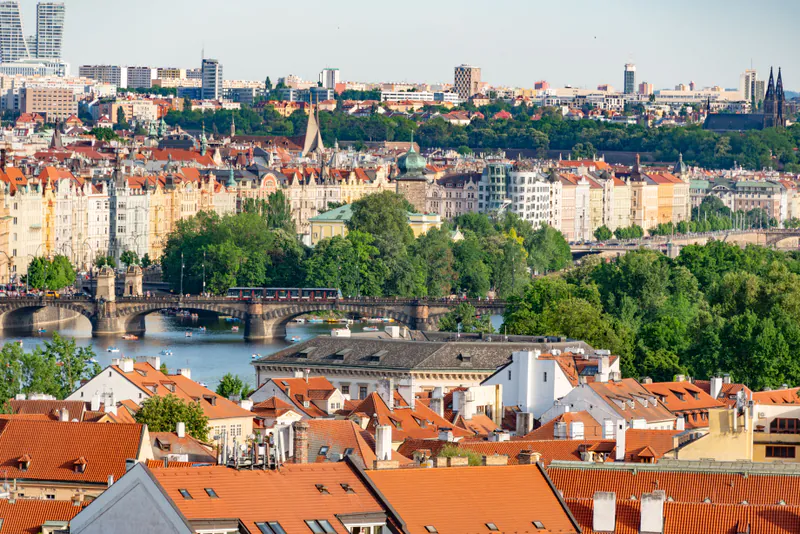
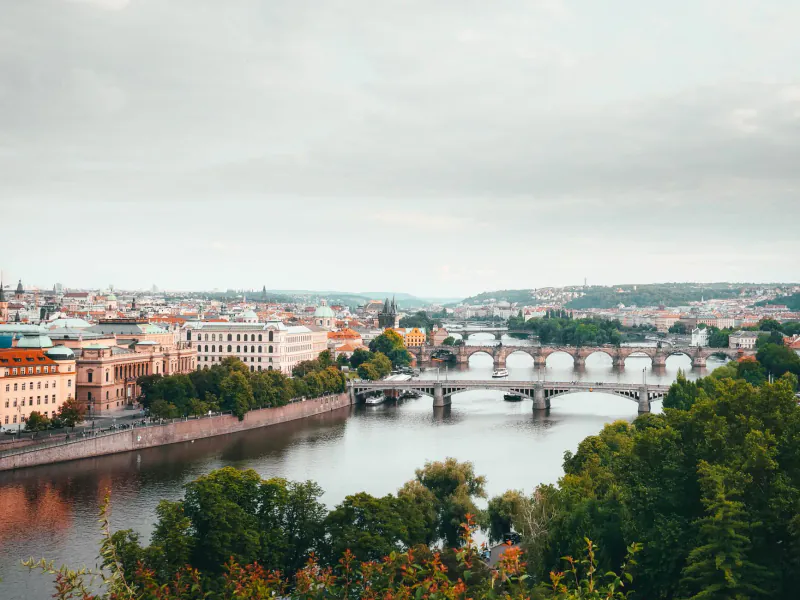
Prague's charming old town - beautiful, but pricey. (Source: Yoav Aziz, Unsplash)
- General Expenses: Prague is the priciest Czech city but still cheaper than Western Europe. Crowdsourced Data reports a single person's basic monthly cost (food, utilities, etc) around CZK-19,000 (≈US$770) excluding rent. Wise estimates a family of four needs about US$3,346/month (≈CZK-75,000) excluding rent. Food and transport are about 10-15% lower than in Germany/France, but imported goods cost more.
- Rent: Expect a 1-bedroom apartment in Prague city center around US$1,200-1,300/month (≈CZK-27,000) and US$1,000-1,100 (≈CZK-22,000) outside center. Brno is somewhat cheaper (1BR in center ~US$850-900), and smaller cities like Plzeň or Olomouc drop to US$600-700. A useful rule: Prague rents are roughly 30-40% lower than Paris/London, ~20% above Warsaw's. Long-term rentals usually require one or two months' deposit plus first month's rent.
- Housing Market: Prices for buyers have cooled. As of 2024, Prague apartment sale price ≈CZK-116,000/m² (~US$70k per 600ft²) - down a bit from 2022. Yield on rental is modest (price-to-rent ratio ~168), so buying is rarely a fast-ROI move. Many expats rent. The paperwork is straightforward (you sign a lease with ID/passport); housing websites and local realtors can help.
- Utilities & Internet: Basic utilities (electricity/heating/water) for a medium apartment run about US$348/month (~CZK-7,600), and high-speed fiber internet ~US$24/month. Mobile data is cheap (~CZK-300-400 for 10-20-GB).
Healthcare: Good, But Prepare Insurance
Czech healthcare is high-quality and largely free at the point of service for insured residents. EU nationals can use an EHIC card for emergency and necessary care. Non-EU expats working here pay into the public system (statutory insurance), which covers most treatments. Many expats still keep a private plan for faster access or for stays not covered. According to one insurance site, "healthcare is affordable and advanced" with modern facilities. But bureaucratic hurdles exist: clinics often require Czech, and waiting times in public hospitals can be long. Tip: Get private health insurance (from a Czech or international provider) to ensure coverage before registry.
Transportation & Infrastructure: Trains, Trams and Fast Internet
- Public Transport: Prague's tram/metro/bus network is world-class. A single ticket (90 min) is CZK-40-50; day passes are about CZK-210. Monthly unlimited passes cost CZK-550 (personalized) or CZK-1,000 (transferable card). Other cities (Brno, Ostrava) have similar systems (one-zone monthly ~CZK-600-700). Trains and intercity buses are abundant and cheap. A fast Pendolino train from Prague to Brno/Bratislava takes ~2.5-3h, and a Prague-Vienna ride ~4h. Driving is possible but parking in Prague's center is hard.
- Internet & Coworking: Czechia is wired for remote work. The national average fixed broadband speed is ~89-Mbps (mobile ~97-Mbps), thanks to widespread fiber and cable. Coworking spaces abound: e.g. Regus/Spaces (IWG) runs 17 centers (~32,000-m²) in Prague/Brno, and Czech chain Scott.Weber has 14 centers (~45,000-m²). Many cafes in Prague and Brno also cater to laptops. In short, you can work smoothly from almost anywhere with good Wi-Fi.
Czech coworking is trendy. Freelancers often work from spaces like this (Source: Shridhar Gupta, Unsplash).
Culture & Language: Slavic Heart, Friendly People
The locals ("Češi") are reserved but friendly once you get to know them. English is widely spoken in Prague and other big cities, especially among younger people. Younger Czechs often speak good English in tech and business; older generations less so. Learn a few Czech phrases (hello Ahoj, thank you Děkuji) as a sign of respect.
- Safety: Czechia is very safe. Violent crime is rare; petty theft (pickpockets) is the main threat, mostly in crowded tourist spots. The country's Global Peace Index rank (#12) reflects its stability. Expats report feeling secure walking cities at night.
- Culture/Outdoors: Expect four seasons: snowy winters (Jan avg ~-2-°C) and warm summers (July avg ~24-°C). Ski resorts (Krkonoše, Å umava) are a few hours away, and Central Europe's many historic pubs offer cheap beer (~CZK-50-70/pint). Cultural life is rich: Prague alone has dozens of festivals and museums.
- Bureaucracy & Bureau: One quirk: Czech paperwork can be tedious. Offices mostly speak Czech; official docs require translations and stamps. Patiently follow government instructions (like registering at the police) - they're strict. But once you're set up, living is straightforward.
City Picks: Where to Live
- Prague (1.3M): Capital, global hub. Highest salaries and amenities, but highest rents. Great for nightlife, theaters, and jobs (especially in finance/IT). Quality-of-life score ~175.
- Brno (380k): Modern tech and university city. Cheaper rent (1BR ~CZK-20-22k in center), big student vibe. Home to software firms and Czech government offices. QoL ~176.
- Plzeň (170k): Beer capital (Pilsner), plus a growing tech scene (Škoda Auto, tech companies). Very affordable (1BR ~CZK-14-15k downtown) and good English skills in industry. QoL ~194.
- Olomouc (100k): Beautiful old town and universities. Quiet, very safe, and cheap rent (1BR ~CZK-13-15k). Great for families or if you like history.
- Ostrava (~290k): Former coal/steel center turned trendy. Artsy redevelopment, lowest rents of the big cities, but heavy industrial legacy. Polish and Slovak borders are nearby.
(Smaller towns like ÄŒeské Budějovice, Hradec Králové, Liberec offer quiet life. Every Bohemian village has its charm, but services fade outside big cities.)
Bottom line: Czechia isn't "tropical nomad paradise," but it delivers sturdy tech infrastructure, high safety, and a European lifestyle at moderate cost. Plan ahead for visas and insurance, pick your city wisely, and you'll find Czech life to be orderly, efficient - and surprisingly hospitable.
Sources: Official Czech portals and expat reports on visas; Eurostat/PwC on tax and salary; Crowdsourced Data/Wise on costs; Czech Statistical Office and TradingEconomics on property; Foreigners.cz and Expats.cz for culture/safety tips; coworking data from industry reports.
Frequently Asked Questions
How much does it cost to live in Prague for a single person per month? Prague is the priciest Czech city but still cheaper than Western Europe. Crowdsourced Data reports a single person's basic monthly cost (food, utilities, etc) around CZK-19,000 (≈US$770) excluding rent.
What are the requirements for applying for a long-term visa or permit as a non-EU citizen? If you don't qualify for the nomad program, you must apply for a long-term visa or permit (e.g. Work visa, self-employment visa, or family reunification) before arriving. In general, when you enter Czechia (with or without visa), you must notify the Foreign Police within 3 working days. If you are granted a long-term visa at a Czech consulate, you then register at the Ministry of Interior within 30 days.
What is the average net salary in Prague per month? The average net salary in Prague is about US$2,344/month (~CZK-50-55k).
Cover photo by Jarod Barton on Pexels.
Want to see how Czechia stacks up?
Are you seriously considering a move? Use our interactive tools to explore Czechia's climate, tax brackets, and nomad visas.
Head-to-Head Relocation Comparisons
Compare taxes, safety, and living costs of Czechia against top alternatives.